"You shall know the truth, and the truth shall make you odd." ~Flannery O'Connor

Showing posts sorted by relevance for query palamas. Sort by date Show all posts

Sunday, March 18, 2007

Development of doctrine, essence/energies,and ecumenism


In a previous post I briefly argued that there is hardly any substantive difference between the Catholic understanding of authentic development of doctrine, as expressed by Vatican II, and a fairly typical account of DD given by a mainstream Orthodox author. But for reasons of space, I discussed no specific instances of DD in detail. In this post, I shall take up the specific instance of the distinction between the divine essence and divine energies ('EED' for short) as propounded by St. Gregory Palamas. I shall briefly argue that EED is true, and also an instance of authentic DD.

For convenient reference, one can find in translation certain texts from Palamas on EED posted at the blog Wisdom!: Readings from the Fathers of the Church blog. (Hat tip to Brandon at Siris). But the argument does not depend on a detailed textual analyis. That would be too lengthy to give here and in any case would not be worth attempting without familiarity with the complete text in the original, which I do not yet have. Rather, Brandon has expressed the heart of the matter better than I have before.

EED is true inasmuch as the distinction follows from the fact that, as Brandon puts it:

...the divine names are not synonymous. But denying the distinction between essence and energies in the sense Palamas makes it would commit us to saying that the divine names are, in fact, synonymous. One of Gregory's arguments for the distinction is that regarding 'nature' and 'things pertaining to nature' as the same leads to heretical confusions; we can't conflate nature, intellect, will, compassion, judgment, etc., because we make nonsense of Christian doctrine if we do. And he is exactly right. Nature and will are not logically equivalent, even in the divine case.

If "nature" and "will" are not logically equivalent, then of course what God is, the divine essence, is not logically equivalent to what God does, the divine energies. Given that there is no such equivalence, EED as Palamas explicates it is true: "there is" such a distinction. And since denying that EED obtains would indeed "make nonsense of Christian doctrine," we must also say that EED is an instance of authentic DD. We do not find the distinction in so many words before St. Basil in the fourth century; under the spur of the Barlaamite controversy, it was only dogmatized by the Orthodox Church in the 14th century, and in the more specific sense that St. Gregory gave to the words. But it is inarguably implicit in much that the Church has always believed.

Now as a Catholic I assume that the dogma of absolute divine simplicity ('ADS' for short), as defined by Lateran IV and Vatican I, is also both true and an instance of authentic DD. It follows that I regard EED and ADS as mutually consistent. The most likely objection to my position from partisans on both sides is that EED and ADS are not mutually consistent. For partisans of EED, that will mean that ADS is false; for partisans of ADS, that will mean that EED is false. The objection, I believe, is misplaced.

In my only previous post devoted specifically to EED, I argued that the question of the compatibility of EED and ADS hinges on how the term 'divine essence' is used:

...if we take the term 'divine essence' to mean God as he necessarily is apart from what he does, if follows that the divine essence is incommunicable; for communication would be a complex of "energies," i.e. divine actions, and nothing can communicate that which it is regardless of communication. It also follows that there is a real distinction between the divine essence and the divine "energies," which are God as what he eternally does. (I say "eternally" not "necessarily" in this case because some of God's actions are atemporal and unalterable yet free and thus not necessitated by his essence or nature). But suppose we take the 'divine essence' as Aquinas ordinarily does, to mean God as what he eternally is. Given further Aquinas' doctrine that God is actus purus, and thus has no unrealized potentialities, it follows that there is no "real" distinction between the divine essence and the divine actions or "energies." And that is also a corollary of his doctrine of divine simplicity (DDS). So the question whether the essence/energies distinction is compatible with DDS depends on what one takes the term 'divine essence' to signify.

The question how we ought to use the term 'divine essence' might seem answerable purely by convention, and indeed that's what it is if we leave matters where I've left them thus far. But of course there remains a problem well known to many readers of this blog.

The most common objection to DDS is that it is logically incompatible with a clear tenet of faith, viz., that God's creating and communicating himself ad extra is free not necessitated. The most satisfactory answer to that objection, I have come to believe, is to affirm that the divine essence as Aquinas uses that term includes a kind of contingency. Thus, what-God-is is eternal and unalterable, but also entails that he do something-or-other he might not have done. Given as much, it was not absolutely necessary that he create at all or that he create this world rather than some other he might have created; that is only conditionally necessary given his free choice to create. But it is necessary that God have done something-or-other ad intra that is free. That God is necessarily and essentially personal (or tri-hypostatic, for those who dislike natural theology) entails that he do some-or-other free action, if only in relation to himself. God is what I call positively mysterious: intelligible, but inexhaustible and hence not fully comprehensible. And the self-contingent God is the same God as the divine essence.

This result jibes nicely with Brandon's remarks. Speaking of the divine names (to use the Pseudo-Dionysius' phrase), he says:

...what these terms refer to are not divided from each other in the Godhead. The divine nature is, as a whole, goodness; as a whole, wisdom; as a whole, justice; as a whole, power. And so forth. The terms are distinct, and necessarily so, but that to which they refer in God is one and the same. It's the unity that evades capture by human thought; we can obliquely refer to it, but we cannot understand it in itself, for refracting it into several non-synonymous conceptions, recognized not to be separable in the divine nature itself, is the only means we have of understanding such things. Thus they differ according to their mode of intelligibility; as does that in God which is incommunicable and that in God by which we participate in divinity.

And that, it seems to me, is entirely compatible with what Palamas says, once we take into account the differing but complementary uses of the term 'divine essence' in the thought of Palamas and Aquinas respectively.

Such conceptual subtleties aside, the most important thing Brandon says is this:

Of course, the point I really wish people would take away is that this is not a matter for polemics but for charitable doctrine. Say that I fail in my understanding of the account of the distinction between essence and energies, which is more than possible; it won't be conceded that the true account is less wonderful than the one I've suggested here. But the account I've suggested here, if true, suggests something so worthwhile that everyone ought to be told about it; no one should be attacked simply for not recognizing it as true, because that wastes precious moments that could be sent lovingly teaching them the truth. And if there is a better account, it is more worthy, not less, to be taught in such a way. For example, you can tell those Orthodox who truly believe the Palamite doctrine and those who merely uphold it through a party spirit. Those who truly believe it are excited about it; it charges them with love for their fellow man and an earnest desire that they, too, may know of this great and good truth, that God became man so that man might receive a deifying gift. They seek to convey it a thousand ways in the hope that those who do not understand might come to understand. Those who uphold it only out of party spirit conveniently forget that their acquaintance with it is not something they have due to their own intelligence or purity but simply and solely because God decided to bless them with the grace of being Orthodox. Because of this, they attack those who do not immediately recognize the doctrine as being stupid, or ignorant, or even corrupt. They spend far more time and effort criticizing other people for not believing it than they do teaching it; a sign of dangerous priorities. For the one the very doctrine is almost a prayer, and certainly a joy, itself; for the other, it is merely a line dividing the party of the Wise from that of the Foolish and the party of the Light from the party of the Dark. Here, as elsewhere, the true believers are marked out by a love for others and a concern for truth that the false believers lack. This is true even when the true believers criticize, which they sometimes do, and sometimes even do sharply. The difference from the mere partisans is palpable. Charity should rule all in all matters such as this.

Alas, it rarely does.

I add: it can. Let's start here.

Wednesday, May 30, 2007

Palamas and Composition

Brandon Watson of Siris studies St. Gregory Palamas' argument to the effect that the essence/energies distinction does not violate the doctrine of divine simplicity. He concludes by observing:

One thing that is striking about this is that from a Thomistic perspective this is exactly how one should argue in order to show that the distinction does not violate divine simplicity. On Thomas's view, simplicity is noncomposition; and all compositio is in some way or another compositio actus et potentiae, a composition of actuality and passive potentiality (cf., e.g., SCG 1.18). If the distinction introduces no potentiality, it introduces no composition, and thus does not violate the doctrine of divine simplicity.

Indeed. I wonder what the Energetic Procession crowd would say about that.

Thursday, June 02, 2005

The Robinson-Blosser Debate on Divine Simplicity

When confronting a thinker of Aquinas' caliber, it is always risky and usually wrong to charge him with inconsistency. I myself have defended Aquinas at some length from the Lovejoy-Kretzmann argument that he could not consistently maintain both the Neoplatonic doctrine that the good is diffusive of itself and being, on the one hand, and the orthodox Christian doctrine that God created freely, not by necessity of nature, on the other hand (see "Mystery and Explanation is Aquinas' Account of Creation," The Thomist 59, No.2 [April 1995], 223-245.) Yet on his blog Energies of the Trinity, Perry Robinson has argued that Aquinas' doctrine of absolute divine simplicity (ADS) is incompatible with that of God's freedom in creating. His errors are simpler than Kretzmann's and hence take less time to expose.

For convenient reference, I quote the relatively formalized version of Robinson's argument that he gave in the course of replying to Phil Blosser's rebuttal of his original argument:

1. If God is absolutely simple (P), then his act of will to create is identical with his essence (R)
2. If God’s act of will to create is identical with his essence (R), thenh is act of will to create is necessary. (Q)
3. If God is absolutely simple (P), then his act of will to create is necessary. (Q) (From 1,2 by Hypothetical Syllogism)
4. God is absolutely simple. (Premise S)
5. Therefore, God’s act of will to create is necessary (R). (From 3,4 byModus Ponens)

Support for (2) is given by the following argument:

6. If God’s essence is had by him necessarily, then if anything is identical with his essence it is necessary.
7. God’s essence is had by him necessarily. (Premise)
8. Therefore, anything identical with his essence is necessary. (From 6, 7 [MP])

(7) I take to be uncontroversial and by that I mean that any Christian should agree with it on its face. (6) can be supported by Liebniz’s Law: (x) (y) [(x = y), then (P) (Px, ≡ Py)]. For any x and any y, if x is identical to y, then if x has a property P then y must have that same property P and vice versa.

Now the main argument, i.e. (1)-(5), is logically valid. It is also a legitimately ad hominem argument in that it's designed to demonstrate the mutual incompatibility of two doctrines Aquinas held. But (1) and (2) are ambiguous: the senses of ‘essence’ and 'identical with...' are either not Aquinas' senses or, if construed in line with Aquinas, are not those which Robinson needs for his argument. In support of that claim, I shall take the difficulties with Robinson's argument in the order most convenient for exposition. Once that is done, Blosser's defense of Aquinas—which is essentially that of Aquinas himself—will emerge as apposite albeit as insufficiently explanatory.

As a preliminary, it is important to get clear about what the 'absolute' in 'absolute divine simplicity' means for Aquinas. For there is a sense of 'absolute' that is very easy to slip into using, but on which Aquinas would have rejected (1)'s antecedent—if he had ever taken that sense seriously to begin with. Thus, if there is no differentiation whatsoever in God, and if Aquinas believed as much, then Aquinas' God would be indistinguishable from the "One" of Proclus. But no professing, orthodox Christian takes or could take God to be absolutely simple in that sense; indeed, no Christian such as Aquinas would deny that there are relations ad intra within God. If God is a living, loving God, as we all affirm, then even granted that all his internal relations are eo ipso reflexive, they are not merely notional. Leave aside the thorny question how the divine nature can be thought to exhibit such relations in abstraction from the interrelations of the Three Divine Persons—e.g., as in God’s eternally knowing the plurality of the divine ideas as ways in which his being could be participated. We can only take one problem at a time. The fact remains that, just by professing the doctrine of the Trinity, Aquinas was fully committed to holding that there are real relations within God and thus some form of differentiation in God. Whatever Aquinas meant by 'absolute' divine simplicity, then, he was very unlikely to have intended it in a sense that would be incompatible on its face with a dogmatic affirmation he made in keeping with Tradition. He just wasn’t clueless enough to make a mistake like that. So if (1) ascribes to Aquinas an essentially pagan sense of ADS, then (1) is true only because it is a material conditional whose antecedent is false. That of course is not what Robinson is after at all. But Aquinas' commitment to affirming some differentiation and plurality in God is important for understanding, if only by contrast, what he means by ADS and how that is relevant to assessing (1) and (2).

Let's start with the obvious: for Aquinas, there is no sort of metaphysical "composition" in God. In ST Ia Q3, he argues that God is not composed of: (i) matter and form; (ii) nature and subjectum; (iii) essence and existence; (iv) genus and difference; (v) substance and accident. Thus God is absolutely simple not in the sense of being wholly undifferentiated ad intra, but in the sense that he is not composed of parts in any of the ways Aquinas thought it possible in principle for something to be so composed. The negative formulation is essential for Aquinas inasmuch as he insisted that we know of God not what he is—i.e., his nature—but what he is not. (Citing John of Damascus, Aquinas premises as much in ST Ia Q2 A2—before discussing the divine attributes or even proving God’s existence.) We know the divine nature not so much by affirming perfections of him, which we can and should do, but by subtracting from the conceptual content of those affirmations whatever is distinctive of the perfections' finite instances. Only then may we affirm the (infinite) perfections as contained "supereminently" and mutually “identically” in God. That of course enshrouds God in a kind of conceptual haze—at least on the level of natural as distinct from revealed theology. Indeed, Aquinas vigorously denied that God is one kind of being among others, one that just happens to be immeasurably more perfect than the others. God is Being in the fundamental and fullest sense: Ipsum esse subsistens. In natural theology, we can only explain "by way of negation and remotion" what that means. Such a method isn’t terribly illuminating: we can say that God thus exhibits such-and-such perfections, but we cannot explain how. Yet given the subject matter, that result is surely appropriate; anything more would be hubris. It explains why Aquinas formulated ADS as he did. Granted (i)-(v) and given what Aquinas took to be the range of possible candidates for composition, there just aren't any ways left for God to be composed (Article 7). For Aquinas, then, ADS is a primarily negative claim.

Now on such an account of the absoluteness of DS, there is no reason to believe that Aquinas would accept (1) and (2) in senses that would be useful for Robinson's argument. Of course one might argue, as Robinson implicitly does, that (1) follows from affirming (iii)—the identity of God's existence with God's essence—along with another characteristic thesis of Aquinas. To sum it up:

(9) God's existence is identical with his actuality [by Aquinas' doctrine of God as actus purus](10) God's actuality is identical with his "act of will to create" [by ADS]
(11) God's existence is identical with his essence [from (iii) above, a conjunctive part of ADS]
(12) God's existence is identical with his act of willing to create (MP on 9,10)
(13) Ergo, God's act of will to create is identical with his essence (MP on 11, 12)

That argument too is logically valid, and I believe Aquinas would have accepted it. But that is useless for Robinson's purpose because the concepts of essence and identity that Robinson invokes throughout his arguments, as distinct from the terms themselves, are not those of Aquinas.

Regarding essence (or nature; in this context the terms are interchangeable for Aquinas), consider Aquinas’ prior argument that God is the same as his nature:

…in things not composed of matter and form, in which individualization is not due to individual matter--that is to say, to "this" matter--the very forms being individualized of themselves--it is necessary the forms themselves should be subsisting "supposita." Therefore "suppositum" and nature in them are identified. Since God then is not composed of matter and form, He must be His own Godhead, His own Life, and whatever else is thus predicated of Him. (ST Ia Q3 A3 resp).

Recall that, in Aquinas’ metaphysics, even angels are identical with their natures because they are purely spiritual “forms” not individuated by matter and thus are, each of them, sui generis (better: sui speciei). But he never thought that a true, complete description of the nature that is a given angel would tell one everything that angel ever did or would do. He believed that all angels have done at least one thing with libertarian freedom, and thus that not everything they do is deducible in principle from what they are by metaphysical necessity. For Aquinas, therefore, the claim that such-and-such is identical with its nature does not mean, as a general proposition, that everything truly predicable of it is an essential property of it and thus is “had necessarily” by it. Nor is the latter even logically equivalent to the former. Without risking too much anachronism, we may formalize his actual claim thus:

For any x and any sortal (not: general) predicate K, if Kx and x is not individuated by matter, then for any y, if Ky and y is not individuated by matter, then x is the same K as y.

Therefore and in particular:

For any x and y, if x is God and y is God, then x is the same God as y.

That is what relevantly follows from Aquinas' denial that God is composed of himself and his nature or essence—the properly negative form of the claim that God is “identical with” his nature. It’s no different from the case of angels.

Note that the concept of identity I’m ascribing to Aquinas here is relative not absolute identity. (Peter Geach has been the strongest and most original contemporary advocate of RI; see especially his Reference and Generality, 3rd edition, 1980).The thesis that there is such a thing as absolute identity is far from indisputable; one bit of evidence that it is incompatible with Aquinas’ thought is precisely the sort of argument that Robinson gives. (Try to explicate Aquinas’ Trinitarian theology with absolute identity. The thing just can’t be done.) What accordingly undermines Robinson’s argument—as an attempt, that is, to saddle Aquinas with a consequence Aquinas would have denied—is that it construes God’s “essence or nature” for Aquinas along the same lines as those of Alvin Plantinga (Does God Have a Nature?, Marquette U.P., 1980) and Christopher Hughes (On a Complex Theory of a Simple God, Cornell UP, 1989): as a collection of properties that, on ADS, seems to become a single necessary property with which God is falsely, perhaps even incoherently, said by Aquinas to be identical in the sense of absolute identity. That is why Robinson feels free to invoke Leibniz’s Law (LL) in support of (6), which he in turn adduces as the first premise of a sub-argument [(6)-(8)] in support of (2). LL’s antecedent employs absolute not relative identity as though the former were itself an unequivocal and uncontroversial notion. But Robinson’s invocation of LL is anachronistic and thus question-begging, just as I think the broader arguments of Plantinga and Hughes are for that and other reasons. Hence there is no reason to believe that Aquinas would have accepted either (1) or (2) in senses that would give Robinson’s argument any purchase.

Well then: how are we to construe Aquinas’ claim that God’s “existence” (i.e., esse, or act of being) is identical with his essence or nature? Well, God’s nature is pure to-be: unqualified esse. Unlike angels or any creature, he doesn’t receive being from anything else: He is Being Itself, so that whatever else there is gets its existence, as well as its kind of existence, from him. Such is God’s aseity, which rules out any sort of composition inasmuch as composition entails a composer other than the composed and at least one constituent that is not the composed (ST IA Q3 A7). Therefore, God is not “composed” of his essence and his existence. He doesn’t “have” existence as though there were something to him that isn’t his existence but which could receive it and thus enter into composition with it. But once again, that does not entail that whatever God does is an essential property of him and thus is done by absolute as distinct from hypothetical necessity. What it does entail is that God’s “to-be,” in the unqualified and thus incomprehensible sense of his actus purus, is the same God as God’s nature, in the sense of ‘nature’ expounded above: a subsisting “absolute form” (ST IA Q3 A3). That God cannot be composed of his nature and his esse, so understood, is simply a logical consequence of his aseity. But that is perfectly compatible with the divine nature, again so understood, being libertarian-free, at least to some extent.

To sum up. Two exegetical results, taken together, absolve Aquinas of the charge of inconsistency: the construal of God’s nature or essence not as a collection of apparently distinct but really identical “properties,” but as subsisting, absolute “form” of which God’s “properties” are merely notional expressions; and the rejection of absolute in favor of relative identity. Thus, the relevant identity relations entailed by ADS should be framed as: God is the same God as God's nature, which is the same God as God’s existence, which is the same God as God’s actus purus. That is why, even though God wills whatever he wills only eternally in one act of will, it remains logically open to Aquinas to claim that some of what God wills is necessary only ex suppositione not by necessity of nature. There is differentiation in God, and some of it consists in his (logically) contingent activity, which befits him but is not necessitated by anything other than his free, rationally befitting choice to manifest and communicate his goodness ad extra.

Blosser is basically correct to invoke that defense and to characterize Robinson’s conception of the divine nature as some sort of “engine of absolute necessities.” Of course anything with a nature is, by that very fact, such that certain things hold necessarily of it; yet for the reasons I’ve given, it does not thereby follow that whatever is identical with its nature does all that it does by necessity of nature. The only problem with Blosser’s critique is that he failed to explain why that is so for Aquinas and thus what was wrong with Robinson’s conception as an exegesis of Aquinas. I have filled that lack.

Apparently, Robinson’s larger purpose in attacking ADS, as exemplified in Aquinas, is to contrast the Latin tradition in natural theology unfavorably with the Orthodox, as exemplified in Gregory Palamas’ distinction between the divine essence and the divine energies. Not having read Palamas myself, I have nothing useful to say on my own account about his theology. But if what Robinson says about Palamas and the essence-energies distinction is reliable, then I see no reason to hold that Palamas’ natural theology is fundamentally incompatible with the Latin tradition about ADS. All we need is a more sensitive and less anachronistic reading of the Latin tradition.

Wednesday, June 18, 2008

The filioque VIII


In the "insanely long" combox to my post of June 9 "A rad-trad converts," I finally broke down and summed up for my long-time Orthodox interlocutor Photios Jones the current state of my thinking about the filioque issue. Naturally Photios had a good deal to say in reply, even though I had indicated that I felt the combox was not the place to continue the discussion and left open the possibility of continuing elsewhere. Well, now that I see fellow philosopher Brandon at Siris weighing in on the issue, I see the occasion to continue.

Before I get to the substance of the matter, two observations are in order. One is that, in my view, the sole good purpose to be served by discussing the filioque at this stage of history is to exhibit how the Catholic dogma thereof is compatible with what Orthodoxy is concerned above all to uphold: the doctrine of the "monarchy of the Father" (MF), meaning that the Father is the sole fons et origo of the Godhead. That is the necessary point of departure for any effort to move the issue off the polemical dime it has occupied for so many centuries. My other preliminary observation is that most of my critics, whether Orthodox or Catholic, tend to see my efforts on the filioque as discontinuous, if not downright incompatible, with what the Catholic Church has dogmatically defined on the subject: to wit, that the Holy Spirit proceeds from the Father and the Son "as from one principle" (quasi ab uno principio). Of course the Orthodox tend to see that as, ceteris paribus, a plus, and the Catholics as a minus. But that is usually how theologizing that tries to move the state of a given question forward is greeted—whether or not the theologizing in question turns out to be sound. If and where somebody can demonstrate that I am in error, I will happily concede the point; and of course I submit my efforts to the judgment of the Magisterium, supposing that I will ever be fortunate enough to see them actually noticed at that level.

With that said, I issue a final caveat: if you have to ask what any of Greek or Latin terms in what follows mean, read no further than that term. This one is for the true nerds.

Here's what I substantively wrote in the aforementioned combox:

First, my position takes for granted three things: the truth of the definitions of Lyons and Florence on the filioque; the truth of the main assertions of the Vatican's 1995 white paper on the filioque (a document you know well); and the logical compatibility of the Lyons-Florence definitions with the "monarchy of the Father." As the historical record of discussion shows, the bishops who signed on to the Florentine definition of the filioque accepted that compatibility, else they could not have signed on in good conscience. Said compatibility is also implied by CCC 248. Second and accordingly, the sole question that concerns me is how the two doctrines are compatible....

The key step is to recognize the polyvalence of the Latin word
causa. If the two doctrines are compatible, then the Son cannot be understood to be a "cause" of the Spirit in the sense of ekpoureusis—a kind of causation which, ad intra, belongs solely to the Father. So, assuming that the Son is, with the Father, a "cause" of the Spirit, that must be in at least one sense of causa other than that of ekpoureusis. The Latin theological tradition recognizes many senses of the term causa, e.g. the "four causes" postulated by Aristotle. The main conclusion I've reached is that, in order to get at the relevant sense of causa, it must be recognized that the two Trinitarian processions are somehow mutually interdependent. Conceptually speaking, if two activities A and B depend on each other, then there's a sense of 'cause' in which the products of A and B respectively are causes of each other. In the present case, it follows that there's a sense in which spirituque is as true as filioque, and it's that consequence which irritates my Latin brethren. So, given the traditional taxis of Father, Son, and Spirit, what I need to work out is the sense in which filiation has a certain priority over spiration. From that standpoint, even though both spirituque and filioque are true, the mutual interdependence of filation and spiration is asymmetrical, with the former having priority over the latter. My work is far from complete even in conception because I haven't been able to give much thought to the asymmetricality I feel obliged to acknowledge.

I'm not working in the dark; I've read a number of Fathers and Doctors of the Church, both East and West, on the subject. I pray about this. But I'm not sure that the effort involved in going further would be worthwhile. It seems to me that the effort would be worthwhile only given insight into the inner life of the Trinity that I'm not sure anybody can reasonably claim to have. So, all I've tried to do is sketch out a logical space where the dogmatic
affirmations of East and West can be understood as mutually compatible. I think I've made some modest progress on that.

Those who are interested in seeing just what progress, if any, I've made can do a search on the term filioque within this blog. But my hunch is that anybody who's read this post this far has already read that earlier stuff.

As I've said, Photios had a good deal to say in response to that comment of mine. Much of it was praise not criticism. But one point he made included both:

...I think you still need to work out how the Father and Son are "one principle," and the Spirit not also be "one principle." Causa is not really the term that the Latins use to describe the relation, but rather principle. Causa is used more of how God relates to creation if I'm not mistaken. So when we say "cause" we mean ekpoureusis. Proienai is a type of cause, but not a relation of origin, or express the uniqueness of hypostatic origination. It is within THIS CONTEXT I see your interpretation being the greatest benefit.

Before I get to those comments of Photios' that caught Brandon's eye, I want to respond to that passage.

From both the record of discussion and the relevant decree at the Council of Florence, it is evident that most of the Latins were disposed to use the terms causa and principium as synonyms in this context. What led them to use the latter rather than the former in the final dogmatic definition is that the Greeks, for old and understandable reasons, were wont to treat the Latin causa as a cognate for the Greek ekporeusis, meaning 'origination', so that only the Father is to be seen as the originating "cause" of both the Son and the Spirit. That is nothing other than a formulation of MF. Now as I interpret both Florence and earlier Western conciliar statements on the filioque, the Latins were willing to concede this point. They did not believe that the filioque was to be interpreted as being incompatible with MF. Nor, I would add, should they have believed that; that much is also implied by the Vatican's 1995 white paper on the filioque.

As for the Spirit's not also being "one principle" (with the Father?), I'm not sure what Photios is talking about. From the claim, which I make, that the Son's coming forth from the Father is in some way dependent on the Spirit's coming forth from the Father, it does not follow that the Son comes forth from the Father and the Spirit in the same way in which the Spirit comes forth from the Father and the Son. Hence, on the (disputed) hypothesis that there is a sense in which it can be said that the Son comes forth from the Father and the Spirit "as from one principle," that would not be the sense in which Lyons II and Florence defined the Spirit's procession from the Father and the Son "as from one principle." If the Son can be said to come forth from the Father and the Spirit as from one principle, that would be more like what's suggested in Photios' point (3) below, to which I do not object. So I don't think I've got a problem just yet. One problem at a time, please.

What caught Brandon's eye in Photios' comments also caught mine:

One must be able to fit together these unique things from the Fathers:
(1) The Father as sole cause and originator of Son and Spirit *as* relation of origin (one by genesis, the other by ekpoureusis). - St. Photios
(2) The taxical order of the Persons coming forth: Father, Son, Holy Spirit, expressing their consubstantiality - Sts. Gregory of Nyssa, Athanasius, Maximus the Confessor
(3) The Spirit rests in the Son as his object, the Son's existence from the Father is the Sprits aim for Spiration. - St. Gregory of Cyprus II
(4) The Spirit as bond of love between Father and Son, because it is this bond of love as the energy of the Spirit that is common to all. - St. Gregory Palamas, St. Augustine, St. Gregory of Cyprus II. This is how the Gregory's interpret Augustine anyway.

What doesn't fit well here is the Carolingian and Scholastic view of 'relations of opposition' since there is no step of two-ness in the Trinity, and dialectic can only consider two and not three.

Like Brandon, I basically disagree with the last sentence. Since Brandon's exposition of what's wrong here seems correct to me, I shall not pursue the matter further in the body of this post.

Nonetheless Photios' (1)-(4) are all true, and I am familiar with them from my patristic reading. I also agree that any adequate account of the filioque must take account of them. So, how would I take account of them on my current theory?

Well, for one thing, the Augustinian idea that the Spirit is the "bond of love" between the Father and the Son, which is what Photios' point (4) alludes to, can be interpreted in a weaker or a stronger sense. In the weaker sense, it means only what St. Gregory Palamas says: that the loving activity (energeia) of the Spirit within the Godhead is the love uniting the Father and the Son. That much can be and has been called the "energetic procession" of the Spirit ex Patri filioque and is not, I believe, in dispute. What is in dispute is the Augustinian idea taken in the stronger sense, viz., that it is also the Spirit as hypostasis (or: prosopon, "person") who is the bond of love between the Father and the Son. In this stronger sense, the Holy Spirit-qua-hypostasis must be thought to proceed ex Patri filioque because, as the Spirit of both uniting them both, his existence is logically posterior to and dependent on that of the Father and the Son. As I understand the matter, it is to that idea among others that the 9th-century bishop Photios the Great so strongly objected, in his Mystagogia, as incompatible with MF.

I doubt that the dogma of the filioque, as defined by Lyons II and Florence, needs to be interpreted in terms of the stronger nexus amoris idea. The Orthodox present at those councils certainly did not do so. But given Photios Jones' point (3), there might be a way to salvage the stronger interpretation.

Thus we could say that the Father, as sole producing cause of the Spirit, produces the Spirit precisely for the sake of the Son. From this standpoint, the Father is like the efficient cause of the Spirit, and the Son like the final cause of the Spirit. Thus the Spirit can be said to "proceed" or come forth from the Father and the Son "as from one principle" because the one principle is the Father not only as Father of the Son, but as the one who eternally and perfectly loves the Son in generating him. Photios Jones cites Gregory of Cyprus on the general point, but I think we could also cite Gregory of Nyssa for greater specificity of the kind I'm striving for. For an extended presentation of what that might yield, go here.

Let me stress that I am offering only sketches of a theory that I look to refine in light of criticisms and further suggestions. The purpose of such a theory is not to strive for greater knowledge of the Trinity's inner life than the Fathers and Doctors of the Church attained. Any such purpose would be laughable hubris on my part. My sole purpose is to logically reconcile those ways of speaking about the Trinitarian processions to which both sides are dogmatically committed.

Tuesday, May 08, 2007

Not talking about God

For reasons well-known to my vast readership, one of the blogs I read often is Energetic Procession, the most academic in the Orthodox blogosphere. It is authored primarily by Daniel "Photios" Jones and Perry Robinson, graduate students in theology and philosophy respectively, with whom I have had regular interaction both here and at Fr. Al Kimel's Pontifications, where I am an occasional contributor. Recently, Fr. Al banned what he termed "Orthodox polemicists" from his site, including Perry (and, I take it, Daniel). So I checked EP to see what reaction, if any, there had been to that move. I observed quite a reaction—enough to convince me that no good purpose could be served by my adding to it. But I also noticed that my name came up several times in more directly theological discussions. That was well, as I had been wondering why, despite having shown a modicum of interest in the earlier parts of the series, Photios and Perry had registered zero reaction to my latest filioque article. Now I know.

In Perry's words:

No model that Liccione or anyone else in the literature has even mapped onto the Orthodox view either in terms of the essence energies distinction, which they FINALLY admit is not the private opinion of some Orthodox but the teaching of the Church or in terms of God as not being pure being. Nor has there been any significant advance on the Filioque since everything Liccone [sic] has done ignores or subverts the Nicene and Cappadocian teaching that God is not being and so necessity is not predicable of God at intra [sic], not to mention the idea of persons as relations in the first place. Here he and others are inventing theology rather than preserving it.

So, Perry believes that my proposal is a non-starter.

His last charge above I shall leave aside for the time being. Those who have contributed, or strive to contribute, to authentic development of doctrine are always charged with innovation or invention—i.e., with trying to add to the deposit of faith—by people who deny there is such a thing as authentic development of doctrine; and Perry is one of those people. But that is a different debate, to which I've contributed before and soon will again. Nor shall I here discuss the "idea of persons as relations," an Augustinian-Thomistic idea which was not mentioned in my articles and does no heavy lifting in them.

The assertion that the essence/energies distinction (EED) is "the teaching of the Church" is more interesting but too vague to be of much use. Clearly, the Palamite councils affirmed EED; and the affirmation appears in the Synodikon of Orthodoxy, even if that section of it is not often used liturgically. But that is not in dispute. The operative question for the present purpose is which particular construal of EED, if any, is binding on all Orthodox on pain of heresy, and whether that construal, whatever it may be, is logically incompatible with the filioque on the sort of construal of that doctrine I've been advocating. The answer is far from clear or uncontroversial, and one doesn't even have to examine my argument at all to see that. For instance, many Orthodox reject this or that canon of the 1672 Council of Jerusalem, whose acta also appear in the Synodikon. That council seems to have at least the same level of authority as the Palamite councils, yet Orthodox who insist on swallowing the latter whole don't do the same with the former. To an extent, the question what is not a matter of opinion seems to be a matter of opinion.

As I've argued before, a Catholic as such can readily affirm EED if 'divine essence' be taken to mean what-God-is-irrespective-of-what-he does, which is an abstraction from reality. But none of that, of course, satisfies Perry and like-minded Orthodox. They seem to believe that EED must be construed in a sense incompatible with Catholic dogma, and that sense of EED is taken to be that of St. Gregory Palamas, which he developed out of the Cappadocian—specifically, St. Basil's—in the heat of the hesychast controversy. Now, since I'm not Orthodox at all, much less an Orthodox bishop, I have no standing to say whether that particular construal of EED is normative and binding for Orthodoxy. But the way it looks to me, the dispute is primarily scholarly and permits a certain range of permissible opinions. I find no reason to believe that Orthodox believers as such must affirm EED in a sense logically incompatible with Catholic dogma, such as the filioque (or, more directly, absolute divine simplicity). Nor do Perry and like-minded Orthodox theologians have the authority to settle such a question. Hence, to hold that it's settled all the same is just "party spirit."

What most intrigues me about Perry's comment, and what I shall focus on, is that he plainly considers it a defect that I "ignore" the "Nicene and Cappadocian teaching that "God is not being." And if indeed it is a consequence of the teaching thus denominated that necessity is not "predicable of God ad intra," then I can indeed be said to "subvert" that teaching too. But there's a lot less than meets the eye in such charges.

In the first place, it is at best unclear what Perry means by calling said teaching "Nicene." It does not appear in the documents of the first Council of Nicaea, a gathering most famous for confessing that the Son is homoousios (of the same substance as) the Father; and nothing that council did say logically entails the proposition that "God is not being" ('GNB' for short). Indeed, if the Greek term being translated as 'being' in GNB were ousia, which is sometimes translated as 'being', then the homoousios can be taken as logically entailing that God is being. Moreover, the Cappadocian Fathers (i.e., Sts. Basil the Great, Gregory Nazianzen, and Gregory of Nyssa) didn't even begin writing until well after that council. Of course, by the time one gets to Constantinople I (381), it's a somewhat different story. Influenced by the Cappadocians, at least one of whom took part in it, that council adopted a creed that came to be used in East and West as "the" Ecumenical Creed. An expanded version of the Creed of Nicaea, the Creed of 381 included a verbatim quotation of the words of Jesus as recorded in John 15:26: the Holy Spirit "proceeds" (ekporeuetai) "from the Father." But having read several scholarly histories of early Christian doctrine, I detect in the decrees of Constantinople I neither explicit affirmation of GNB nor anything which would logically entail such an affirmation.

The case that the Cappadocians as a class held GNB is of course stronger. But here as elsewhere, the problem is one of interpretation. Specifically, the challenge for Perry and his like-minded friends is coming up with a construal of GNB that is clearly ascribable to the Cappadocians, binding on Orthodox, and in the final analysis incompatible with the treatment of the filioque I've been developing. I am not in the least convinced the challenge can be met. Here I shall give just a few reasons why.

In discussing Gregory of Nyssa's Life of Moses, for example, Orthodox philosopher David Bradshaw says: "Gregory identifies God with true Being, yet denies that God as Being is an object of conceptual knowledge." In context, Bradshaw makes clear what he means by 'true Being' and 'conceptual knowledge', and I have no problem either with his exegesis of Gregory or with Gregory's actual claim. When it is said that God as true Being is beyond conceptual knowledge, it is not being asserted that God as true Being falls under no concept; otherwise, one could not say without self-refutation that what-God-is is somehow manifested in his energies. Rather, it is being said that God as true Being vastly outstrips our concepts and is thus incomprehensible. Aquinas and other Catholics giants would, and did, happily agree, while at the same time affirming an analogia entis. So we don't yet have a relevant construal of GNB.

There are of course passages, in the Cappadocians and in later Eastern fathers, where God is said to be "beyond being." And if God is beyond being, then of course he is not being. But what is the relevant sense of 'being'? The phrase 'beyond being' originates in Plato, who used it to refer to "the Form of the Good" as source of all being. But the Cappadocians can hardly be considered uncritical Platonists; and even if they were, the term 'being' in the present sense is being used to refer to the meta-class of particulars, not to just whatever can be said to exist. That God is not identical with the meta-class of particulars goes without saying; that God is not being among others is also granted all around, including by Aquinas and other influential Latin theologians. So we still don't have a relevant construal of GNB.

Patristic exegesis or no, I can't think of a relevant construal of GNB that would make the slightest bit of sense. In one sense of 'being', a being is whatever can be truly said to exist, in the sense of the existential quantifier; that is why Quine said: "To be is to be the value of a variable." Thus for some x, x is God, and in that sense God is a being. It would be nonsense to deny that. But there, we're talking logical existence, not Being in some metaphysical sense yet to be clarified. So 'being' in this sense does not supply a relevant construal of GNB.

What Robinson et al, including Bradshaw, really object to is the Thomistic version of absolute divine simplicity (ADS), according to which God's "being" or esse, the divine actuality, is somehow identical with God's essence. ADS has many consequences for the rest of theology, including triadology. But I've addressed that topic before; indeed, my very first interaction with Perry online, two years ago, was about what he alleged to be one of its deleterious consequences. But just as, back then, I don't think he showed what he thought he'd shown, here I don't think he's even established the relevance of his main point to what I've been attempting. My use of modal notions in triadology cannot be said to "subvert" a doctrine whose relevant sense, never mind whose normativity, hasn't even been established.

Thursday, July 27, 2006

The book meme

Before I sign off, I note that the Pontificator has memed me and several others with a list of book questions. I'm delighted to oblige.

1. One book that changed your life:
C. S. Lewis, That Hideous Strength (I prefer his fiction to his apologetics, though the latter ain't too shabby either)

2. One book that you’ve read more than once:
J. R. R. Tolkien, Lord of the Rings (eleven times, actually, and that's the whole trilogy)

3. One book you’d want on a desert island:
The Bible (no-brainer, that)

4. One book that made you laugh:
John Tyerman Williams, Pooh and the Philosophers (you'd laugh too, if you've ever studied or taught philosophy)

5. One book that made you cry:
Henri Nouwen, Adam (those who know me personally won't need an explanation of that)

6. One book that you wish had been written:
Gregory Palamas, Why I Love Thomas Aquinas (let's get the chronology right)

7. One book that you wish had never been written:
Ariel Levy, Female Chauvinist Pigs (yes, there really is such a book, and it made me want to retch)

8. One book you’re currently reading:
John F. Haught, Is Nature Enough? (my review is forthcoming in First Things)

9. One book you’ve been meaning to read:
Hans Urs von Balthasar, The Office of Peter and the Structure of the Church (heck, I've used its themes often enough)

Wednesday, March 19, 2008

That little black spot


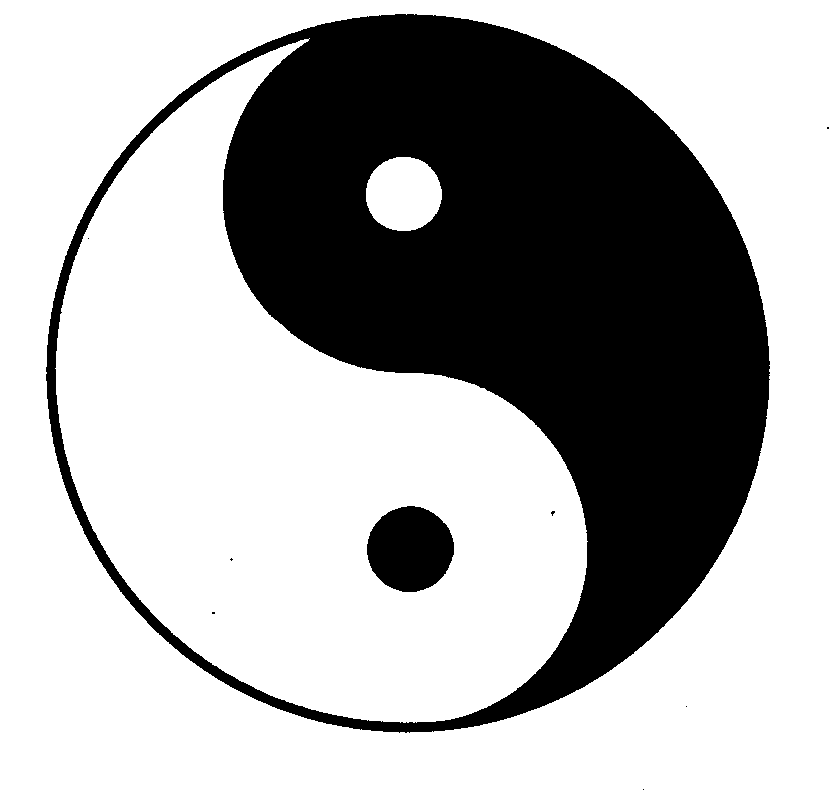
Most literate folk are familiar with the Yin-Yang symbol. I don't want to get into a discussion of what Yin and Yang really are, or are supposed to be; that is a topic for comparative religion, and Gagdad Bob is better qualified to handle it in a way I would respect. By way of introduction to my real topic, however, I note that when I first saw the symbol, I thought that it was intended to represent the relationship of good and evil in human beings. Thus, there's a little bit of good even in bad people (the little white spot) and a little bit of bad even in good people (the little black spot). I am told that such is a common misimpression among undergraduates. I am reminded of it by a post I've just read by a man who calls himself "janotec" and seems to be an Orthodox cleric, even perhaps a theologian.

The post appears at the blog "Second Terrace" and is entitled Orthodox theologians do not speak in tongues. It is an impassioned yet reasonably well-argued plea for Orthodox theologians to expound dogma more and worry less about meeting the so-called "challenges of the age." With one qualification, I wish that I had written that post myself as a plea to Catholic theologians, whom I am better positioned to address. The qualification is that I object to the following two sentences, which unfortunately appear near the beginning:

A long time ago, when Orthodoxy got too conservative (or seemed that way), relevant philosophers who "responded" to "contemporary challenges" forged a nominalism that made Grace a far less frightening thing, and intellectualized it into something less than a phenomenon. Too, the West could now take its ethics in spoonfuls, in casuistic legerdemain.

For me, that kind of thing is like the little black spot: a stain on what would otherwise be dazzling white. I want to explain why so as to contribute, in my own small way, to an eminently desirable goal: getting Orthodox and Catholics to preach the Gospel effectively in today's world not only with the abiding resources of the Great Tradition, but with better mutual understanding.

The problem with the above-quoted little passage is not that it is altogether false. It contains an important element of truth. The problem is that it rhetorically lumps in something of the bad with something of the good which may be found within the theologies of something called "the West"—a term of art which, in Eastern-Orthodox parlance, means that part of Christendom which, for well over a millennium, worshiped and theologized in Latin rather than Greek. (To Christians in such places as Armenia, Iraq, and India, of course, "the West" included Constantinople too. And John Bekkos, a medieval patriarch of Constantinople with strong "Western" leanings, at least got a hearing in the city for a while. Yet for reasons it would be counterproductive to explain, I don't want to stress that very much.) The resentments, misunderstandings, and rivalries go back to at least the time when Pope Damasus I (366-384) substituted the vernacular Latin for Greek in the Roman Mass and didn't even take note of the First Council of Constantinople (381), which produced what was eventually accepted everywhere as the ecumenical Creed. And for various reasons, the negativity gradually worsened over time, eventually causing the schism that persists to this day. For my present purpose, the two most relevant problems are the Catholic-scholastic idea of "created grace" and the Western development of moral theology at the same time in terms drawn from legal theory.

I start with the concept of created grace. There certainly were Catholic theologians in the later Middle Ages who were "nominalists," and it is certainly true that many of those nominalists treated the question of grace in more or less the way janotec criticizes. But not all scholastics were nominalists by any means. The via moderna of that period in Catholic theology, in my opinion, did tend to go wrong as janotec says; and that was a key precursor to Protestantism's essentially forensic account of justification. But some Catholic theologians were Franciscans and Thomists who were anything but followers of that path. Indeed, in the hands of those more traditionally-minded theologians, the very concept of "created grace" was intended largely to explain how justification and sanctification consisted in what we'd now call an "ontological" change in the human soul, in such wise that the soul could become a "partaker of the divine nature" without becoming God-by-nature. In that respect, use of the concept of created grace had the same goal as that of St. Gregory Palamas when he expatiated on the distinction between the divine "essence," which cannot be shared, and the divine "energies" or actions ad extra, which can and indeed must be shared if we are to have the life God destines us for—the "life eternal" otherwise known as theosis or "divinization." As I see it, the chief difference between the older, more robust Catholic theology postulating "created" grace, and the Palamite view that the divine energies are "uncreated" and thus God, is that the Catholics used the term grace not merely for its primary referent, which is indeed the Uncreated himself insofar as he communicates his life to us, but also for the instruments he uses to communicate his life to the human person, and especially for some of the effects of that communication within the human person.1

The main problem arose when neo-scholasticism as a whole became preoccupied with classifying and analyzing the kinds of created grace so understood, in order to explain how our "correspondence" with grace causes "congruous merit" in the human soul. That went on to such an extent that people started forgetting about the primary referent of the term 'grace' and got into the habit of speaking of grace as though it could be located, divvied up, and distributed almost according to formula. That explains a way of speaking even today that has always grated on me. Catholics often speak of grace as if it were some sort of spiritual fuel, with differing levels of octane, that one can get more or less of depending on one's recourse to the "means"of grace, such as the sacraments and prayer. That's what accounts in part for why many Catholics seem to treat church as a spiritual gas station: a place where you pull up, pay up, tank up with grace, and pull out in time for brunch or the football game (depending on which scheduled Mass you got up in time for). When people receive the Eucharist with such an attitude, it does them a lot less good than it could and, in cases of unrepented serious sin, real harm. Catholicism really has needed to recover a more Eastern, relational sense of grace as God himself operative within the person, without thereby sacrificing use of the term 'grace' in the derivative senses already described, which are perfectly consistent with the primary referent of the term when properly contextualized and understood. That, in effect, is what various Catholic movements and theologians have been doing ever since the ressourcement that preceded and helped to guide Vatican II.

For a long time, though, the chief obstacle to bringing that to fruition in Catholic sacramental, ascetical, and mystical theology has been a tendency to legalism in moral theology. When one treats Christian morality primarily as a set of rules, one comes to think of progress in the Christian life primarily as progress in observing those rules. Salvation is then conceived primarily as a reward for such progress—i.e., for one's degree of merit—and the function of grace is seen primarily as that of enabling one to achieve such merit. The serious Christian will thus do what they can to get "all the graces" they can because, after all, one can never have enough fuel for a long journey in which one too often finds oneself traveling backwards. That is the grain of truth in the common Protestant view that Catholicism teaches salvation by "works" rather than by "grace." Many Catholics, and not just Catholics, have in fact run their spiritual lives as if that were so. It is a kind of spiritual immaturity that certain tendencies in late-medieval, neo-scholastic, and Counter-Reformation thought only encouraged. I have seen the results in many an older Catholic, even those in bitter rebellion against it. I've even seen it in some young "trad" Catholics.

But as a doctrinal matter, the common Protestant view is false. The Catholic Church does not teach that salvation can be earned, and many writers have taken great pains to show that. "Merit" is the fruit of grace, and when God crowns our merits he is crowning his own gifts. Theologically too, the Catholic tradition is much richer than legalism and much closer to the Orthodox. And many Catholics do get it. The reasons why also show that janotec's charge of "casuistic legerdemain," made from an Orthodox point of view, is mostly empty rhetoric.

The purpose of casuistry is to apply genuinely Christian norms to "hard cases" so that people have specific, well-thought-out helps to form their consciences for dealing with such cases. Casuistry need not be, and is not intended by the Church to be, a substitution of law for grace. It is not even intended as an exhaustive resolution of cases. The harder the case, the more its resolution is a matter of individual judgment—or, if you prefer, conscience. The norms governing casuistry are guideposts, not inspiration. To be sure, many people have ridden "the rules" too hard, as if external conformity to even the most technical of them were the primary measure of virtue. But that's not a problem with the rules in themselves. It's a problem with some people's own spiritual growth. And though I can't speak for all Catholics, I don't take my "ethics in spoonfuls." I have learned by hard experience that Christ often calls us to a level of discipleship beyond "the law," i.e. beyond that level of behavior which casuistry can often excuse. He never stops challenging us to reach greater spiritual maturity. And I have found plenty of room in Catholicism for that recognition. It is indeed Catholic saints who have helped me to attain that recognition. And that room is taken up every day by a myriad of saints-in-the-making who will never be canonized.

I just wish janotec and many other intelligent Orthodox could lay off the potshots at "the West" and join with Catholics in rediscovering the common ground that East and West have come to till differently. That little black spot would then get smaller and smaller, so that scandal would not be given to undergraduates and other innocents.

_____________________________
1. I have been influenced to adopt this view by, among other works, Cardinal Journet's The Meaning of Grace (1957), republished in 1997; and by Jeffrey D Finch, "Neo-Palamism, Divinizing Grace, and the Breach between East and West," in Partakers of the Divine Nature: The History and Development of Deification in the Christian Tradition, edited by Michael J. Christensen and Jeffery A. Wittung, (Grand Rapids: Baker Academic, 2008).

Monday, March 26, 2007

Essence/energies: a reply to Benedict Seraphim

Having just lamented, in the combox to my previous EED post, that I had not got "a peep from the Orthodox" about my irenic proposal, I was putting the blog to bed for the night. Then a friend informed me by e-mail of this peep at This is Life!: Revolutions around the Cruciform Axis. I want to get in my reply before the debate gets ahead of me.

Benedict's reaction is predictably negative, though not—to give him credit—nasty, which is what I've become accustomed to from certain other quarters. His critique is two-pronged: ecclesiological and theological (where 'theological' means 'pertaining to the doctrine about God' as distinct from about the Church). Unfortunately, neither prong engages my actual argument.

The ecclesiological critique is no more enlightening than pertinent. Like my fellow Catholic philosophers who blog, and many who don't, I am keenly aware that Catholics and Orthodox approach each other with different ecclesiological premises. The Catholic Church teaches that the Catholic Church is the Church; the Orthodox Church teaches that the Orthodox Church is the Church. Catholics view Orthodox as "separated brethren" belonging to a communion of true, particular churches that are properly part of the Catholic Church, lacking for full communion with said Church only...well, full communion with the See of Peter. You can read all about that in the documents of Vatican II and the CCC; it's the ecclesiological basis for Catholic ecumenism with the Orthodox. On the other hand, and despite what Benedict asserts, Orthodoxy does not have as clear an official "line" about Catholicism. While most Orthodox view the Catholic Church as heretical on this or that point, by no means would all maintain that the Catholic Church is, in no sense, part of the Church. The more moderate view espoused by the Orthodox priest Stephen Freeman of Glory to God for All Things is hardly unknown or condemned in Orthodoxy: "We know where the Church is; we don't know where she isn't." Now if we don't know where the Church isn't, then we don't know that the Catholic Church is not part of the Church. Hence it's a bit much for Benedict to rebuff my ecumenical gestures on the grounds that I'm begging the question against "Orthodox" ecclesiology. To be sure, my frustration at seeing my ecumenical gestures rebuffed does beg the question against his ecclesiology and that of a fair number of other Orthodox, such as the monks of Mt. Athos. But then, their ecclesiological rejectionism begs the question against their more moderate co-religionists. It's pretty rich to be accused of begging the question against Orthodoxy when the Orthodox themselves haven't yet adopted an ecclesiology definitive enough to beg the question against.

The theological critique is that my argument's method—or, in more precise neoscholastic terms, my ordo theologiae—is incompatible with Orthodoxy's. Thus:

Dr. Liccione asserts his both/and scenario from a particular vantage point: that of natural theology. This may not be quite so clear from the post itself, but in the related links and the comboxes it’s clear that two things are going on: a) if Orthodox would only understand the doctrinal issues from the standpoint of natural theology, as the Roman Catholics do, all would be well, and b) Orthodox theology itself doesn’t stand up, so the Roman Catholic commenters claim, to natural theological critiques, and therefore is itself problematic (and thus a good reason to jettison it).

In other words, what Dr. L is implicitly asking, even if this is not his intention, is for Orthodox to cease doing theology in the way Orthodox do theology and to start doing theology the way Roman Catholics do theology. Or, to say it another way, what we have is a tautology: since Rome is right, Rome must therefore be right. Now commenters like Dr. L, Jonathon Prejean and others will object to this accusation of such a vicious circle. After all, they claim, what we have made are substantive arguments. And I agree, they have.

What they have not done, however, is justify their starting presuppositions. And that’s where the trouble begins. Orthodox begin with different theological first principles than do the Roman Catholic commenters here referenced. And to object that Orthodox do not make cogent arguments is primarily to say that Orthodox do not make arguments that start from the same point.

Alas, that is no more more pertinent than the ecclesiological critique. I don't need to "justify" the "starting presuppositions" Benedict is talking about. That's because I don't make them.

I was quite explicit that I was speaking about dogmas: Orthodox and Catholic dogmas. The notion of absolute divine simplicity (ADS) has been dogmatized by the Catholic Church; the essence/energies distinction, as expounded by St. Gregory Palamas, has been dogmatized by the Orthodox Church. St. Gregory also argued that God is simple. His considered position is not quite the same as that of, say, St. Thomas Aquinas; but his conclusion is quite similar to the dogma formally defined by the Catholic Church. Therefore, my attempt to harmonize the dogmas of EED and ADS in no way depends, as Benedict would have it, on any "presupposition" that natural theology has "authority over revealed theology," a presupposition that no orthodox Catholic would dare make. It depends on analysis of the meaning and purport of the two dogmas in question. My argument was that the two are logically compatible, true, and instances of authentic DD. Benedict has said absolutely nothing to show otherwise.

Of course, he can't quite make up his mind what my presuppositions are. For he also rejects what he thinks might my idea that "revealed theology must be consonant with natural theology." But he's still just jerking his knee.

Natural theology is a branch of metaphysics, which is a branch of philosophy, which is an exercise of human reason. Like other products of human reason, some things that some natural theologians have said are both true and well argued; others are false or otherwise not worth crediting. Done well, natural theology can attain enough truth to function as what Aquinas called a "preamble" to faith; done poorly, it can be an obstacle to faith. There's nothing particularly controversial about any of that—unless you begin with the premise that human reason can learn nothing of God without starting from the assent of faith as understood by traditional Christianity. That position is known as "fideism." But last time I checked, fideism is not a dogma of Orthodoxy.

Moreover, I strain to locate an argument that somebody like Benedict might have against what Vatican I said about the relationship between faith and reason (emphasis added):

Now reason does indeed, when it seeks persistently, piously and soberly, achieve by God's gift some understanding, and that most profitable, of the mysteries, whether by analogy from what it knows naturally, or from the connexion of these mysteries with one another and with the final end of humanity; but reason is never rendered capable of penetrating these mysteries in the way in which it penetrates those truths which form its proper object. For the divine mysteries, by their very nature, so far surpass the created understanding that, even when a revelation has been given and accepted by faith, they remain covered by the veil of that same faith and wrapped, as it were, in a certain obscurity, as long as in this mortal life we are away from the Lord; for we walk by faith, and not by sight.

Even though faith is above reason, there can never be any real disagreement between faith and reason, since it is the same God who reveals the mysteries and infuses faith, and who has endowed the human mind with the light of reason. God cannot deny himself, nor can truth ever be in opposition to truth. The appearance of this kind of specious contradiction is chiefly due to the fact that either the dogmas of faith are not understood and explained in accordance with the mind of the church, or unsound views are mistaken for the conclusions of reason. Therefore we define that every assertion contrary to the truth of enlightened faith is totally false.

As a Catholic, I believe that. And of course Aquinas affirmed the same in substance, especially in the "double-truth" controversy with Siger of Brabant and the "Latin Averroists." So, the "presuppositions" that Benedict says we're starting with, or at least that I'm starting with, are no such thing. The conclusions of human reason must always be consistent with revealed truth; when those conclusions are true, revealed truth is necessarily consistent with them. But that doesn't tell us which conclusions of reason are true. All it does it set out boundary conditions.

The aim of my post was modest: to sketch a way of removing an intellectual obstacle to ecclesial unity. But rather than critique the structure of my argument, or even reject one of the premises doing logical work in the argument, Benedict rejects what he mistakenly takes to be my methodological presuppositions. I can't help getting the impression that even such relatively well-mannered Orthodox as he are determined to cast about for reasons to rebuff Catholic gestures. Benedict's reasons will impress only those who are equally determined.

Wednesday, November 21, 2007

Orthodox (non?)-ecclesiology, continued

It appears that Owen White, the Ochlophobist, had been composing his latest, and characteristically lengthy, contribution to this topic even as I had been composing and posting mine of yesterday. That leaves me a bit embarassed for closing that post by criticizing a different and weaker argument of his that he had posted in my combox. Here, I want to address what I now see as his real—or, at least, more interesting—argument. For reasons of both charity and self-interest, I won't make this post nearly as long as his. So I just want to focus on what I see as the heart of the matter.

First, he writes (emphasis added; paragraph broken up):

The spiritual ascesis Mike wants from the Orthodox is one in which we refrain from our "rejectionism" of various sorts, and develop our ecclesiology to the point where we can accept the above statements of Vat I (and the other RCC dogmas we have problems with) and state that there is nothing false found in them. In other words, Mike, as a good and devout RC, thinks that spiritual ascesis for the Orthodox will lead Orthodox to accept Roman Catholic dogma. The "radical spiritual ascesis" that Rome must undertake is what? They already think that they formally embrace all that is authentically Orthodox. Thus what can be meant here other than posturing[?]

Rome will promise not to exercise certain powers she believes she has. Rome will make formal statements against abuses in her own liturgy (which as we know, will accomplish little). Rome may even remove the filioque from her recitation of the Creed, but I assure, you, dear reader, that she will not relent from her dogmatic commitment to the filioque (thus while the filioque remains formally true, in their dogma, it is not practiced for reasons of Christian charity - absurd!). Rome's work, her "radical spiritual ascesis" is to posture herself in any way which will foster reunion without relenting a single Roman dogma. This is what Benedict XVI, Mike, and conservative Catholics on the whole intend. But couching this intent in language which suggests that we will go on a great spiritual journey together, finding our hope in a mutual development is flattery of the first order.

What they want of us is that we state that Vat I and other Roman innovations are not false. Thus our "development" is to develop into those with Roman Catholic dogma while still retaining Byzantine Rites and nomenclature. This is indeed their own formal teaching. They state that we lack nothing save our affirmation of certain Roman dogmas. Thus this "progress" so often spoken of is the progress of Rome and Orthodoxy coming to see Orthodoxy accept Roman dogma.

For reasons I needn't elaborate, it is flattering of Owen to call the ecumenical approach favored by the Pope, and myself, as "flattery of the first order." But I'm afraid that, in my case—the only case of which I can confidently speak—a distinction must be made between what I hope for and what I think it reasonable to seek directly.

I hope for what Owen says I do, because I believe Catholicism to be true in a way that does not contradict the positive affirmations of Orthodoxy. But I don't think that the cause of unity will be advanced by Catholics trying to argue Orthodox into that view. Human beings don't work that way. The cause of unity will indeed be better advanced in more spiritual ways. Owen doesn't think much of the ways I believe the Catholic Church could undertake from her side, but that is neither here nor there. What I think it reasonable to seek directly from the Orthodox side is greater clarity about its own ecclesiology. If such clarity were forthcoming, that would not necessarily improve the prospects for unity; for all I know, it might worsen them; for if the Athonites turn out to speak for Orthodoxy, then the prospects for reunion, at least on the collective level, are dim indeed. If Athonite ecclesiology truly is the ecclesiology of Orthodoxy, then the only thing left for the Catholic Church to do is die. Of course, for all I know, Orthodox ecclesiology could develop along lines similar to that which is manifest in Vatican II's teaching for Catholics. That would hold out more favorable prospects for collective reunion. But none of that is particularly germane to Owen's critique either. Owen's position is not only that Orthodoxy now lacks the ecclesiological clarity I think it reasonable to seek; he holds, in effect, that there is no objective reason for Orthodoxy even to develop such clarity.

Thus:

I suppose someday I may write at length about Orthodox ecclesiology, but come to think of it I probably will not. Orthodoxy does not really have an ecclesiology in a formal, academic sense. Certain of our theologians, especially now Zizioulas, have written such, but in the end I think the Church takes such as suggested ways of conceiving things, not as theology proper (by theology proper I mean Orthodox theology proper - the manner in which we formally speak of Christ and what He has taught us, which takes place in the liturgy and its cosmic ripple effects). Zizioulas may help us grasp things ecclesial, but that grasp will remain provisional.... How do we define the Church? What are the categories? Blessed is the Kingdom.... my friend.

Mike wants "enough clarity about the meaning of the term ["the Church"] to give a clear, consensual, and consistent account of how the Roman and [Oriental Orthodox] communions relate to "the" Church, understood as the Eastern Orthodox communion."...

The Church, in a since, has no real need to know how those outside her relate to her - not because she is arrogantly triumphant, but because she is so dependent upon God's presence and grace herself that she has not the time or resources to devote to her relations with others. Her need is wholly for God. The widow of Nain has no defined relationships outside of her when her son is dead, she is nothing in this world. When her son is risen, her identity is connected to that of her risen son, or so her culture had it. When God hung dead on a tree, the icon of all reality, the triumph of the Church, what does it mean to be outside of Him who has died in obedience to the Father? God has died on a tree. What else means? Can anything else mean after that? There is only one meaningful relationship at that point, and it is Triune.

He is risen from the dead, and He proceeds to teach the pattern of the Cross in all things, on the road to Emmaus, telling of Jacob crossing his arms in the sign of the Cross as he blessed Ephraim and Manasseh, and on and on and on, the cruciform nature of the God who empties Himself in His saving of man. Christ taught the apostles, the apostles taught the fathers, the fathers teach the Church, the Church knows this hermeneutic of reality in her liturgy. Many Eastern Orthodox look at the Oriental Orthodox liturgy and think that the similarities suggest that we share the same hermeneutic, but this remains to be seen, and for it to be seen, literally seen (and heard, and touched, and felt, and smelled), the Oriental Orthodox would have to sing and pray and accept our prayers with regard to all 7 ecumenical councils as well as the prayers of the Church concerning Sts. Photius, and Gregory Palamas, and Mark of Ephesus. Most Orthodox do not look at the Roman Catholic liturgy and think that we share anything close to the same christocentric hermeneutic of reality.

The argument I can extract from that, to the extent there is an argument, is this: given how Christocentric and crucifiorm Eastern Orthodoxy is, there is no need or basis for EOs to get clearer about how "the" Church—understood as the EO communion—relates in the economy of salvation to other churches. If one becomes Christocentric and cruciform in the sort of way Eastern Orthodoxy is, then the notion that "the" Church would do well to commit herself to some doctrinal account of how she relates to other churches will melt into the irrelevance it deserves. Obversely, since the Roman liturgy just doesn't have that "christocentric hermeneutic of reality," it is quite understandable that the Catholics would, and do, go in for such a conceit. But the flattery motivated by such clarity is empty.

Frankly, I can't make any more of that argument than I could make of the argument of Owen's that I criticized yesterday. Catholicism too has its own tradition of cruciform spirituality; indeed, it could well be argued that Catholic piety and mysticism places more emphasis on the Cross, as distinct from the Resurrection, than Orthodoxy piety and mysticism does. When I attend Mass, virtually all I can think of Christ. He is constantly spoken of and celebrated; his Passion is made sacramentally present in the sacrifice of the Mass; his risen body is what I receive when I receive the sacred elements, so that I may be incorporated into both his Passion and his Resurrection. Such a liturgy, says Vatican II, is "the font and summit" of the Church's life. It is what enables the members of the Church to be transformed, individually and collectively, into Christ "for the world." If Owen does not find in that liturgy a sufficiently "christocentric hermeneutic of reality," that is because something extrinsic to the liturgy has prevented him from doing so. Like my solid bishop and like the Pope himself, I can assure him that it is there and that I experience it regularly. Yet we don't think it follows that there's no need for the kind of ecclesiological development that Vatican II exhibited. Indeed, and for reasons I've given already, the cause of that unity which is celebrated in the Eucharist could be promoted by such clarity.

I am getting the sense that theology is not the problem here. And I mean 'theology' not merely in the relatively academic sense that Catholics normally mean, but also in the more Orthodox sense, whereby theology is spirituality manifested through the intellect. I don't know what I'd call the problem, at least not at the moment. I can intuit it better than I can describe it. And I'm not motivated to describe it in words, because I cannot think of a charitable way to do so.