"You shall know the truth, and the truth shall make you odd." ~Flannery O'Connor

Showing posts with label reason. Show all posts

Tuesday, February 07, 2012

A non-trivial way to infer 'ought' from 'is'?

A shibboleth of modern Anglo-American philosophy is a belief to the effect that "one cannot infer an ought-statement from an is-statement." The first explicit formulation of and argument for that occurs in Hume's Treatise on Human Nature, but there's much controversy about how to interpret the relevant passages. So it's not always clear what the statement is supposed to mean, whether it's true on this-or-that construal, or even what the argument for it should be. "No ought from is" just seems to be one of those slogans that entrenches itself in the mind of philosophers when they're young, so that the corresponding, deceptively clear dogma rarely suffers critical scrutiny. Taken seriously, it runs counter to moral philosophies that are both cognitivist and non-utilitarian.

But the matter does get critical scrutiny from time to time, such as in a post I've just come across from Catholic philosopher Alexander Pruss of Baylor University. Pruss uses his blog to germinate and sketch philosophical ideas, with which he positively teems. Here, the general thesis is that "We have prima facie reason to conclude from the fact that something ought to be so that it is so." If that thesis can be further developed, disseminated, and defended, it would go a long way to removing what I consider a major obstacle to doing sound moral philosophy.

It seems to me that Pruss' argument is valid, or can be made so on suitable restatement. What interests me is what his thesis, if true, says about philosophical argumentation generally. To say that one has "prima facie reason" to infer such-and-such is, I take it, to say that one is within one's epistemic rights to infer such-and-such unless a clear defeater is known. I'm uneasy about non-demonstrative arguments of that sort, for their conclusions are of interest less for learning what is the case than in learning what we have justification for believing is the case. It is possible to be justified in believing something that is not actually so, if one lacks grounds for inferring that it isn't so. But the interest of that lies more in its utility for defending one's intellectual virtue than in its utility for discovering facts.

And yet, Pruss' ambitions for this thesis are apparently bigger than that. Thus he muses: "It is an interesting question whether the is-from-ought inference is at all plausible apart from a view like theism or Plato's Platonism on which the world is ultimately explanatorily governed by values. There may be an argument for theism (or Plato's Platonism!) here." If that musing turns out to be true, then the truth of the original thesis would itself serve as a premise in an argument for the existence of God, as well as removing a major de facto obstacle to natural-law and virtue theory in ethics.

I need to think about this more. Do any readers have thoughts in the meantime?

Wednesday, February 01, 2012

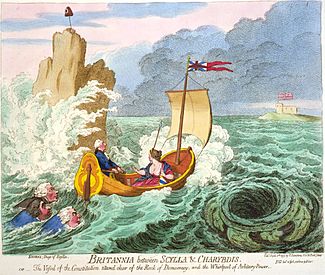
Scylla and Charybdis in theology


For the ever-growing majority without a classical education, my allusion to Scylla and Charybdis can be understood well enough with the Wikipedia background. Suffice it to say that, although those twin dangers often loom in theology, they can and should be avoided. They often appear under different pairs of names. One such is "fundamentalism and modernism," about which I've written before and will again. We must and can steer between the Scylla of fundamentalism and the Charybdis of modernism. Another S/C pair is common, for pretty much the same reasons: rationalism and fideism. Adherence to either only runs faith aground.

How rationalism runs faith aground is easy enough to understand. If the only admissible religious beliefs are those which can be established or otherwise secured by human reason, then there is no room for the unmerited, freely accepted gift of divine faith. Nor is there any room for the object of such faith: divine revelation. For such revelation supplies us, among other things, with truths that cannot be established or otherwise secured by natural reason; but ruling out divine faith entails ruling out recognizing, and trusting, any religious authority as the conveyor of divine revelation. Religion thus reduces to a matter of opinion—for there are no methods of proof that even religionists agree on. That was pretty much the view of Thomas Jefferson and of many others influenced by the Enlightenment. It is still the view of many philosophers today.

At the same time, fideism has undergone something of a renaissance among unbelievers as well as believers. Fideism is the view that religion, and with it divine faith, has nothing to do with reason, in the sense that "reasons" for having faith are as unnecessary as they are insufficient. The most common reason some believers end up as fideists is their conviction that the ultimate object of divine faith, God, so far transcends our reasoning capacities that rational criteria cannot be used to assess beliefs about God. Such beliefs are thus seen as insulated from rational criticism, which in its turn is seen as either ignorance or blasphemy. Most Sunni Muslims, and not a few Protestant and Orthodox Christians, are fideists in such a way. But to those of a scientific or otherwise critical bent, fideism can itself count as a reason against religious belief. For if religion is held to have nothing to do with reason, so that no particular religious belief can or should be subjected to rational scrutiny, then religion itself appears as positively irrational. And a cognitive stance that's irrational is not worthy of rational credence. Thus can rationalism and fideism, like so many pairs of extreme ideas, converge in similar attitudes.

To me, it seems almost self-evident that fideism, every bit as much as rationalism, is incompatible with divine faith. If rational criteria are not applicable to religious beliefs, then the fideist can only see the content of such beliefs as established arbitrarily by the absolute will of God. But such radical voluntarism empties the transcendental concepts of truth and goodness of all intrinsic content, and thus of all intrinsic meaning. It reduces religion to the blind worship of power. Some may find that prudent, but it hardly even makes sense to call it admirable.

The only way to steer between Scylla and Charybdis here is to insist, like such thinkers as Thomas Aquinas, both that divine faith cannot be established by human reason and that such faith must all the same be a reasonable choice. "Reasons", called "motives of credibility" in traditional apologetics, thus render divine faith rationally intelligible but not rationally necessitated. Such faith matches creation, for creation itself is rationally intelligible yet not rationally necessitated. Both faith and creation are thus mysteries in a positive sense—mysteries that will never be entirely dissipated when we see God face to face.

Thursday, August 25, 2011

Evolutionary theology

Yes, it feels like a so-bad-it's-good Chuck Norris movie. At the climax of yet another such flick, the words of the steely-eyed hero played by Chuck resounded in the villain’s head: “It’s time…to die.” The poor fellow promptly turned around to see Chuck fire a live RPG into him. In tackling the subject to which my title alludes, I feel like that villain. I can sense some combat-hardened defender of orthodoxy behind me, ready to fire his overkill and watch me blow up. The time has come to address the subject; indeed, that time is overdue in the Church. But at least I’m not the villain of the piece, and the conversation will continue regardless.

I do, after all, have a legion of well-intentioned company. A few weeks ago, as my radio droned over my chores, I heard Barbara Bradley Hagerty conducting an NPR piece that their webmaster entitles “Evangelicals Question the Existence of Adam and Eve.” At first, I rolled my mind’s eyes: Since when is it news that not all evangelicals, never mind other sorts of Christian, are fundamentalists?  Of course it’s possible for a faithful Christian to doubt that the first several chapters of Genesis are literal history. E.g., the chronological order of creation described in the first chapter does not square with that of the second—a fact that surely cannot have escaped the notice of whoever first put these stories together in a single written text. And many scholars, including one Joseph Ratzinger, have pointed out the similarities between Genesis and Babylonian myth. As a Catholic, I tend to think of the first eleven chapters of Genesis as myths and legends given a distinctive theological interpretation in their divinely inspired, written form. What’s important is not that they be history as the modern mind understands that genre, but that their theological interpretation be—well, divinely revealed truth. That, to be sure, must bear some relationship to what literally happened in the past. But it’s not clear exactly what that is, and it’s doubtful that we can ever get clear enough about it to satisfy intellectual curiosity. I’m far from alone in that attitude, not only among Catholics but among Christians generally.

But despite my inclination to let the matter rest there, other Catholics won’t. I’ve noticed over the years that whenever the question of humanity’s origins comes up, many thoughtful Catholics will take the evolution of the body for granted (as did Pope John Paul II), but all will zero in on the question of monogenism.

Last week, e.g., science writer John Farrell observed on his blog at Forbes.com:

The question arises: Can theology adapt to the findings of science? Can the strict monogenism of the human race as traditionally understood by Christians, be modified to the scientific consensus that the human species originated in a small population, not a single couple? In famous cases, of course, such as the trial of Galileo, and acceptance of the reality of heliocentrism, the answer is yes, though it took the Catholic Church a long time to officially come around. But as Coyne points out, the erosion of the idea that the human race descended from a single couple is something that is much more necessary to the theology of salvation in Christian tradition than is the issue of, say, whether God really made the sun stand still for Joshua and the Israelites. Christians have for centuries adapted to a more allegorical interpretation of many books in the Old Testament. But not the Book of Genesis and its account of the Fall and Expulsion from Eden.

The question at issue here is really dual: Did the human race today descend from a single couple? And: Is an affirmative answer to that question necessary for preserving Catholic soteriology? From a scientific standpoint, the first question seems to be settled in the negative. Many faithful Catholics think the second is settled in the affirmative. So, to that extent, we have a conflict. Farrell worries that the Catholic Church has not tried to resolve the conflict. He’s right to worry, for the conflict is a serious test of faith for many educated Catholics.

At the magisterial level, the only explicit treatment of the matter we find is Pope Pius XII’s  1950 encyclical Humani Generis. Here’s the passage Farrell quotes, like many others before him:

For the faithful cannot embrace that opinion which maintains that either after Adam there existed on this earth true men who did not take their origin through natural generation from him as from the first parent of all, or that Adam represents a certain number of first parents. Now it is in no way apparent how such an opinion can be reconciled with that which the sources of revealed truth and the documents of the Teaching Authority of the Church propose with regard to original sin, which proceeds from a sin actually committed by an individual Adam and which, through generation, is passed on to all and is in everyone as his own.

That came partly in response to the speculations of Jesuit paleontologist Teilhard de Chardin, who indeed had little compunction about coloring outside the lines of orthodoxy. The Vatican, needless to say, was not pleased. Even today, most champions of orthodoxy believe that Pius XII settled the matter in favor of monogenism, “science” be damned. But I’m not so sure about that.

Since I’m not a scientist, and my academic credentials are not in theology, I’m not the one to solve the problem. But I suggest that, to make progress, we should first ask whether the conflict is real or apparent, temporary or permanent. For answers, there are three basic options:

  1. The conflict is real and permanent: the “surrender” option.
  2. The conflict is real but temporary: the “truce” option.
  3. The conflict is only apparent: the “creative” option.

WWhich option is the faithful Catholic to take?  Clearly not (1). Since the Church has long insisted that “reason” and “faith” complement rather than contradict each other, surrendering the confirmed results of natural science to theological dogma on this point is not an option. So the debate among thoughtful Catholics is really about whether to embrace (2) or (3). Do we settle for a temporary truce, waiting science out a while longer? Or do we take the present results of science for granted as a point of departure for some creative theological re-thinking?

It’s tempting to go for (2). Science does develop and change, after all. Prima facie, waiting science out still seems to be the Vatican’s preferred route. Largely for that reason, it is the preferred route of orthodoxy’s champions. But after six decades of scientific progress since Humani Generis, continued silence on their part is a theological and apologetical embarrassment. What, then, can be done with the creative option while remaining within the bounds of orthodoxy?

As a philosopher, my instinct is to look for the logical wiggle-room. And in Pius XII’s words, that’s what we find. To be sure, it is irreformable dogma that an individual couple committed the first sin and transmitted the resulting loss of grace to their descendants as “original” sin. With the usual two exceptions understood, those descendants are all of us. But a conflict with current science arises only if we assume that the “generation” by which original sin is transmitted logically entails that a first couple, Adam and Eve, were the first humans in a purely natural sense, i.e. the genetic sense. Nothing in magisterial documents requires adopting that assumption. So it is no more theologically irreformable than scientifically defensible. We may and should dispense with it.

Why not hold instead that Adam and Eve—whoever they really were, and wherever they really lived—were the first humans in a supernatural sense? As a couple, they were the first people to be called and elevated by grace to a state of fellowship with God meant to culminate in a greater union with him. That doesn’t entail that they were genetically the first humans. It entails only that they were the first humans God gave a destiny beyond Nature. So when they sinned and lost his grace, they largely reverted to Nature, which is the state all of us since then find ourselves in until we are somehow incorporated into Christ.

Of course such a proposal raises many questions. There are always questions, and I don’t pretend to have all the answers. But centuries ago, the Church slowly came to see that affirming biblical inerrancy did not entail rejecting heliocentrism. It is not unreasonable to imagine her coming to see that affirming monogenism need not entail rejecting evolutionary biology.

OK, time to duck the RPGs….


Wednesday, August 04, 2010

Organizing apologetics

Perhaps I'm weird, but I must admit that, even when I was alienated from the Catholic Church in youth, I never had any principled difficulty with the faith/reason relation. I always took for granted that the two are compatible, even before I learned that the Church teaches as much. Of course, and like most other thoughtful people, I did have difficulties with certain specific issues. But the Catholic Church has shown, at least to me, that she has means to address such issues reasonably without compromising what she says is de fide.

As we all know, though, more than half the Christian world disagrees. I say "more than half" because, even though about half of all Christians were baptized in the Catholic Church, many educated Catholics reject what I've just said the Church has shown me. The two most common objections to Catholicism one hears from educated Christians, including some who are nominally Catholic, are: (1) Distinctively Catholic doctrines are not rationally necessitated by the early sources, and so shouldn't be thought to belong to divine revelation as distinct from human tradition, and (2) The course of Catholic doctrinal development yields internal inconsistency at the highest level, so that the Church's claim to infallibility--even under limited conditions--is not credible. It might be useful to others for me to state here, in baldest outline, what I offer as answers to such objections. Such a way of organizing the arguments, if sound and taken to heart, would save a lot of people a lot of wheel-spinning.

(1) misconceives the nature of divine revelation and the assent of faith thereto. Divine revelation does not consist primarily in a set of propositions to be inferred from writings and other evidence from the past. Such things, to be sure, are indispensable for preserving the Church's collective memory of what's been handed on by the Spirit through Sacred Tradition. Yet at bottom, what's handed on is the reality of the decisive encounter between God and man in Christ Jesus. Forms of words, archeological evidence, comparative religion, and so on merely help express that. Now if Christianity is true, then by God's design, the ongoing encounter between God and man takes place through something called "the Church" even though, as is the case with many who hear the call to faith in Christ, it needn't start in the Church. Yet without being in any way limited to the authority of the Church, said encounter always and necessarily depends on a visible, clearly identifiable ecclesial authority which exercises God's own authority as revealer and sanctifier. For without such an authority, the content and power of divine revelation would end up appearing only as a matter of opinion. That, for us, would be no revelation at all, and assent to it, such as it is, would be no faith at all. Despite how different they are in many respects, Aquinas and Newman made essentially that argument. Following them, it's one that I've long made myself.

What about (2)? As an argument, it begs the question either at the outset or in the end. In some formulations it premises, as the only reasonable ones to adopt, interpretations of Catholic doctrine that yield contradictions. But if the Magisterium's claims for itself are true, said premise is false. There must be other reasonable interpretations of Catholic doctrine that are collectively self-consistent, and those turn out to be just the ones the Magisterium itself, the author of the doctrines in dispute, has come to adopt. Given as much, the objector needs to show that interpretations yielding contradictions are ones that the Magisterium itself once adopted, and did so in such a way that its own criteria for infallibility were thereby satisfied. But those who press (2) usually don't try to show that. When they do, they end up begging the question all over again—by assuming a way of applying the criteria for infallibility that the Magisterium itself would reject.

Now it should go without saying, but often needs to be said, that successfully rebutting (1) and (2) does not prove Catholicism to be true. Indeed, given the Catholic understanding of how reason and faith are interrelated, nothing could "prove" Catholicism to be true. Faith is a divine gift that can only be accepted freely. If there were compelling arguments for Catholicism, then those who recognize as much would be compelled to believe, which is not faith. The role of reason in coming to faith is to show that faith is fully compatible with reason, not that reasoning compels it. That, of course, does not rule out the possibility that there are compelling arguments against Catholicism. But it is precisely the task of apologetics to show that there are no such arguments. In this post I've sketched two examples of how to carry out that task. I've elaborated those examples elsewhere, especially on this blog.

Thursday, February 05, 2009

The authority question restated

As promised, I have deleted my lengthy post of February 1, "Which contest is worth pissing in?". I did so in order to respect the privacy that my chief interlocutor felt he needed in order to conduct his theological discussion without scandal. That said, however, I want to improve the contribution I made to that discussion, and to encourage the continued involvement of readers who made contributions to the lengthy combox of the deleted post. (Any of those contributors who want a copy of that combox for reference purposes should email me for one. I've saved it in Word format.)

Over the decades, I have heard countless debates about ecclesial authority and contributed to not a few of them. For reasons I've described on this blog and elsewhere, such debates are unavoidable and, up to a point, healthy. Many people try to avoid them, of course. They deny that any entity called "the Church" has authority beyond appeal to preserve, present, and interpret divine revelation for us. They insist that Jesus Christ alone, who has been given "all authority in heaven and on earth" (Matthew 28:18), has the requisite authority and thus merits the requisite submission of mind and will. In a sense, that is true. But the debate is precisely about the extent to which something called "the Church," the Mystical Body of Christ which, together with the risen Christ, makes up "the whole Christ," has been granted such authority. I don't believe, and never have been able to believe, that we can dispense with the living voice of "the" Church—whichever communion of churches that may be—in ascertaining what God has revealed to us. In that belief, I am far from alone.

I hold said belief because, after many of the aforesaid debates, I became convinced that, if nobody on earth after the Apostles has the same degree of divine authority as theirs to say which propositions are and are not de fide, then the question where to draw the line between theological opinions about the data of revelation and divine revelation itself reduces, always and necessarily, to a matter of opinion. And that effectively renders the entire subject of divine "revelation" a matter of opinion, not of revelation. That is the reductio of denying divine teaching authority to some entity justly deemed "the Church." As Newman so pithily put it: “No revelation is given, if there be no authority to decide what it is that is given.” Such an authority cannot of course decide on its own “what is given”; to serve its function, it can only do so with the subject matter and the authority Jesus Christ has given it. But if such authority has in fact been given it, then when it interprets Scripture and Tradition in a manner intended to bind the whole Church irreformably, the Holy Spirit guarantees that those interpretations will not be false.

That follows from the teaching of the Catholic Church, but it is not a distinctively Catholic position. The Orthodox churches too maintain that Scripture and Tradition can only be rightly received and interpreted in and through something called "the Church," that the authentic voice of the Church is the voice of Jesus Christ. The authentic voice of the Church is thus beyond appeal even if not "infallible" in the technical sense of that term employed by the two Vatican councils. Orthodoxy does differ from Catholicism about ecclesial authority, to be sure: it differs with Rome over the questions who in the Church teaches with the aforesaid voice and when. And those differences are significant enough to cause the Orthodox communion to regard itself, rather than the Roman communion, as "the" Church of Christ.

In point of fact, the centuries-old debates about ecclesial authority reveal not two but three distinct "hermeneutical circles" encompassing the relationship between Scripture, Tradition, and ecclesial teaching authority. I shall describe those circles shortly. To characterize and understand them, however, we need to be limit who counts as participants in the debate.

It has become a sociological commonplace over the past few decades to note that the divisions between the three major strains of Christianity—Catholicism, Protestantism, and Orthodoxy—are less important than the division between the more conservative and the more liberal believers within each of those strains. A conservative or a liberal believer within a given church generally has more in common with her counterparts in other churches than with people on the opposing wing in her own church. (Orthodoxy, of course, has a smaller percentage of "liberals" than Protestantism and Catholicism; but "liberals" there are, and I suspect there will be more in future.) I think the new commonplace is correct, and is best explained as the difference between people who believe that religious doctrine is ultimately a matter of provisional opinion—i.e., the liberals—and those who believe that divine revelation has given us identifiably absolute truths—i.e., the conservatives. It is the conservatives who count in the debate about ecclesial authority, because it is they who maintain that the revelation in and through Jesus Christ is public, complete, and definitive, in such a way that the deposit of faith left to us as the precipitate of revelation many neither be added to nor subtracted from. Accordingly, the three basic disagreements about the relationship between Scripture, Tradition, and ecclesial authority are disagreements among those who hold that the DF is both reliably identifiable as absolutely true and may neither be added to nor subtracted from. They are disagreements about precisely how the DF is to be handed on, received, and interpreted reliably, without augmentation or diminution, even as it was first left to us by a God "who can neither deceive nor be deceived."

As I've said, the disagreements take the form of three hermeneutical circles. The idea of a hermeneutical circle began, ironically enough, with the liberal Protestant theologian and biblical critic Friedrich Schliermacher; the term was formally introduced a century later by the philosopher Martin Heidegger, who developed the idea further in parallel with another German philosopher, Hans-Georg Gadamer. The core idea was that, in reading a text, the parts can only be understood with reference to the whole and the whole can only be understood with reference to the parts. That yields a circle. But an interpretive motif arising therefrom need not be viciously circular. For hermeneutical circles are unavoidable, and the way to decide between them—if and when we face such a decision—is to assess which of them is most capacious and plausible in light of what is known about the intentions of the author(s), the literary antecedents, and the historical context of the text. And even when such "knowledge" is too limited to settle the question, there's always the distinct possibility that such limits will be outgrown in the future.

For purposes of discussion, I cannot avoid oversimplifying the content of the three competing hermeneutical circles which, I believe, define the epistemic differences between the three main strains of Christianity. I am forced to omit all the variations and nuances of each and most of the supporting arguments for each. But each involves an account of the relationship between Scripture, Tradition, and ecclesial teaching authority; and I believe that, in the final analysis, the three circles may be described as follows with minimal unfairness:


  • The Protestant HC. Scripture records the substance of apostolic Tradition, and the canon of Scripture was put together by ecclesial authorities over a rather long period of time. But once that process was complete, Scripture was recognized and accepted by all Christians as the sole written work of man which is inspired by the Holy Spirit. As such, Scripture is (a) materially sufficient as an expression of the DF, and (b) perspicuous enough in itself to enable any Spirit-led believer who reads it to reliably understand the parts in terms of the whole and the whole in terms of the parts. Accordingly and (c), Scripture is the sole "infallible" rule of faith after the Apostles, and comprises all that is necessary for any Spirit-led believer to know, in its fullness, the verbally expressible content of what God has revealed to humanity in and through Jesus Christ.

    This HC is complete in principle. It enables believers, quite generally, to judge the orthodoxy of ecclesial authority in terms of Scripture. For given the material sufficiency and interpretive perspicuity of Scripture, any doctrine which is not explicitly stated in Scripture must be derivable therefrom by some form of rational necessity. The sole function of ecclesial authority is to bear and enforce faithful institutional witness to the Truth that can, in principle, be understood independently of such authority. Thus, such authority is not strictly necessary for assimilating divine revelation; it is only a disciplinary and educational convenience.

  • The Orthodox HC. Scripture is indeed inspired by the Spirit and materially sufficient for expressing the DF. But Scripture is a work of the Church and for the Church, and can only be reliably understood as read by the Church in light of the broader "Holy Tradition" handed down to her from the Apostles. Tradition in that sense is the sum total of the ways in which the life of the Holy Spirit is manifest in the Church as a collectivity. Those ways chiefly include: the liturgy, the writings of the Fathers, the lives and wisdom of the saints, and the Ecumenical Councils. Although ecclesial teaching authority is ordinarily exercised by individual bishops over their flocks, only the dogmatic decress of the Ecumenical Councils must be understood as affirmations of faith which bind the whole Church.

    The doctrinal authority of such councils, however, is not primarily juridical. It lies in their "reception" by the whole Church over time as authentic expressions of the consensus of the faithful, informed as that consensus is by Scripture and Tradition understood together. From that point of view, "the Church" consists of those believers who accept such criteria as exhaustive touchstones of orthodoxy; hence the "Orthodox" communion. Such an account of the relationship between Scripture, Tradition, and ecclesial teaching authority constitutes an HC; for we know by the consensus of the Church which understandings of Scripture and Tradition are orthodox, and we know who is in the Church by their adherence to what is orthodox.

    But this is not a vicious circle. For to know the Way, the Truth, and the Life, who is a Person, entails belonging to his people, his Body, the Church; there is no standpoint outside her by which the true doctrine can be reliably known. At the same time, there is nothing in the historic consensus of the faithful to suggest that Jesus Christ willed that any one bishop or leader in the Church, apart from the consensus of the whole, exercise supreme doctrinal or disciplinary jurisdiction over the Church catholic. Orthodoxy is a gift of divine love, collectively received and collectively known. Though juridical authority is necessary in the Church, even for teaching, disputes about doctrine cannot be resolved by mere juridical imposition on the whole Church without her consent. Consensus, not diktat, is the true sign of what is Orthodox.

  • The Catholic HC. First, read Dei Verbum §7-§10 and Lumen Gentium §25.

    Although Scripture and Tradition taken together are "materially sufficient" for expressing the entire DF, and can sometimes be understood to a great extent by various individuals without ecclesial authority, they can only be interpreted and understood "authentically"—i.e., with the authentic and thus binding voice of the Church—by the apostolic teaching authority or "Magisterium" of the Church. The "ordinary" way in which that is done is by the consensus of the bishops, which must be at least diachronic and is ideally synchronic too; "extraordinarily," it is done by the dogmatic decrees of ecumenical councils of the bishops and/or the dogmatic definitions of popes.

    For a putatively ecumenical council to bind the whole Church, it is necessary that its dogmatic decrees have at least the free consent if not the ratification of the Roman Pontiff, who succeeds Peter as the visible head of the episcopal college. Indeed he can, if he so chooses, speak unilaterally with the authentic voice of the Church, and when so doing enjoys "the infallibility with which Christ willed His Church to be endowed in teaching on faith or morals." Such definitions do not therefore acquire their binding character from the "consent of the Church" (cf. Vatican I, Pastor Aeternus); yet in such cases "the assent of the Church can never be wanting, on account of the activity of that same Holy Spirit, by which the whole flock of Christ is preserved and progresses in unity of faith" (LG §25).

    Such an account of the relationship between Scripture, Tradition, and ecclesial teaching authority constitutes an HC. On the one hand, it is clear that Scripture and Tradition, which together form "one sacred deposit of the Word of God," were not formed and cannot be authentically understood without the Magisterium (DV §10). On the other hand, the Magisterium has no authority other than that which Scripture and Tradition record as having been given by Jesus Christ to the Apostles and their successors, the college of bishops united with their head, the Bishop of Rome. Indeed the Magisterium, whether episcopal in general or papal in particular, would make no sense and could not function without a general understanding and possession of the DF in the Church as a whole. But without sitting, knowingly or unknowingly, on the "three-legged stool" of Scripture, Tradition, and the Magisterium, one cannot know what is orthodox by reference to Scripture and Tradition without the Magisterium. The ambit of orthodoxy, including the authentic development of doctrine, is definable only by the Magisterium in its definitive and binding interpretations of that unified "Word of God" known as Scripture-and-Tradition. But whenever the Magisterium does issue such definitive and binding interpretations of the DF, it must do so in a manner that logically consistent with its prior interpretations that enjoy the same degree of authority. It is of course logically possible for the Magisterium to fail to do so; but it is not spiritually possible, given that the three-legged stool is God's means of ensuring the Church's unfailing profession of the "faith once given to the saints" (Jude 3).

The first point to be made about the above three "hermeneutical circles" is that none can be shown superior to the others with an argument containing only premises that all parties involved—Protestant, Orthodox, and Catholic—would accept. From within each circle, the others will seem at best question-begging and, at worst, viciously circular. To borrow a metaphor from the philosophy of science: each HC constitutes a paradigm that is epistemically incommensurable with the others. And that holds even when many quite similar doctrinal conclusions are reached from within each HC.

For example, for the last quarter of 2008, I actively participated in a series of Bible studies led by a team of conservative, evangelically-oriented Protestant ministers. Throughout the series, I heard not a single doctrinal assertion that was incompatible with Catholicism. Although the leaders did not recognize the Catholic Magisterium's claims to authority, their interpretations of the DF on the doctrinally significant points that came up were virtually indistinguishable from those of the Catholic Church. Similarly, as a college student in the 1970s, I attended many Orthodox talks and liturgies; once again, I heard not a single doctrinally significant assertion that I could find, after due inquiries, to be logically incompatible with Catholicism. Both the Protestants recently and the Orthodox back then turned out to be professing the same doctrines I did on the points being discussed, even though their language and conceptual framework were often quite different from what I was used to. The disagreements with me as a Catholic only came up when I asked them to give their reasons for interpreting the sources as they did. More generally, it seems to me that the differences defined by the three HCs are less over what we know of the DF than over how we know it.

But that source of Christian disunity, I submit, is not merely a philosophical problem. It is not just a matter of epistemological differences that could eventually be overcome by scholarly means such as clever argument, creative re-reading, and further research. No discoveries of lost texts or artifacts, no renewed critical editing of known texts, no work of theological genius, would even begin to break open and join into one the three HCs that define the basic epistemological differences between the three main strains of Christianity. By the same token, no arguments from reason alone are objectively cogent enough to rationally compel any informed but uncommitted inquirer to decide that one particular HC is better than the others. Each such inquirer should in due course decide, on the basis of the sort of information I've described above, which HC is the most plausible to him; and ordinarily, that suffices to justify a decision in good conscience to embrace one of them as a matter of faith. But given that each HC presents its understanding of doctrinal authority as an element of the DF, and therefore as a matter of faith, no such decision can be shown to be the only rationally justifiable one. For if any one HC were the only rationally justifiable one, then its understanding of doctrinal authority would be a conclusion of human reason rather than a tenet of divine faith.

I shall not repeat here my reasons for having chosen the Catholic HC. I've explained all that before and, if only as a means of defending my faith, will doubtless find myself doing so again. The point I want to close with is one that ought to be granted by any participant in the intra-Christian debates over ecclesial authority: if such debates could be resolved by scholarly considerations alone, they would already have been resolved. I am tempted to say they would never have arisen in the first place.


Tuesday, March 18, 2008

Monday, July 23, 2007

Why I'm a natural theologian

Most people who meet me for the first time are surprised to learn that I am interested in theology. Some who have known me for a number of years think me misguided when I indicate that, at this point in my life, it is my chief interest. The former group assumes that I am, and the latter that I ought to be, a lawyer or a salesman, or at least somebody whose energies should be devoted mainly to acquiring money, prestige, and sex. But those who care to know me for who I am know that I am a natural for theology, where 'theology' is used as a name for an academic discipline, as distinct from that speech about God which only the truly holy can efficaciously utter. Of course I'm not considered qualified to teach theology at the post-secondary level, even though I have taught at several seminaries and touch on theology whatever and wherever I teach. That's because I have never taken any graduate-level course in theology; for reasons having to do with academic and ecclesiastical politics, I chose in youth to pursue the slightly less unmarketable discipline of philosophy. But the philosophy is my point.

When I call myself a natural theologian I mean that I am a practitioner, fitfully, of that branch of metaphysics, and therefore of philosophy, which is known as natural theology. The aim of natural theology is to acquire some knowledge of the divine that does not, logically speaking, require data of special divine revelation (if any) as premises. Here I want to explain, in terms anybody can appreciate, why I made that choice and why it is so worthwhile.

Alluding to Romans 1:20, the First Vatican Council defined: "If anyone denies that the one true God, our Creator and Lord, can be known with certainty in the natural light of human reason through the things that have been made: let him be anathema." Accordingly, as a Catholic I take the Church's word for it that natural theology, as a way of acquiring some real knowledge of God, is possible. But that is reliance on authority, not just on reason. It is not why I originally took up the discipline. I took up natural theology as a student for three reasons.

The first was that I could find no other honest way to decide whether it was rational to profess a religion, and rationality was something I prized given the physically and emotionally chaotic environment in which I was raised. By the time I was 15, the faith of my childhood was no longer adequate for me; I needed to find some basis for an adult faith if I was to have faith at all. And it seemed to me that an adult faith entailed making not only a "reasonable" choice but a "rational" one. What's the contrast?

It is reasonable for some people to cling uncritically to the religion in which they were raised, simply because they lack either the leisure, the inclination, or the native ability to think critically enough to arrive at an adult faith. If they live long enough, life will probably challenge them to go beyond that; and it would be unreasonable for them to refuse the challenge if they're up to it. But some people never experience the challenge, and others who do aren't up to meeting it. Who's to say they are unreasonable for having, or even losing, a childish faith in such circumstances? Not I. But neither did I have the luxury of not knowing better than such people.

I had had Catholic catechesis, accurate as far as it went, and I had a good mind. But I came to need a worldview that was objectively rational, not merely reasonable given my limitations. That was because I had ceased being able to believe that what mattered to my parents, teachers, and friends, or even to myself, mattered period. I could no longer believe that life was worthwhile just because I had a sanguine personality, or because I had been taught it, or because everybody around me assumed it. For a time that left me in something of a void, depressed and rudderless; my mother, whose values were entirely conventional, worried that I studied and brooded instead of dating; but I didn't want to spend my spare time working a boring, menial job in order to get money for dating when I wasn't even sure that life was worthwhile. I read voraciously and worked diligently on a project I would now describe as trying to find sound arguments that that life is worthwhile. Otherwise there was no reason to prefer reality to the drugs that I couldn't afford any more than I could afford the girls.

What ended up convincing me that life is worthwhile was a deceptively simple point: in the final analysis, it's more rational to try to make overall sense of reality than not; whereas the various forms of nihilism, such as atheism and French existentialism, did not make overall sense of reality, and indeed argued that it was irrational to try. Thanks to an English teacher who happened to be a Jesuit scholastic, I had read as much of C.S. Lewis, JRR Tolkien, GK Chesterton, and Dorothy Sayers as I could get my hands on. As much by the power of imagination as by logic, they convinced me that theism made much more sense out of who and what people are than atheism. My high-school religion classes, fashioned just after Vatican II when so many priests and religious were shucking tradition, seemed sterile and pointless by comparison. Yet the salient point has been put well in the context of the current debate about "the new atheism:"

Atheists and theists seem to agree that human beings have an innate desire for morality and purpose. For the theist, this is perfectly understandable: We long for love, harmony and sympathy because we are intended by a Creator to find them. In a world without God, however, this desire for love and purpose is a cruel joke of nature — imprinted by evolution, but destined for disappointment, just as we are destined for oblivion, on a planet that will be consumed by fire before the sun grows dim and cold. This form of “liberation” is like liberating a plant from the soil or a whale from the ocean. In this kind of freedom, something dies.

I was, to be sure, prepared to accept the death of what is thus said to die; what I could not accept was the earnest belief of the atheists that it was somehow more rational to see reality that way than to be a theist. The theists had a reasoned answer to the question why the world, and we, exist; the atheists could only try to persuade me that the question is unanswerable. But proving a negative is notoriously difficult. It seemed to me then, and still seems to me, that the atheists had only one argument: unlike religion, science has a consensual, publicly accessible method for testing claims to knowledge; therefore, it is more rational to accept a purely scientific worldview than a religious one. But the argument struck me, and still strikes me, as a non-sequitur. From the fact that only science gives us such a method, it does not follow that science is the only reliable way of acquiring knowledge. All that follows is that we should rely on science to evaluate the kinds of knowledge-claim that science, as a method, can evaluate. But that supplies no reason to believe that only what can be known scientifically can be known at all, i.e., the thesis now called 'scientism'. Given the inner world first limned for me by the British writers in question, I was compelled to believe that true empiricism had to be wider than the advocates of scientism allowed. And I could find no argument for atheism other than scientism.

So, I was now a rationally convinced theist, and that itself involved the doing of natural theology. I was relieved because I now had reason to participate actively in life; I was also challenged, because the Hound of Heaven was still after me. Thus the question for me became what sort of theist I should be. As a college freshman, I decided to double-major in philosophy and religion largely in order to answer that question. Since ideas have consequences, and wrong ideas about ultimate things have very bad consequences, the question struck me as vastly more important than that of what career such disciplines could equip me for. (My father was pleased by my choice, since he thought the intellectual discipline I would learn would equip me to follow him in a career in law. I didn't have the heart to disappoint him by telling him I was much more attracted to the clergy; in any event I didn't have to tell him, since I could never interest the Catholic clergy in accepting me into their ranks. Indeed, several of the priests I later consulted about the matter seemed much more interested in my body than in my mind or soul—a fact which itself turned out to be a grave challenge to my ongoing intellectual project.) But I had gradually become convinced that only monotheism, as opposed to pantheism or polytheism, was philosophically defensible. The question then became what sort of monotheist to be.

The three major monotheistic religions are Christianity, Judaism, and Islam. It didn't take me long to decide for Christianity. Having arisen from the Judaism that preceded it and persisted despite the Islam that came after it, Christianity seemed incomparably fuller and richer than either, incorporating even what seemed true in the various pagan religions. It seemed to me that, if the one true God did reveal himself to humanity, this was more likely to be the full story than the alternatives. So then the question became what sort of Christian to be.

I couldn't help noticing that the two main Christian alternatives to my native Catholicism, Protestantism and Orthodoxy, didn't seem to put much stock in the discipline that had helped convince me that life is worthwhile. As best as I could tell at the time, most of their representatives held that we cannot arrive at any knowledge of God without already being committed to the truth of Christianity. In other words, natural theology is an illusion, and to persist in the illusion is to corrupt the Faith. Of course, I gradually learned that the picture is more complicated than that. Some Protestants have done, still do natural theology explicitly, and I have read a good many of them; some Orthodox, including some of the Eastern Fathers, have done what is in effect natural theology, but without characterizing it as that; and I've read some of them too. But even having learned all that, I find no reason to abandon my youthful impression that only Catholicism explains why natural theology is both possible and worthwhile. So, once I decided to remain Catholic for that and other reasons, I had further reason to do natural theology, if only so as to deepen my acquaintance with my own tradition.

But the third and clinching reason I kept at it came from the political philosophy I also studied and debated in college. It seemed to me, as to nearly everybody else at Columbia, that the West in general had only learned relatively recently the social importance and the moral necessity of religious freedom. The Catholic Church herself had only acknowledged it within my lifetime. Yet for reasons I explained yesterday, secularism as a political ideology also seemed to me untenable—a conclusion that set me sharply at odds with my professors and most of my fellow students. So the question for me then became: How can one expound a basis for the moral legitimacy of the state that is neither theocratic nor secularist, i.e. that required neither imposing a particular religious tradition on people nor dispensing with God altogether? The only answer I could find was the sort of thinking summed up in Thomas Jefferson's phrase "the laws of Nature and of Nature's God"—in other words, the natural law as promulgated rationally by the Higher Power, the God, knowable to some extent by human reason. Only in the Catholic tradition was that notion seriously and systematically developed, and it depended in part on that natural theology for which the Catholic tradition had always maintained an important place. And so my chosen discipline bore, at least for me and for some Catholic thinkers, considerable political significance. Given the challenge of Islamism today, it retains that significance.

I don't expect this little autobiography to convince my readers to become natural theologians. But I hope to have exhibited why that discipline is both a reasonable and an important one to pursue.

Monday, November 27, 2006

Science and religion: the latest skirmishes

Last weekend, Dr. Scott Carson posted on the most recent updates from the battlefield. Usefully, he points us to a few solid refutations of Richard Dawkins' standard rants against religion. Their authors have it rather easy, I'm afraid. Just as Andrew Greeley is a presumptively celibate priest who appears to have had no unpublished sexual thoughts, so Dawkins and his ilk will publicly spew whatever they feel about the Great Enemy as if they were actually authorities on the subject. One can hardly avoid noticing that they've gotten almost hysterical of late, both causing and signifying a certain degradation of thought that can only work to the advantage of philosophically trained theists. Yet, and more generally, the skirmish that most interests me is not the clash of the biblical fundamentalists and the scientistic extremists; that is a tiresome sideshow for most philosophers. To me, the important debate is over how the relationship between natural science and religious belief should be conceived in the first place. I think Scott lowballs that one a bit too much.

Last summer I read two recently published books by theists on that relationship: The Language of God by Francis Collins, lead scientist of the Human Genome Project and an evangelical (not: fundamentalist) Christian; and Is Nature Enough? by John Haught, the Landegger Distinguished Research Professor of Theology at Georgetown University, who has made a long career of this very topic. While the two men obviously come from quite different intellectual backgrounds and thus bring somewhat different agendas to the table, they do have a few key points in common. While science by itself can present no evidence in favor of religious belief, and indeed does present evidence against certain particular religious beliefs, its methodology leaves untouched the basic human questions to which religions typically offer answers. So, while "creationism" is decidedly not science, the philosophical gates remain wide open for scientists to be theists. In that vein, Collins and Haught argue to the effect that, when nested within a non-fundamentalist religious worldview, strictly scientific discoveries can actually help to reveal the mind of God. All that is rather familiar and congenial to certain philosophically trained theists, a group within which Catholics form the largest subset. But for some reason, Scott won't even go that far.

He writes:

For someone who has a great deal of interest in science and a great deal of interest in religion, I have remarkably little interest in that domain of inquiry sometimes called "the intersection of science and religion". I myself do not see that they overlap all that much, except in the rather trivial sense that all knowledge, whether scientific or otherwise, is subsidiary to our knowledge of the good, which is God.

Now if that means that the respective methods by which science and religion can present truth are largely incommensurable, I cannot but agree. Ditto for Collins and Haught; indeed, that very incommensurability is essential to Haught's larger thesis. But the larger debate is not merely about epistemology. If classical theism is true, then the subject matter of natural science is what God has created, or at least that part of God's creation which we can observe. Hence, both natural and revealed theology can and should take account of what science tells us about the observable universe. That's exactly why Aristotle thought of "theology"—i.e., God-talk—as a branch of "metaphysics"—i.e., that kind of inquiry which comes "after" physics and to some extent relies on physics.

To be sure, philosophical and theological conclusions reached thereby must always be provisional, inasmuch as the theories of natural science itself are always open to revision. When theologians forget that, the result is often the sad but amusing spectacle of believers watering down their faith in light of scientific theories that have been superseded by the progress of science itself. The most egregious example of that is how theologians started working physical determinism into their thought as a premise precisely when quantum mechanics was relativizing, if not altogether discrediting, a determinism that Newtonian mechanics had made long fashionable among non-believers. But such errors needn't be made and are by no means always made. So the question what science can help us to know about the mind of God is at least worth exploration by theologians and theistic philosophers.

St. Thomas Aquinas, Common Doctor of the Church, thought the same and wrote accordingly. He wasn't always right, of course; science progresses, and so must philosophizing and theologizing that uses scientific ideas as subject matter. But even when we have to modify our thoughts, that's s no reason not to have developed them.

Sunday, November 12, 2006

Regensburg II: the Pope on faith and reason at Verona

Pope Benedict XVI's address to the 4th Annual Convention of the Catholic Church in Italy, on October 19 and now available online, was rich fare indeed. One theme that stood out for me was one on which I've posted before: what one might call the apologetical significance of mathematics. Thus the Pope:

Mathematics, as such, is a creation of our intelligence: the correspondence between its structures and the real structures of the universe—which is the presupposition of all modern scientific and technological developments, already expressly formulated by Galileo Galilei with the famous affirmation that the book of nature is written in mathematical language—arouses our admiration and raises a big question.

It implies, in fact, that the universe itself is structured in an intelligent manner, such that a profound correspondence exists between our subjective reason and the objective reason in nature. It then becomes inevitable to ask oneself if there might not be a single original intelligence that is the common font of them both.

Thus, precisely the reflection on the development of science brings us towards the creator Logos. The tendency to give irrationality, chance and necessity the primacy is overturned, also to lead our intelligence and our freedom back to it. Upon these bases it again becomes possible to enlarge the area of our rationality, to reopen it to the larger questions of the truth and the good, to link theology, philosophy and science between them in full respect for the methods proper to them and of their reciprocal autonomy, but also in the awareness of the intrinsic unity that holds them together.

This is the task that is before us, a fascinating adventure that is worth our effort, to give a new thrust to the culture of our time and to restore the Christian faith to full citizenship in it.

Such is the vision of the relationship between reason and faith that Benedict defended at Regensburg, where he criticized theological voluntarism as inimical to it. It seems to me that only in Catholicism is the inevitable creative tension implied by that vision maintained. Some of course would see that as a disadvantage; but I don't think it can be disputed that Western culture, which has given so much to the world, depended on it for a long time. That it no longer does means we are living off the spiritual capital of the past.