"You shall know the truth, and the truth shall make you odd." ~Flannery O'Connor

Friday, January 12, 2007

The latest development in the development discussion

Brandon, the philosopher who blogs at Siris, has posted a lengthy and thoughtful commentary on the discussion between me, Scott Carson of An Examined Life, and Zippy Catholic on the nature of the development of doctrine. He provides all the necessary links, and I find his entire discussion illuminating. Here I shall respond only to the points where I believe clarification or criticism on my part is in order.

1. He writes:

...it's perhaps not so clear what the discussants mean by 'doctrine' when they talk about 'development of doctrine'. A doctrine, after all, is just something taught; but necessarily there are different modes or levels of things taught, differentiated by how they are taught, and what the properties of the teaching are. For instance, a doctrine like the Chalcedonian definition is rather different from a doctrine like the limbo of children, and necessarily so; they are both things taught, but what is being done in teaching them is radically different. I think any discussion of development of doctrine has to make very clear what sort of doctrines are being discussed...

I think I can speak for both Scott and Zippy when I say that the doctrines whose development has been discussed, at least so far, are those whose development issues in dogmas. At least, all the examples have been of such doctrines. Nevertheless, I did not stipulate as much for two reasons.

First, I did not use the phrase 'development of dogma' because it raises too many hackles. In my experience, what too many people take one to be naming by that phrase is a process of development undergone by dogmas precisely as dogmas. That is not what I mean at all. Dogmas, which are "articulations" of the faith, can be "explicated" or "elucidated"; but in the standard case a dogma is a development only in the sense that it is the term, rather than the subject, of a process of development. Once a given doctrine is defined as a dogma, it is irreformable: not in the sense that the formulation in question could not be improved in principle, or even integrated into a broader whole, but in the sense that what the formulation affirms may never be negated. Yet, to many people, the suggestion that dogmas develop implies denying that dogmas are irreformable. Since we we all want to forestall such a reaction, the phrase 'development of dogma' has been left to the side for rhetorical purposes. But that is not to deny that doctrines other than dogmas develop; nor is it to imply that dogmas can never be better understood than they were when first formulated.

Second, developed doctrines that became dogmas have occasioned the most controversy. That is because dogmas are meant to be irreformable formulations of aspects of the depositum fidei—i.e., articles of faith—not merely theologoumena that some pope or council happens to want to make unquestionable. Yet it is precisely the objection of the Orthodox to certain distinctively Catholics dogmas, such as the Immaculate Conception, that they purport to make what are only allowable theologoumena into dogmas. In the case of papal infallibility, it is said that a demonstrably false theological opinion has been made a dogma. So, for apologetical purposes, it's worth focusing our initial discussion of development on dogmas that some do not recognize as genuine developments, in Newman's sense of the term 'genuine'.

2. Brandon writes:

While the dispute has been framed in terms of the nature of development, it seems to me that this is not quite the right way to frame it. After all, the nature of the development is purely historical, and to discover it you simply look at how the doctrines did, in fact, develop it. Rather, what the discussion has been looking at is the nature of anticipation or intimation in development of doctrine....what distinguishes a development from other changes is that what we have before internally anticipates or intimates what we have after. The change is not imposed from without, and the relevance between before and after is not merely a common substrate....This link of relevance between the before and the after in a case of development I will call, for lack of a better term, intimacy.

However, even intimacy is not enough to make a development in the strict sense, because there is another form of change involving intimacy (that therefore is development in a broad sense of the term) that is not development in the strict sense. This is deterioration, or decay, or corruption. In deterioration or decay, the before internally anticipates the after; but the change is not progressive. It is, so to speak, the development of the dying rather than the development of the living.

It is noteworthy that virtually the whole of Newman's discussion in An Essay on the Development of Doctrine is devoted to this distinction between development and deterioration. The reason is not hard to find; Newman is not so much interested in development of doctrine for its own sake, as for the light it sheds on an important question: Why is it important and worthwhile to consider the history of the Church from its origin to the present time in order to clarify current matters of dispute?...It is for this reason that Newman denotes so much time and space to the seven notes of development: they provide "tests" or signs (albeit "of varying cogency, independence, and application") that help us decided when something is development or decay. (It is also why it doesn't matter to Newman's discussion which development of doctrine we have in mind.)

This is quite right, and a real advance on our earlier discussion. The point of discussing DD is not to establish, in general terms, that there is such a thing; that is a matter of historical fact. The point is to learn, to the extent possible in theory, to distinguish between instances of "genuine" DD and corruptions or "deterioration." In genuine DD, the relation between the relevant normative sources and the developed dogma is, as Brandon, says, on of "intimacy": more like how an oak tree is related to an acorn than how a chair is related to the stump of wood it's made out of.

Yet the question remains how to understand the normative sources in such a way that the later developments being defended as genuine can be shown to bear such a relation of intimacy to those sources. I can't speak for Scott and Zippy here, but I don't think that's just a matter of figuring out what sorts of inferences—deductive or inductive—we can make directly from texts. The normative sources are far broader than texts, and both Brandon and I have given instances of them. Beyond indicative statements, many are practices (e.g., the liturgy), instructions (e.g., moral precepts), metaphors (e.g., God the "Father" and "Son"), experiences (say, of miracles or private revelations), or images (e.g., the Cross).

3. Here's where I think Brandon doesn't get me quite right. He writes:

The discussion here, however, seems to me to be very different; the focus is on the nature of the intimacy between the beginning and the end of legitimate development, or, to put it in other terms, the question is: given that B is the result of A, what constraints on A's anticipation of B make A's growth into B a development rather than a deterioration of some sort.

Michael's basic idea is that the process of understanding divine revelation recapitulates (in at least a general way) the unfolding of divine revelation. The unfolding of divine revelation, however, is ampliative -- new revelation does not merely clarify or work out the implications of the previous content, it (also) adds new content. His standing example is the way in which Isaiah's prophecy about an almah, became understood as about a parthenos, and this as suggesting a virgin birth. However, Scott has argued that the unfolding can't be ampliative: nothing can be contained in the conclusions that is not contained in the premises collectively. He argues that the Isaiah 7:14 example shows not an inference at all but an interpretation; and interpretation is common to ampliative and non-ampliative inferences alike....

Where I think a problem arises with both accounts is that they both end up talking about development of doctrine as if it were an inference. Clearly it is not; development of doctrine is a dialogue involving many different people, and what is more, it is an extremely complicated dialogue involving hundreds of thousands of inferences of many different kinds relating to each other in many different ways. This is not a trivial point; you can have both ampliative and non-ampliative inferences reaching the same conclusion, for the obvious reason that whether the inferences in question are ampliative or non-ampliative has nothing to do with the conclusions reached but only with the principles with which you started, which may be different in different contexts in which the conclusion in question is important. So the intimacy involved in actual development of doctrine can't simply be one or the other, but must be characterized in a different way; it must be as much richer than inference as the reasoning of a wild, living intellect is richer than paper logic.

First, I believe that what I'm doing is "different" from what Newman did only in the sense that I am trying to supply a bit more analytical rigor to the process of evaluating developments according to Newman's seven notes. I am not seeking to give an account of how the developments actually took place historically; they took place pretty much as Brandon says. I seek, rather, to say what form of reasoning would justify a given development, which would also and as such trace the intellectually fruitful path of the collective activities Brandon describes. That's why I've suggested that the way to see a development as genuine is, standardly, to see it as ampliative inference. As inference to the best explanation of the sources, it is a kind of abduction and thus a kind of induction; and it is just such a process that the "wild, living intellect" of the Church uses to arrive at genuine developments yielding articles of faith.

4. Brandon concludes:

Of course, what is tricky here is how we should characterize it if we are not going to characterize it inferentially. I hope to say more about my (somewhat embryonic) ideas about that in some future post.

As I eagerly await that post, I shall point out that we must all be careful to distinguish between describing what actually went on in various processes of development, which was indeed far wider and richer than logical inference, and describing what it was about the various processes that enabled them to yield genuine developments. I suggest that the latter is the kind of inference I've already described.

Thursday, January 11, 2007

Who says ecclesiology is just theology?

I've just read that "[a] federal judge in Kentucky has ruled that sex-abuse plaintiffs can proceed with a lawsuit seeking damages from the Vatican." That ruling was made on the ground that "the American bishops were acting as agents or employees of the Holy See when they allowed known abusers to remain in clerical ministry. In his ruling the judge reported that lawyers for the Church had declined to contest that claim. If the Holy See can demonstrate that US bishops are not Vatican employees, he said, the ruling could be reconsidered."

So far, it appears that the plaintiffs' lawyers have successfully argued that, for legal purposes, the Catholic Church is Catholic Church, Inc. This is very bad news for the Vatican. On such an ecclesiology, the bishops are "employees" or "agents" of the Holy See, so that the latter becomes legally liable for the actions or omissions of the former—just as a foreign bank would be liable for fraud committed in the United States by its agents therein. So, in order to defend itself in this suit, lawyers for the Holy See (or perhaps just the U.S. bishops' lawyers, on appeal), would have to argue that the bishops are not "employees" or "agents" of the Holy See. The only way they could plausibly do that, it seems to me, is to present an understanding of Catholic ecclesiology superior to the one implicit in the case being made by the plaintiffs' lawyers.

I think they can and should. But whether they do or not, a lot of money and a dangerous precedent for international relations now seem to be riding on a theological debate conducted before a secular judge. Do any of our lawyers out there have anything to say about that?

Two promising new blogs

AtonementOnline, by Fr. Christopher Phillips, a Catholic of the Anglican Use (hat tip to Fr. Al Kimel), and Cathedra Unitatis, by an Orthodox exploring Catholicism.

Wednesday, January 10, 2007

Living mystery

Diogenes at Off the Record, a blogging Catholic priest whose favored tone is mordant sarcasm, sometimes manages to combine that with profundity in a way I find irresistible. I invite readers savor this instance with me.

Commenting on the latest book by Donald Cozzens, a prog priest whose caginess impressed me when I read an earlier book of his, Diogenes first says:

Fr. Donald Cozzens puts me in mind of one of those divers who takes higher and higher bounces on the springboard until he has everybody's attention, but then kills his jump, walks back off the board and robes up, still dry. As an author, he's penned a series of Prolegomena to Daring Stances, in each of which we are threatened with imminent candor. And spared. Recently Cozzens allowed himself to be interviewed about his latest book, Freeing Celibacy. No, he isn't calling for an end to mandatory celibacy. He says it needs to be "reviewed."

Anybody who follows these things knows what "reviewed" really means. But Cozzens isn't the sort to just come out and say it. He accomplishes more, or thinks he does, by seeming prudent, moderate, sagacious. So, in a promotional interview he says things like: "Many, if not most, of the inactive priests would be serving in our parishes if it were not for the law of celibacy." And this: "Celibacy used to go with priesthood as fish went with Fridays. Over the past 40 to 50 years, I would argue that more and more Catholics are questioning the need to link celibacy with priesthood." This sort of thing is not exactly unique. It is one symptom of a more general spiritual problem in the Catholic priesthood that is instantly recognizable in Diogenes's description:

We're all familiar with Cozzens's attitude, though perhaps most of us meet it in the celebrant at Mass. It's not as if they're obviously bored or perfunctory, but somehow they communicate the feeling that the real business takes place somewhere else. They seem bewildered, not by the meaning of Calvary exactly, but that the faithful would find it important. They don't understand genuflections or silences or prayers said kneeling. They're embarrassed by awe. Their breeziness at the altar as well as the velcro on their vestments shows that, for them, the whole golgotha/sacrifice/wine-into-blood thing is No Big Deal.

Their priesthood means something different to them than it does, say, to the faithful that show up at Mass during the week, whose eyes tend to focus on host and chalice. It's a priesthood in which the gift shop and the altar are simply two ways of reaching out to spiritual needs. It's a priesthood in which there's no damnation from which souls need to be rescued, a priesthood in which acceptance of self is more urgent than contrition. Small wonder if, for Cozzens's generation of priests, asceticism in general -- and celibacy in particular -- is hard to make sense of.

I don't know about you, but I can't tell you how many times, in my four-and-a-half decades as an active Catholic, I have encountered just that attitude in Catholic priests at Masses, at campus ministries, at academic conferences, and even in the confessional. It wasn't just there either.

As an adolescent in the early 1970s who had been abused by a priest as a pubescent, I gradually rediscovered and embraced my Catholic faith through prayer, reading, and a great hunger for authenticity. I was led to want to give my life to God, and I did so more in spite of than because of the clergy I knew. Yet the half-dozen or so apparently untainted priests I approached about the priesthood, over a three-to-four year period, seemed indifferent at best. They never quite said I didn't have a vocation; it was more that they seemed unable to understand why I would be interested. An attractive, intelligent young fellow like me could get married and become a well-earning professional, after all; why was I talking about spending my life in a way that would entail sacrificing such things? Was I trying to avoid real relationships, real work? I was urged to get my college degree; then to do post-graduate work of my choice; then to shed any debts; then to do the psych evals; then...well, you get the picture. Each time I left the meetings, and them, slightly bewildered. It wasn't that their concerns were off-base, exactly. Many were legitimate. But they didn't seem to give any weight to the real reasons I was interested in the priesthood. Only one even found them worth acknowledging.

With a nascent adult faith, I believed that Catholicism is true. Accordingly, I not only believed but felt that the truths and values which it conveys, and which are visibly embodied in the ministry of the sacramental priesthood, are, quite objectively, the most important truths and values in the world. That was why I wanted to be a priest. I couldn't think of anywhere near as worthwhile a way to spend my life. Of course I had a problem with celibacy. Not with the discipline itself, which I admired and wished to emulate; but like many young men who have considered the priesthood—including some priests—I doubted my ability to live it. I looked for a priest who would help me with that issue, perhaps by being or pointing me to a spiritual director who could aid my discernment and teach me sound spiritual disciplines. None did, or even showed much interest in doing so. So eventually I concluded that I did not have a vocation to the priesthood. I never lost my interest, but I could find no other way to explain why I wasn't getting anywhere with it. In my mid-20s, I acted accordingly and got married for the first time.

Looking back, I now believe my conclusion was premature. Whatever my own personal issues may have been, there was a problem with the priests I had approached, a problem that Diogenes describes in general terms and that I believe accounts in large measure for the dearth of vocations we saw in the last quarter of the 20th century. The sex-abuse scandal was only the most extreme manifestation of it. The problem was, and in some quarters still is, that the men in question did not have a lively enough faith to fully appreciate what they were and live accordingly.

Diogenes concludes his post as follows:

For a radically contrary view, compare the following remark of Cardinal Emmanuel Suhard (Archbishop of Paris 1940-1949), from a retreat he gave to his own clergy, published in a book called Priests Among Men:

To be a witness does not consist in engaging in propaganda, nor even in stirring people up, but in being a living mystery. It means to live in such a way that one's life would not make sense if God did not exist.

Suppose the Church took the advice of her Cozzenses and, having "reviewed" the discipline in question, made the change to optional priestly celibacy. To whom would the change appear as eminently sensible? What would the new witnesses be witnesses to?

The questions virtually answer themselves, of course. The reasons why indicate that the attitude Cardinal Suhard described should be the attitude of every baptized Christian adult, not just of every ordained priest. Each of us share, in some small measure, in the priesthood of Christ. I'm not the priest I should be yet: to most people who do not know me well or at all, my life makes perfect sense as that of a broke divorcé. But I strive for more, in prayer and in penance. My life is such that I don't need a special ascetical regimen to do that. And I trust that, to some who do know me well, my life would not make sense if God did not exist. Like others who want to be intentional disicples, and thus share in Christ's priesthood, I can be a living mystery by living the mystery of the Truth revealed to us through the Church. That is my goal. If the Cozzens of the world were as committed to that goal as their own vocations call for, there would be no clamor for making celibacy optional—and no shortage of worthy priests in the Catholic Church.

Excuses are running out: amniotic stem cells

It has been known for some time that adult stem cells have proven to be more successful therapeutically than embryonic stem cells. Far more, in fact. The excuse usually given for government funding of research into the latter is that, if only scientists could extract lots more stem cells from embryos, thus killing the embryos, the usefulness of ESC therapy could, and probably would, improve dramatically. Of course, only if you're a utilitarian at heart would you think that such a result would solve the moral problem; but then, most Americans are indeed utilitarians at heart, else we wouldn't have legal abortion. Yet now the usual excuse for embryonic stem-cell research is weakening.

It appears that stem cells gleaned from the amniotic fluid of the placenta have great potential. Since obtaining them involves no killing, the U.S. bishops' pro-life spokesman and the Vatican have acclaimed the new avenue of research. Of course the drumbeat for ESCR remains. Some scientists say that amniotic stem-cells aren't a "one-size-fits-all" shoe, so that there can and must remain a place for ESCR. That allows the political momentum for ESCR, renewed by Speaker of the House and "Catholic" grandmother Nancy Pelosi, to continue. To any objective observer, however, it seems that the excuses for forcing all of us to fund ESCR are starting run out. But the excuse that persists will remain powerful despite its objective weakness.

The momentum for ESCR funding is about the same thing as what motivates much other legislation: butt-covering. Most politicians, including nearly all Democratic ones, don't want to be blamed for the deaths of visible people that, it is thought, could be avoided if only the right laws, with the right funding level, were passed. The same goes for other issues, such as domestic violence. Congress recently renewed the Violence against Women Act, with its considerable price tag and outrageously sexist assumptions, so that it wouldn't have to deal with women who get angry whenever a woman is badly injured or killed by a male significant other. Men of course enjoy no similar protection even under state laws, which are mostly gender-neutral as written but far from gender-neutral as applied. There is no political cost to pretending that male victims of domestic violence don't matter, because the near-universal assumption is that men can "take it" on what is falsely imagined are the rare occasions when such violence occurs. Neither is there any political cost, in most jurisdictions, to pretending that embryos don't matter. With legal abortion, embryos are killed every day so that their mothers' lives won't become as difficult as they would be if they were allowed to develop to term and be born. That is now taken as a constitutional entitlement by the majority of women; one moral excuse given for that legal status quo is that unwanted pre-born children are better off dead. More important, however, is that if efforts to make most abortions illegal ever were to succeed temporarily, an army, mostly of women, would descend on state capitals and even Washington screaming bloody murder about deaths from back-alley abortions. All branches of government know that, which is why, despite considerable and growing pro-life sentiment, abortion will not be substantially limited by law anytime soon. And then there's in vitro fertilization and pre-natal genetic "testing." Because much-desired babies result from using those techniques, most politicians care no more than most parents do that their price includes the destruction of many embryos. And so nothing will be done about such practices, save to find ways of funding them at everybody's expense. Politically, there's far less of a downside to the killing of embryos for the benefit of others than there would be to forbidding it. That, after all, is why it isn't forbidden.

Long-term, the only solution to such problems is spiritual. Respect for the sanctity of life must grow to the point that there's a greater political cost to permitting, even funding, such things than to forbidding or discouraging them. That seems to be happening among young people regarding abortion, and may eventually happen regarding ESCR if present scientific trends continue. But the basic problem is the prevailing assumption that it's up to us to decide, for reasons that seem good to us, who among the most vulnerable should live and who should die. I'm not optimistic that such an assumption of godhood will be overturned. And if it is not, our society will eventually self-destruct from hubris.

Tuesday, January 09, 2007

Reblossified

Christopher Blosser has informed me that I've "misread" him. Apparently, my previous post gave him the impression that I believe he approves the Catholic hierarchy's development of pacifism and abolitionism into what John Allen calls "practical absolutes." That shows I failed to make clear by my language what was clear to me: that he accepts only Allen's analysis of where things have been headed. He has revised the last part of is post accordingly:

Bracketing for a moment the specific case of the war in Iraq, I think Dr. Johnson has demonstrated that there has been intellectual transition in contemporary Church thought on the interpretation of just war teaching which stands in sharp contrast to 'classical' Catholic tradition. More often than not, the Vatican, while registering its practical judgement on empirical matters regarding the war and the death penalty, has not adequately clarified or conveyed its present position in a way that reconciles it to past teaching.

According to John Allen, Jr.:

Indications from the Vatican and from a wide swath of Catholic officialdom suggest that in practice, it's unlikely there will ever again be a war (defined as the initiation of hostilities without international warrant) or an execution the church does not officially oppose.

At the level of application, at least, it would seem the debate is almost over, and the abolitionists are winning.

A conclusion that I find personally troubling, in light of the widespread confusion it has wrought and its tenuous relationship with -- echoing Cardinal Dulles -- "two millenia of Catholic thought."

Oh dear. I feel like the perennial student complaining that he's been given yet another addition to the ever-lengthening reading list he'll never get caught up with. (I often feel that way anyway, but I do manage to forget sometimes.) Only now I confront not a reading but a writing list. Once again, it's about the development of doctrine.

As I keep finding occasion to point out, and as Christopher knows, I did a multi-part series on that topic last year at Pontifications that Fr. Kimel has condensed into a little treatise with the series' title: Development and Negation. Within the constraints of the format, my aim was to show that on a range of topics where it has been claimed that the Church has reversed or negated past doctrines taught definitively, the claim is false. (I do not call that claim a "charge" or a "criticism," because some who make the claim applaud the Church for doing what they claim.) Many besides Christopher among my vast readership are already familiar with that effort; I left out several topics that did not strike me as particularly difficult or controversial, such as slavery and original sin as personal guilt. Given Christopher's not-uncommon belief that present teaching on capital punishment and war stand in "sharp contrast" to that of the past, it looks like it's time to add those topics to the list. I'll ask Fr. Al if he's willing to let me augment the series over there.

It should go without saying that, on the present as on the earlier topics, I do not believe the Church has negated any previously taught doctrine that satisfies her criteria for having been infallibly taught by the ordinary magisterium. As I suggested in my previous post, I believe that what the magisterium has been doing of late is propounding a "consistent ethic of life" not as an allegedly "seamless garment," which it isn't, conceptually, but as an "evangelical program" to promote respect for the sanctity of life. Even so, what Allen terms the "practical absolutes" are not quite so absolute, at least in the case of war. As for capital punishment, even if the hierarchy's present stance does render a practical absolute, that is not inconsistent with past definitive teaching but only renders more stringent the definition of the sort of social harm that capital punishment, even on the older tradition, is supposedly necessary to prevent.

That move, it seems to me, does not so much elaborate a precept of the natural law as prescribe an attitude that Christians as such should strive to develop. It's an effort to focus our concern less on human justice, which is always imperfect, and more on being vehicles of divine love. In the world as it is, of course, there is a limit to how much the state can do that without abdicating its responsibilities. But that limit has not been reached in the United States or anywhere else.

Monday, January 08, 2007

Blossified

Over at Against the Grain, Christopher Blosser, son of Dr. Phil Blosser and rescuer of this blog when I first despaired of its layout—a dubious honor now belonging to Joshua Goforth—has posted an intriguing review article on the state of the questions of war and capital punishment in the Church. As he does me the honor of mentioning me in the same breath as John Allen, the only Catholic journalist I always learn by reading, I thought I should do Christopher the courtesty of admitting that, and explaining why, he's raised a question in my mind that I am not happy to confront.

Taking a cue from Allen, he argues that the Church has turned her teaching on war and capital punishment into "practical" as distinct from "ontic" absolutes. Examples of ontic absolutes would include the prohibition on the direct, voluntary killing of innocents (e.g., abortion) and the direct, voluntary interruption of the generative process (i.e., contraception). Such actions are of kinds that are always and intrinsically wrong irrespective of motive, circumstance, further intent, or consequences. A practical absolute, on the other hand, would be the full proscription of action-kinds that are not always and intrinsically wrong as a matter of principle, but are such that the conditions necessary for their liceity are never recognized as being satisfied. That appears, says Allen, to be where the magisterium is now about war and capital punishment. While acknowledging in theory that such actions can be licit, in practice the Catholic hierarchy never seems to find an instance of either of which they approve. Thus we now face, from the ordinary magisterium, "functional" pacifism about war and abolitionism about capital punishment.

Allen and Blosser are surely correct about capital punishment, though I'm not so sure about war. John Paul II was quite explicit that he was "not a pacifist," presumably because World War II, which so marked his youth, remained fresh in his mind. Benedict XVI, who as a teen had been pressed into service on the Eastern Front by the Wehrmacht, would presumably agree. And under both popes, I have found some willingness in the Vatican to entertain the idea of "humanitarian" military intervention, such as in Kosovo in the 90s or Darfur now, so long as such an action is supported by the "international community" through the UN. But offensive military action to unseat odious regimes (Gulf War II), or even to repel their aggressions against their neighbors (Gulf War I), appears to be out of favor at the very least.

These are developments, and they are developments I cannot see as binding on Catholics. Of course I am well aware of, and can hardly disapprove, what motivates them: a desire for a "consistent" ethic of life. If we're going to oppose abortion, euthanasia, embryonic stem-cell research, and even IVF on the ground that they kill, then it seems natural, almost inevitable, that we take the same attitude toward any other sort of action that kills. And surely it cannot be gainsaid that due respect for the sanctity of life entails a presumption against war and capital punishment. But the fact remains that there is neither logical inconsistency nor doctrinal selectivity in approving some cases of war and capital punishment while always opposing, as intrinsic evils, the other kinds of action I cited. Accordingly, the "consistent ethic of life" is not so much a theoretical necessity as an evangelical program: the Church wants humanity to unlearn the habit of employing lethal violence as a means of solving problems. And well she should. But at what cost?

I have no great difficulty, in theory, with functional abolitionism about capital punishment. The fate of whole societies in no way hinges on whether this or that heinous criminal is executed or not. If certain people are outraged that some such criminals are not executed, then all I can say, for the reason already given, is that they have a habit to unlearn. And as I've already noted, the Vatican's keeping the door ajar for war as humanitarian intervention reassures me. But I am nonetheless uneasy. World War II kept the world from being Nazified; and that was an undertaking all popes since have admitted as just, while rightly rejecting as immoral the targeting of civilians. But how much and what kind of a threat does an aggressor have to pose today before one can approve of military action? As I've suggested lately in the case of capital punishment, the answer to that depends on empirical judgments that can sometimes be reasonably disputed. So, while the Vatican may be turning pacifism into a virtual practical absolute, that development depends on ways of looking at the world that do not enjoy the prerogative of infallibility. Even when they happen to be right, the empirical judgments involved are necessarily matters of opinion. Hence there can be no requirement-in-conscience on Catholics to believe they are always right, any more than 19th-century Catholics could have been similarly required to accept Pius IX's thunderous condemnations of "liberal" regimes and the loss of the papal states.

What makes me uneasy about that result is not so much its content as the polemical handicap it incurs. Many Catholics who have no problem accepting the "practical absolutes" of pacifism and abolitionism, and who indeed seem to regard them as more than just matters of opinion, often have a very serious problem with ontic absolutes about, say, sexual behavior. In that respect, they are in a weaker position theologically than the "neocons" they disdain. But they can and do cover their polemical flank by tu quoque-ing the neocons about war and capital punishment, thus deflecting the charge of doctrinal selectivity from where it really is justified. Overcoming that is wearisome work; and so long as the Vatican carries on as it does about war and capital punishment, it is work that isn't going to end.

Oscar Wilde and the Vatican

The current tempest-in-a-teapot about that is best quelled by Wilde's own words: "The Catholic Church is for saints and sinners alone. For respectable people, the Anglican Church will do."

Hat tip to Mark Shea.

Almost-Archbishop Wielgus: same tune, different lyrics

I rarely miss an opportunity to excoriate the U.S. bishops for collective, if not always individual, hypocrisy. Most of what disturbs me is motivated by worldliness: an inordinate desire to protect positions and keep money flowing, leading to coverups that are invariably blown and other moral compromises—such as those about birth control for the laity—that speak louder to people than words. I used to think, however, that certain sectors of the Church were far less tinged by moral compromise. A few indeed are. But the Polish Church, so long taken as a beacon of strength and vitality, is apparently not one of them.

By now, most Catholics know that Stanislaw Wielgus, appointed Archbishop of Warsaw by Pope Benedict XVI little more than a month ago, was forced to resign when it was revealed that he had once "collaborated" with the security services under the Communist regime. You can read the story and the background in last Friday's column by the ever-reliable John Allen of NCR. Scandal-mongers are, naturally, most interested in knowing what the Pope knew about Wielgus and when he knew it; it would appear that there was no excuse for his not knowing, if indeed he didn't know in time. Perhaps he was in denial, relying on the character testimony of his late predecessor or that pope's longtime personal secretary, now Archbishop of Krakow. The affair is certainly an embarassment. But that too shall pass. What interests me far more is the fact that Wielgus was far from unique among Communist-era Polish clergy in collaborating for the sake of securing coveted privileges. The environment was quite different from that of the United States, but the moral failing was of the same kind that I so often criticize in the U.S. bishops. To frame it as a sound bite: pandering for perks.

Such of course is hardly new in Church history. One might even say that Judas was the first and most egregious instance of it. The Church has always seen betrayal from within, even at the highest levels, and always will until the Parousia. My disappointment about it stems not from any imagined novelty thereof, or any naïvete about partially regenerate human nature, but from my impatience with the obstacle it poses to what so desperately needs doing: evangelizing the culture. No matter how many sound, well-reasoned, and high-sounding documents exhort the laity to do what needs doing, it won't be done sustainably with so many worldly prelates and clergy.

Mutilating Ashley: from parenthood to pet ownership

Diogenes at Off the Record has some biting commentary about the case, and a touching photo, of Ashley Peters, the mentally disabled nine-year-old whose parents have had various surgeries done to prevent her from becoming more difficult to care for as she grows older. Understandable though their motives may be, what her parents have done is mutilate a child for their own future convenience. Not that they would care, but the CCC (§2296) condemns that. Is this still another disturbing precedent for the future, or just an anomaly?

I hope the latter and resign myself to the former.

Sunday, January 07, 2007

The question really is: to be or not to be?

Over at Glory to God For All Things, Orthodox priest Stephen Freeman has a terrific post entitled Resting in God. Starting with a poem by George Herbert, one of my favorite poets, Fr. Freeman interweaves several themes like the skilled preacher he is. The one that struck me most is that "the world," meaning the once-Christian world, is "weary." Thus:

There is a weariness of a world which no longer rejoices in the birth of children, only of a child, who, alone, will bear the brunt of all a family’s hopes, if hopes there be. But now our world shrinks, as Malthusian fears triumph and children are heard less and less. And with the divorce comes the blessing, “At least they had no children.”

Children are a marvelous gift of God. My parish is beginning to flourish with children and pregnant women. It is a noise I had almost forgotten as my own children have slowly grown into quiet, thinking, mostly adults. But in Western Country after Western Country, birthrates continue to shrink. Excuses such as overpopulation and the like come easily when the truth is that children “cost too much” and they’re “ever so much bother.” Surely it cannot be that the post-Christian nations of the world are so good that they have birth-controlled themselves out of existence and yet that is the claim....

John Paul II once spoke of the “culture of death” when he described the West. We’re not so much the culture of death as the culture that isn’t living. Sure, we kill plenty of people and would kill many more if only electorates would let us. Fewer elderly and fewer unborn would somehow make things better. There would be “less suffering.” But the goodness that afflicts us is the goodness that bears no fruit. Sex that has no purpose - wealth with nothing to buy and no one to buy it for.

Some are writing today of a “clash of civilizations,” but that would presume that there are at least two civilizations involved. Ours is weary, deeply weary. We can only pray that it draws us to God’s breast and not to the yawning emptiness that we create for ourselves.

Quite so, and it sounds the same existential theme that the Pope did in his review of 2006:

The Visit to Valencia, Spain, was under the banner of the theme of marriage and the family. It was beautiful to listen, before the people assembled from all continents, to the testimonies of couples -- blessed by a numerous throng of children -- who introduced themselves to us and spoke of their respective journeys in the Sacrament of Marriage and in their large families.

They did not hide the fact that they have also had difficult days, that they have had to pass through periods of crisis. Yet, precisely through the effort of supporting one another day by day, precisely through accepting one another ever anew in the crucible of daily trials, living and suffering to the full their initial "yes", precisely on this Gospel path of "losing oneself", they had matured, rediscovered themselves and become happy. Their "yes" to one another in the patience of the journey and in the strength of the Sacrament with which Christ had bound them together, had become a great "yes" to themselves, their children, to God the Creator and to the Redeemer, Jesus Christ. Thus, from the witness of these families a wave of joy reached us, not a superficial and scant gaiety that is all too soon dispelled, but a joy that developed also in suffering, a joy that reaches down to the depths and truly redeems man.

Before these families with their children, before these families in which the generations hold hands and the future is present, the problem of Europe, which it seems no longer wants to have children, penetrated my soul. To foreigners this Europe seems to be tired, indeed, it seems to be wishing to take its leave of history. Why are things like this? This is the great question. The answers are undoubtedly very complex. Before seeking these answers, it is only right to thank the many married couples in our Europe who still say "yes" to children today and accept the trials that this entails: social and financial problems, as well as worries and struggles, day after day; the dedication required to give children access to the path towards the future. In mentioning these difficulties, perhaps the reasons also become clearer why for many the risk of having children appears too great.

A child needs loving attention. This means that we must give children some of our time, the time of our life. But precisely this "raw material" of life -- time -- seems to be ever scarcer. The time we have available barely suffices for our own lives; how could we surrender it, give it to someone else? To have time and to give time - this is for us a very concrete way to learn to give oneself, to lose oneself in order to find oneself.

In addition to this problem comes the difficult calculation: what rules should we apply to ensure that the child follows the right path and in so doing, how should we respect his or her freedom? The problem has also become very difficult because we are no longer sure of the norms to transmit; because we no longer know what the correct use of freedom is, what is the correct way to live, what is morally correct and what instead is inadmissible.

The modern spirit has lost its bearings, and this lack of bearings prevents us from being indicators of the right way to others. Indeed, the problem goes even deeper. Contemporary man is insecure about the future. Is it permissible to send someone into this uncertain future? In short, is it a good thing to be a person? This deep lack of self assurance -- plus the wish to have one's whole life for oneself -- is perhaps the deepest reason why the risk of having children appears to many to be almost unsustainable. In fact, we can transmit life in a responsible way only if we are able to pass on something more than mere biological life, and that is, a meaning that prevails even in the crises of history to come and a certainty in the hope that is stronger than the clouds that obscure the future.

Unless we learn anew the foundations of life - unless we discover in a new way the certainty of faith -- it will be less and less possible for us to entrust to others the gift of life and the task of an unknown future.

The question for Europe, and for other countries where the birth rate among the native population is below replacement level, is simple: is our life, our civilization, worth passing on? The question has really become: to be or not to be? It is no longer just drama, as in Hamlet; it is no longer the preserve of bright, tortured adolescents and of philosophers safe in their tenured chairs. It concerns all of us, and we answer it by the concrete choices we make.

As of now, the existential question seems to be getting answered largely in the negative. I find that astonishing. At a time of unprecedented progress in technology, increase in wealth, and political freedom, people apparently would rather disappear than believe and live by what the Church, for two millennia, has proposed as "the foundations of life." The tragic irony of that is the most powerful bit of evidence now available in favor of what the Church proposes.

Theophany and the darkness

On second thought, it might not be so bad that Epiphany has become a moveable feast which, this year in the Latin Church, runs smack into the Baptism of the Lord celebrated today. In Orthodoxy, the feast of Theophany effectively combines both the first public "manifestation" of Jesus at his birth and the second at his baptism in the Jordan. Thus Theophany signifies the beginning of God's public, definitive, and complete Revelation precisely in its beauty. That is the primary meaning of both Epiphany and the Baptism of the Lord. And it is in contrast with that beauty that the faithlessness of so many American Catholics in public life seems so ugly.

The new Speaker of the House, Nancy Pelosi, has already made her agenda clear. She describes herself as a "Catholic grandmother" and has already received the Eucharist from Archbishop Wuerl of Washington. Yet what is near the top of her agenda? Easing federal funding for embryonic stem-cell research, which President Bush, a Protestant, successfully vetoed early last year. It is also well-known that she supports Roe v Wade and gay marriage. In all that, she is in harmony with the majority of those 155 members of the House who call themselves Catholics. I call them CINOs: Catholics in name only.

This is a sign of darkness in the bosom of the Church. Like many Catholics, Pelosi supports those aspects of Catholic social teaching which are popular among Democrats and opposes those which are not. It is clear where her primarily loyalties lie, and they are not to the truth preserved and taught by the Church. She supports the teaching of the Church only to the extent that it conforms to ideas developed on other grounds, ideas that bear a striking resemblance to those of the secular Left. And her bishops do not impose any ecclesiastical discipline as the price of such infidelity. Is it any wonder why the Church in this country is so confused and divided? The followers do not follow and the leaders do not lead. The reasons for that are easy to explain. But the explanation does not come close to a justification.

At Jesus' baptism, the voice of his and our Father could be heard saying: "This is my beloved Son. Listen to him." Pelosi and her ilk are not listening to the voice of the Church on basic moral questions about which she has made herself undeniably clear. But "he who hears you hears me." Therefore, they are not listening to Christ. Why, then, give them that sacrament which signifies intimate unity with him? Do Wuerl and his colleagues believe that doing so might bring about a unity which exists in name only? If so, they are rendering their own stated guidelines effectively nugatory. As in the case of the sex-abuse guidelines, they do not impose on themselves the norms they prescribe for others. The light and beauty of Theophany exposes such hypocrisy for the ugliness it is.

Saturday, January 06, 2007

Epiphany: light amid the darkness

It is one of the perversities of contemporary Catholicism that far more American Catholics are celebrating the Baptism of the Lord today than Epiphany. January 6 is the latter's ancient and traditional date, and the feast has long been a bigger deal in Orthodoxy than Catholicism. Of late it's gotten to be an even smaller deal for Catholics. Most of those attending Mass today will have availed themselves of the Saturday evening "vigil Mass" for the Baptism of the Lord tomorrow—not the Mass for Epiphany, which today comes only in the morning when Mass attendance is the sparsest of all the days of the week. At least I managed to bestir myself to attend the Vespers for Epiphany at Belmont Abbey. I was even alert enough to get most of the chant notes right. But I'm not proud that I forgot all about Mass in the morning, when I slept in to get over the remnants of my cold.

A few years ago, the U.S. bishops moved Epiphany to the nearest Sunday to January 6, so that Catholics in our highly mobile society would not be burdened by betaking themselves to Mass during the Christmas season any more than absolutely, positively necessary. Most Catholics, after all, seem to agree with the merchants that Christmas ends on December 25; I suppose the bishops' thinking was that, if you can neither beat 'em nor join 'em, you can at least make a concession to those sedentary folk who are still recovering from "the holiday season." So now the Sunday for Epiphany gives way to the Baptism of the Lord when the celebration of the former on a Sunday would push the latter Sunday past January 10 or so. O tempora, O mores.

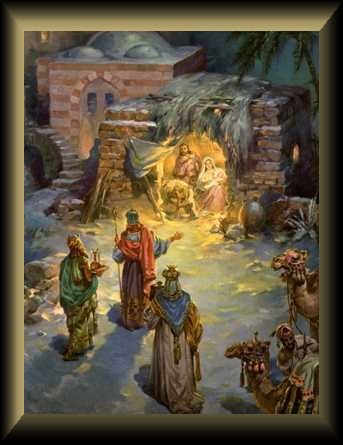
What I see in this trend is the dimming of the light. According to Scripture and Tradition, three "wise men" from the East—quite possibly Chaldea (Iraq) or Persia (Iran)—were the first Gentiles to lay eyes on the Messiah, God-become-man. They were not deterred from doing him homage, and offering him expensive if symbolic gifts, by the lowly circumstances of his birth and by King Herod's grisly reputation for protecting his power at all costs. They had, and acted on, more faith than most Jews had. Of course that was taken by the early Church not only as the occasion of Christ's first "manifestation" or "epiphany" to the world, but as a sign of what was to come several generations after Jesus' birth: the "Gentilization" of the Church. "His own received him not," and so God's promise to Abraham of countless descendants was fulfilled in the churches of the Gentiles. That is more relevant today than in many centuries past because today, people of faith are a smaller minority in the West than they've been since the fall of the Roman Empire. The true disciples of Christ are like the three wise men, drawn by the light to what seems unimpressive, even superstitious, to the majority. But instead of using Epiphany to emphasize the themes of light in darkness and majesty in humility, we are steadily sandwiching it into oblivion.

Kyrie, eleison.

When the disputed question is which question is to be disputed

Over at Disputations, Tom Kreitzberg has a thoughtful post entitled Could you repeat the question? written largely in response to my post of Thursday the 4th entitled "Yes, and?". I had written that "... it is possible for a Catholic to disagree with the pope and the bishops about when conditions justifying the death penalty are present, without thereby being a bad Catholic. One might still be wrong, but one is not a bad Catholic just for being wrong in that way." Tom remarks:

What Mike writes is, of course, absolutely true, and I hope you remember it the next time you're taking a test in a for-credit course on Catholicism.

But when you're not taking a test in a for-credit course on Catholicism, I hope you say, "Frankly, I care a lot more about whether I'm wrong than about whether I'm a bad Catholic." Being a bad Catholic is a question of rules. "But is is true?" is a question of virtue.

Tom definitely has a point. In youth I taught myself Catholicism "to the test," and at the time I gave that more importance than it merits. I always did great in catechism and loved it, but the nuns never considered me virtuous enough even to make it to the applicant list for service as an altar boy. Later, as part of my college quest to enter a seminary, I took an extensive and tricky "Catholic orthodoxy test" given by a couple of friends studying there and almost identical to one they themselves had been given. I scored 100%. I should not have been as surprised as I was that the higher-ups found that almost irrelevant to determining my suitability for admission. Apparently, however, they found it quite relevant to determining my suitability to teach there—which they hired me to do as an adjunct, five years after having denied me admission as a student.


Even so, I believe Tom is largely missing the main point at hand. It is of course perfectly true that the question "Is one a bad Catholic for disagreeing with the bishops about topic P?" is quite distinct from, and subordinate to, the question "Is what the bishops say about P true?" But the two are nonetheless related; and if one reflexively treats the latter question as merely a matter of opinion, then one will sometimes find oneself failing to give the former question the importance it truly merits. That's because the latter is sometimes to be answered precisely by answering the former. In cases when what the bishops say about P calls for "the assent of faith" from Catholics, then the question whether what they say is true is already answered for Catholics. In cases where what the bishops say about P calls for "religious submission of intellect and will" from Catholics, then Catholics must treat what the bishops say as though it is true even if it might later turn out to be false. Only in cases where what the bishops say about P calls for neither kind of adherence is the latter question worth considering without the former.

The most important quaestio disputanda here, then, is precisely how one is to tell when what the bishops say does or does not call for either the assent of faith or religous submission. One might say that such a question betrays a quasi-pharisaical concern for getting the "rules" down pat. In some cases, it may well do that. But it is precisely the question underlying the debate between Paul of 153: Catholic Deep Fishing and myself. And its importance is quite objective, irrespective of the motives of some who raise it.

Friday, January 05, 2007

St. John Neumann, "the little bishop"

Actual photo (1854)

American Catholics don't seem to realize how important this saint is for today. I myself realized only last night, just before retiring, that his feast was yesterday, when he received only the usual perfunctory mention in a few corners of Catholic cyberspace; that's why I've backdated this post to the 5th. Yet not only he is the only male American citizen (naturalized) ever to be canonized; he is the only American bishop ever to be canonized. At a time when Catholic bishops as a class are even less admired than men in general in this country, we need to sit up, take note of his example, and seek his help.

Neumann is a man, and a bishop, after my own heart. He emigrated from Bohemia to North America as a recent seminary graduate because, his own country having too many priests, his bishop would not ordain him. But the Western Hemisphere had too few and was appealing to the Church in Europe to send 'em over. He answered without hesitation and was ordained by Archbishop Kenrick of Baltimore. Bright, but of a more practical than intellectual bent, he mastered six languages for purely pastoral purposes. He lived and worked without complaint in conditions that no American bishop today would envision for himself; most would indeed regard them as unacceptable for virtually anybody. He joined the Redemptorists, a relatively young, Italian-based order that had only recently sent members to America, because he felt the need to live in community. Soon thereafter, Kenrick got Pope Pius IX to make Neumann Bishop of Philadelphia over the candidate's vociferous protests and appeals. Once there, Bishop Neumann grew the local church like kudzu grows itself, with the number of Catholic schools going from one to over a hundred. He died in 1860, at 49, having spent his health in service of what was still "missionary" territory for the Church. In the 20th century, three miracles were recognized by the Vatican as evidence for his canonization, formalized by Pope Paul VI in 1977.

That date was perfect for the purpose. It was a time when the Catholic Church in North America was in almost complete disarray. Following the lead of many theologians and clergy, the laity had rejected Humanae Vitae and largely reserved to themselves the right to decide which teachings of the Church they would be bound by. We're still living with that problem. Many priests and religious were abandoning their vocations; new vocations were at an all-time low; and we now know that clerical sexual abuse of minors, mostly adolescent boys, was at its height. We're living now with the effects of all that too. Just the time for the example and intercession of St. John Neumann.

Unfortunately, the point does not seem to have been taken yet. While vocations have crept upward in the most conservative American dioceses, thanks to John Paul II and orthodox bishops, the institutionalized hypocrisy about sexual sin remains in place. Most laity fornicate and contracept without any pang of conscience; serious fasting and penance seem neurotic old hat to most, when thought of at all; the Church seems divided, like the Anglican communion, into traditionalist, progressive, and squishy-middle sectors. The response of the bishops as a whole to the sex-abuse scandal has been to impose rigid bureaucratic and legal safeguards only on those under them, not on themselves. And this despite the fact that, since the scandal broke forth fully in 2002, nearly a dozen bishops have been either deposed or demoted for sexual improprieties. Far from spreading with vitality, the Church is hobbled by payouts resulting from civil judgments in the countless sex-abuse cases. Yet there has been no visible, collective penance or any other significant change in how the bishops as a whole do business. Regardless of their actual views, many bishops still carry on as well-fed, well-traveled bureaucrats. The current president of the USCCB, unlike the Vatican, does not even think that priests of homosexual orientation pose any special problem. In that attitude, he reflects chancery culture in far too many dioceses.

I'm sure that St. John Neumann would be turning in his grave if his soul were not in heaven interceding for us. His intercession would be more effective if we sought it more. Little as he was in stature and remains in reputation, we would seek his intercession more if we understood how well he represents the opposite of what American Catholics in general, and their bishops in particular, have become.

St. John Neumann, pray for us.

The scope of "prudential" dissent for Catholics

My post yesterday "Yes, and...?" consisted mostly of support for Prof. Robert Miller's point, in First Things, that Catholics may legitimately dissent from moral judgments made by Church leaders, including the pope, if and when those judgments themselves depend on "empirical" judgments that may reasonably be disputed. The issue is very important for Catholic life; the latest occasion for making our point was the execution of Saddam Hussein, a matter on whose moral status Catholics disagree. Speaking for the Vatican, Cardinal Renato Martino condemned that act as failing to satisfy the only sort of condition, specified in CCC §2267, for just application of the death penalty. Now I happen to agree with Martino's conclusion, if not with all his arguments; but I also insist that Catholics as such may legitimately disagree. Having demurred in comments on this blog, Paul of 153: Catholic Deep Fishing has argued in greater detail against Miller's broader position. Paul insists that Catholic must submit to judgments such as Martino's, which certainly reflects the Pope's. My aim here is to reply to that argument.

The key section of Paul's post begins with a quotation from then-Cardinal Ratzinger's Doctrinal Commentary on the Professio Fidei. Referring to that class of teachings which are "non-definitive" but which still require "religious submission of will and intellect" from Catholics, the Commentary says (emphasis added):

A proposition contrary to these doctrines can be qualified as erroneous or, in the case of teachings of the prudential order, as rash or dangerous and therefore "tuto doceri non potest". [Trans: "not able to be taught safely"].

The type of proposition at issue in this debate is, precisely, a "teaching of the prudential order" to the effect that the conditions for just application of the death penalty are not present even in the case of a mass murderer and head of state like Saddam. But the text of the Commentary gives no specific examples of such propositions; it contents itself rather with restating the general point made in prior magisterial documents, including Lumen Gentium:

...one can point in general to teachings set forth by the authentic ordinary Magisterium in a non-definitive way, which require degrees of adherence differentiated according to the mind and the will manifested; this is shown especially by the nature of the documents, by the frequent repetition of the same doctrine, or by the tenor of the verbal expression.

One might well ask why no specific examples of such teachings are given, even though numerous examples of definitive teaching had previously been given. The answer is that, in certain cases, neither bishops nor theologians are entirely clear about exactly which "non-definitive" teachings call for which "degrees of adherence." In some cases, of course, there can and ought to be such clarity; but since what I believe those cases to be is irrelevant here, we do best to focus on teachings of the "prudential order."

Consider what Cardinal Ratzinger wrote to the U.S. bishops during the 2004 election campaign: (emphasis added):

Not all moral issues have the same moral weight as abortion and euthanasia. For example, if a Catholic were to be at odds with the Holy Father on the application of capital punishment or on the decision to wage war, he would not for that reason be considered unworthy to present himself to receive Holy Communion. While the Church exhorts civil authorities to seek peace, not war, and to exercise discretion and mercy in imposing punishment on criminals, it may still be permissible to take up arms to repel an aggressor or to have recourse to capital punishment. There may be a legitimate diversity of opinion even among Catholics about waging war and applying the death penalty, but not however with regard to abortion and euthanasia.

Very well: there cannot be legitimate diversity of opinion about whether abortion or euthanasia are ever permissible, but there can be such diversity about war and capital punishment. Of course it is not in dispute that Catholics as such must render religious submission of will and intellect to the moral criteria set forth by the ordinary magisterium of the pope and the bishops, as expressed in the CCC, for just war and capital punishment. They surely must. The only question at issue is whether Catholics as such must render the the same submission for those prudential judgments according to which this or that instance of war or capital punishment is just (or unjust) according to the definitive moral criteria that everybody agrees are binding.

The answer, it seems to me, is clearly no. An opinion contrary to the Pope's about such an instance would certainly be tuto doceri non potest, to use the phrase of the Doctrinal Commentary; but nobody, to my knowledge, is suggesting that such opinions be "taught" as ones that Catholics as such ought to accept. Such opinions are not teachings but, precisely, prudential judgments that can legitimately vary among individuals. That's exactly why Cardinal Ratzinger, now Pope Benedict XVI, could write what he did to the U.S. bishops.

Yet Paul seems to have a problem with such reasoning. After quoting Miller thus:

When the bishops go further...and make claims about whether actual circumstances in the world are such as to make some particular application of the death penalty right or wrong, we are in the realm of empirical judgments about circumstances, and these judgments are not matters of faith and morals

Paul says:

And that is a most bizarre claim. The Church has been judging circumstances throughout its history. How could confessions ever work, if the priest had no authority to decide if a sin had or had not been committed, based on the circumstances? How could the validity of sacraments ever be judged, if circumstances could not be judged? And there are many other such judgments regularly made by the Church, to which the appropriate attitude of a Catholic is religious submission of will and intellect.

And this submission of will does apply to capital punishment; since a Pope in an encyclical, and subsequently the Church in its Catechism, has judged that the necessity of capital punishment in modern times and circumstances is "very rare". That is a teaching of the prudential order, and not merely an opinion to be given respect.

Yet Paul's argument is a simple non-sequitur. From the fact that the Church must, in some cases, make empirical judgments in the course of making prudential judgments that call for religious submission, it does not follow that the empirical judgments of her duly constituted leaders today in all cases, and therefore the cases of war and capital punishment, call for such submission. For example, supposing that the circumstances today which would warrant capital punishment are very rare, they might not be quite so rare as Pope John Paul II believed. One in a hundred thousand cases, perhaps. But there are hundreds if not thousands of murders committed every day in the world; and one is not ipso facto a bad Catholic if one argues that deposed dictators who not only ruled by mass murder but also retain many violent followers are just such one-in-a-hundred-thousand case.

Again, I happen to agree with the Vatican about Saddam's execution. But I don't believe that I or anybody else must agree. The argument Paul gives to the contrary would work just as well as an argument that Catholics in the Middle Ages and beyond were obligated to render religious submission of intellect and will to the proposition, maintained by Thomas Aquinas and applied by many popes, that obstinate, public heretics should be tortured and/or executed as a necessity for the common good. Surely such an argument is more than Paul wants.

Thursday, January 04, 2007

The Duke "rape" case

As Thomas Sowell has pointed out, the collapsing Duke rape case is all about the career of the prosecutor, Michael Nifong. At first the case was about advancing his career. Now it's about saving it: after being caught lying, he'll be lucky to avoid disbarment. But the explanation why he fadged up this thing in order to advance his career says some disturbing things about our society.

Nifong is DA in Durham, NC, a city where I have intermittently worked. Its voters are mostly liberal, black, or both in a relatively conservative state. An interim DA in danger of losing last fall's election to an opponent whom he had once fired from the DA's office, Nifong didn't want to end up being fired himself. So as a way of appealing to the voters, he took the stripper's allegations at face value, played them up in the media, and suppressed all contrary evidence. The disgusting thing about that was not merely that he was willing to destroy the lives of four young men to secure his position. Crushing people on one's way to the top is so common that outrage about it in this case could only be selective. That says something bad enough about our society. What's even worse is that he had good reason to think he could get away with it—and almost did.

The four young men he charged are white and privileged: athletes at a top university. Their alleged victim was a black female. I don't think the students were admirable: hiring a stripper for a boozy party is not the sort of thing that calls for defense. But Nifong's constituency was not only ready but all too eager to believe that the students were guilty; if it hadn't been, Nifong would not have got the case off the ground and might not even have been elected. As things turned out, his demogoguing of the case turned off enough voters to make turnout higher, and the election closer, than such things normally are. But does anybody imagine that a rape case would have been an issue in that election if the race and class of those involved had been the reverse of what they are? A few generations ago, it sure would have: a a group of black men alleged to have raped a privileged white woman would have been lucky to make it to trial alive, much less be exonerated. But nowadays the pendulum has swung so far in the other direction that the Duke students were the ones whose lives were almost destroyed, and will have been seriously disrupted even in the best-case scenario. The injustice Nifong did to them is of the same kind as the old kind. Thank God it wasn't of the same degree: they weren't lynched, and in the end enough people care about the truth to have stopped the injustice.

Still, this is not just about race and class. I don't think it's even primarily about that. It's primarily about gender. Why is it that a woman known to be sexually promiscuous can make a rape accusation against men with no criminal record and be taken seriously enough to drag a case out for months when even the prosecutor knows there is no good supporting evidence for the prosecution? The explanation is that nowadays—whether it's in the family courts, the media, or just in broken relationships—men are presumed guilty until proven innocent and women are presumed innocent until proven guilty. Such is the dark side of the gains made by the women's movement over the last generation. The idea seems to be that men are dogs, and that's bad, while it's good for women to be bitches, even though they aren't, really.

Still, I've begun to observe that it isn't just men who are getting tired of that cultural meme. Millions of women, mirabile dictu, still love the men in their lives and are disgusted by what's become the fashionable demonization of men. Perhaps one can hope for another swing of the pendulum. One must pray for it.

Yes, and...?

Over at First Things, law professor Robert T. Miller makes a point that I have often made about the death penalty and indeed assumed in my recent reflections on the hanging of Saddam. Since the point is of quite general application even as it often escapes people, it's worth making yet again.

Thus (with emphasis added):

Consider this from the Catechism of the Catholic Church (no. 2267):

Assuming that the guilty party’s identity and responsibility have been fully determined, the traditional teaching of the Church does not exclude recourse to the death penalty, if this is the only possible way of effectively defending human lives against the unjust aggressor.

If, however, non-lethal means are sufficient to defend and protect people’s safety from the aggressor, authority will limit itself to such means, as these are more in keeping with the concrete conditions of the common good and more in conformity to the dignity of the human person.

Today, in fact, as a consequence of the possibilities which the state has for effectively preventing crime, by rendering one who has committed an offense incapable of doing harm—without definitely taking away from him the possibility of redeeming himself—the cases in which the execution of the offender is an absolute necessity “are very rare, if not practically nonexistent.”

The first two sentences concern morals, but the third sentence is an empirical claim about the state of the world and so is not about morals. The first two sentences are thus, at the very least, doctrina catholica, which Catholics must accept with a religious submission of will and intellect. The third sentence, however, is not; it need only be respected and considered in forming one’s conscience. Catholics need not ultimately agree with it. Compare Justice Antonin Scalia’s conclusion in First Things from 2002.

That is quite true. Thus, it is possible for a Catholic to disagree with the pope and the bishops about when conditions justifying the death penalty are present, without thereby being a bad Catholic. One might still be wrong, but one is not a bad Catholic just for being wrong in that way. Similarly, it is possible to disagree with the pope and the bishops about whether a given war actually satisfies the moral criteria for a just war; but one's being wrong makes one a bad Catholic in that respect only if one rejects one or more of the criteria themselves, as distinct from a particular judgment that one or more of them is, or fails to be, satisfied in the concrete. In both cases, we're dealing with empirical judgments about circumstances; and in making such judgments, reasonable Catholics, like reasonable people generally, can reasonably disagree.

Miller's larger point is this:

Bishops, like everyone else, prefer it when people agree with them, and so some bishops are tempted to enunciate positions and invest them with the authority of their office, even when those positions go beyond matters of faith and morals and depend on particular, even idiosyncratic, views about empirical circumstances. There is a danger, in other words, of bishops leveraging their legitimate authority in faith and morals into the political arena by implicitly passing off empirical judgments as if they were teachings on faith and morals commanding the assent of faithful Catholics.

That is for the most part true, and Miller's post is worth reading just for his argument to that effect. But I am amazed time and again by how widely the distinction Miller invokes above—between moral teachings that bind and empirical judgments that don't—is ignored.

From (politically) liberal Catholics, for example, I've often heard that many (politically) conservative Catholics are not good Catholics because they disagree with the present and the previous pope about certain cases of the death penalty and of war. Today it's Saddam and Iraq; years ago it was Timothy McVeigh and Iraq; still further back, it was Ted Bundy and Grenada. (They don't seem to mind the prospect of armed conflict between the Sudanese government and the U.N. in Darfur, however, even though there's nothing at stake strategically for us there. It would be humanitarian intervention, after all. Whatever. Kosovo redux.) For that matter, one sometimes hears from liberal Catholics that if one disagrees with the U.S. bishops about immigration or the desirability of tax-funded universal health care, one is a bad Catholic. All such criticisms simply fail to observe the distinction Miller is undeniably right to press: it's one thing to render the assent of faith or religious submission to articles of faith and moral principles; one must do that; but the question which political measures best apply the principles, while balancing other duties and rights, is another thing altogether. I don't quite understand why the distinction seems lost on many otherwise intelligent people.

Conservative Catholics are hardly immune from the disease in question, especially on economic matters. I distinctly recall Bill Buckley's reaction, over four decades ago, to John XXIII's Mater et Magistra: "Mater sì, Magistra no." Conservatives often say that the Church should stay out of the boardroom—save, that is, for reiterating the Fifth Commandment—just as liberals often say the Church should stay out of the bedroom—unless of course the bedroom is occupied by a minor and a member of the clergy. But there remains an imbalance. The conservatives' difficulty in forming their consciences according to Church teaching is not as radical as the liberals'.

For example, the conservatives in question generally do not reject the moral principles that have recognizably and consistently belonged to "the social doctrine of the Church," i.e. those moral teachings pertaining most directly to politics. What they do often dispute are particular applications thereof, which depend on empirical judgments about the likely effects of this or that policy. I think they're wrong sometimes, but they're not wrong in such a way as to be certifiably bad Catholics; it's a matter of poor empirical judgment, clouded perhaps by self-interest and cultural prejudice. Liberals, however, go further. They reject moral teachings that have been constantly held and taught from the beginning by the ordinary and universal magisterium: some reject the teaching on abortion; many on sodomy; almost all on contraception. Even the immorality of sexual congress with minors by adults, so apparently clear to all sides today, draws only selective outrage from the Left, whether religious or secular. I have heard no howls from liberals about the recent spate of female teachers raping male students, or indeed about the sexual abuse of minors in the public schools generally; but I do hear a fair amount about the sexual abuse of girls in the home by their fathers or stepfathers, and about the date-rape of high-school girls. It seems that the seriousness of the crime depends both on the gender of the perps and the prior victimhood credentials of the victims. That is classic ideological thinking, which has no place in theology.

At a time when their moral credibility is at an all-time low, the Catholic bishops would do well in political terms to focus on the irreformable principles of faith and morals while leaving to the laity such applications as depend on circumstances. Thus they should continue to make clear that abortion, embryonic stem-cell research, and gay marriage are great and intrinsic evils in which Catholics may not materially cooperate; on other matters, such as the death penalty, war, and care for the poor, they should say only what the Church has always said, leaving the empirical judgments of political policy to those whose business that is.

The Pagels story: getting worse and worse

Last year I wrote a post about a bit of scholarly legerdemain by Professor Elaine Pagels, whom I described, correctly, as "the media's go-to person" for the nest of historical and theological topics associated with The DaVinci Code, Gnosticism, and indeed the early Church generally. Now, another flap about her scholarship has made its appearance in the blogosphere. It gets worse and worse. I don't enjoy chronicling all this, since I like Elaine, having once been her student and been treated fairly by her. But as I feel strongly that her influence on the general public has been, on the whole, pernicious, I think it important to make people aware of her reputation among her peers.

Fr. Robert Hart of The Continuum, in a post with the characteristically understated title "Lies and Slander," has exposed two other such piece of deception by Pagels and defended himself from one erudite commenter's charge of tu quoque. Good for him. What I most enjoyed was the following quotation in the combox from his brother, the Orthodox theologian David B. Hart, whom I presume has given consent to its being made public:

It might be germane to the conversation to point out that, in the academic world (of which, if you don't mind my saying so, I am a somewhat veteran witness), Pagels is often an object of ridicule, but never of respect. Even at Princeton her colleagues hold her in scorn as a silly popularizer who entirely distorts the history she discusses. And it has not gone unnoticed by her students that--for a reputed expert in ancient Gnostic documents--she owns a very small knowledge of either Greek or Coptic. In my year's sojourn at Princeton, I heard many barbed remarks about the quality of her "scholarship" from the faculty of the divinity school; not once did I hear anyone undertake to defend her. Anyway, since she writes about a period I know quite well (the languages pertinent to which, moreover, I can actually read), I feel free to assert that what she really knows about the early Church or the Gnostics could fit quite comfortably on the back of her calling card. I'm surprised anyone would be so silly as to leap into the breach to defend her; she is--and has long been known to be--a charlatan.

Wow. The next time you hear Pagels cited as an authority against the Church, keep all that in mind.

St. Elizabeth Ann Seton

Since the elder of my daughters is named "Elizabeth," I sometimes invoke saints of that name for her. Today's saint is one of them. She is now of more general interest than ever, when many faithful Christians belonging to The Episcopal Church (TEC) find themselves unable to be reconciled to the changes that have occurred in that denomination.

Child of a wealthy, socially prominent New York Episcopalian family, St. Elizabeth paid a huge price for her conversion to Catholicism after her husband's death while the family was in Pisa, Italy. A bill was even introduced into the New York State Legislature to have her expelled from the state. While anti-Catholicism is not as virulent today, it is no accident that far more Episcopalians who reject what TEC has become are forming schismatic churches than crossing the Tiber. Protestantism has a mental DNA all its own, which is very hard to shed—especially for Protestants who think they're really Catholic anyhow, or at least more Catholic than the "Roman" Church. But as Elizabeth's example showed, and as the examples of a few readers of this blog show even today, for God all things are possible.

St. Elizabeth, pray for us.

Wednesday, January 03, 2007

Communion vs. Consumption

Over at Cosmos, Liturgy, Sex, theologian David Delaney has a fascinating post on a distinction which I'd call that between the attitude of holiness and the attitude of sin. The whole thing, though but a sketch of what could be a massive project, is well worth reading.

Basically, Delaney's idea is that holiness is about communion, in which the good of life is received and returned as a gift; sin is about consumption, in which the good of life is taken and hoarded. The first sin, which was one of consumption, created a situation in which man could be restored to communion with God only by a different kind of consumption.

Thus:

Adam and Eve’s fall is depicted in terms of consuming the fruit of the knowledge of good and evil. This is what I mean. Though it is not a necessary result, creation arises out of the overflowing of Trinitarian Love, from total Self-gift. Created being, because it’s archetype is in God, must reflect God’s perfection in some manner. The Early Church Fathers, especially Pseudo-Dionysius, characterized the manner the entire cosmos reflects its Trinitarian archetype as the eternal cosmic return to the Father, where all that was given by the Father will ultimately all return to Him. They saw this truth firmly revealed in Scripture when all creation will be recapitulated in Christ.

Adam and Eve, who on behalf of all of visible creation, were called to freely complete this eternal return after the archetype of Trinitarian love, by totally giving themselves back to God in trusting thanksgiving for their existence. This free act of total self-gift was destroyed when instead of trusting in God and receiving as a gift all He intended to give them for their happiness, they decided they needed to “take” instead. They were tempted to believe God was withholding from them something that they needed for their fulfillment, for their ultimate happiness. This taking seems to be presented as the antithesis of the gift. Instead of returning themselves to God and bringing forth a communion with Him, they chose another path. Notice, they not only take, but they consume. Consumption has now replaced communion as the dominant mode by which mankind is motivated and, thereby, so often deceived into replacing the true good with apparent goods.

With the Fall, we lost original communion, original grace. God reconciled this grave situation through a new creation. To transcend the infinite gulf between God and man, a rupture opened up by an act of consumption, indicating self-trust at the expense of divine trust, God became Man. On behalf of all creation, the God-Man returned to the Father all He was given, which included His human life. The Cross is, par excellence, a manifestation of Trinitarian love. It is also the singular saving act of human total self-gift because it has an infinite character due to its having been performed by a divine Person. With the Cross, humanity now has renewed access to divine nature. However, this access comes only through each person’s incorporation into the Incarnation. We must become new creations as Jesus told Nicodemus and as St. Paul advised, through Baptism. Baptism incorporates us into the Mystical Body of Christ, which is the Catholic Church. In the Church we are wedded to divinity through the Bridegroom and through which we become what we eat. We are the Mystical Body of Christ because we consume Him, Body, Blood, Soul, and Divinity in the Eucharist. Only by this act of consumption can we have real communion.

Such a way of thematizing the Fall and the Redemption is especially relevant in our consumerist society, in which many babies are killed in the womb for convenience and people themselves are in danger of becoming commodities.


Hat tip to Fr. Al Kimel.

I wonder as I wander...

Sorry for the three-day hiatus, dear readers. Perhaps the explanation will be of general interest.

After my last post I drove to DC to see some friends in Communion and Liberation as well as my brother, who lives not far away in Maryland. I attended a marvelous, family-oriented New-Year's-Eve party at the boys' school run and largely attended by CL folk, and had a good talk with my sibling the following morning. I returned the night of New Years' Day with a rip-roaring cold, and of course had to work a 12-hour day starting at 6:30 the following morning. (Since, as a wage slave, I only get paid when I work, I had little choice.) Of course I was destroyed by last night, but managed anyhow to poke into a CL "School of Community" conference call coordinated by my DC hostess. Immediately afterwards, I got a call from my landlord informing me that the month-to-month lease under which my roommate and I live here will end by the end of the month. Knowing I have to move yet again, I took a strong dose of NyQuil, went to bed, and stayed there until now.

On my enforced day off, I wonder and ask the Lord how this latest housing problem will constitute an opportunity. While paying child support, I cannot save enough to come up with a deposit for an apartment in addition to the rent, both of which are always required up front. This is why I have not had a stable housing situation since moving to Charlotte last August. And that in turn is why I have found it impossible to do serious, peer-reviewable, publishable academic work, which I have long realized is necessary if I am to return to academia. It seems quite a dilemma and leaves me quite frustrated—if I let it.

But the Holy Spirit often has a way of making us think outside the box. The CL people in particular give me a sense of "possibilities," to use a pregnant phrase of Star Trek's Mr. Spock. In them I truly experience Christ in his Mystical Body, which I generally do not in the usual parish settings. They are far more caring, and eager to support each other, than I had realized. There's a guy in prison here in North Carolina who is visited regularly by them and has converted, sincerely, because of them. A good number of them seem to work either professionally or as volunteers in religious education, which I once did and wouldn't mind doing again. As a community they are, I believe, what the pre-Constantinian Church was. And I have seen "liberation" in them from much of what oppresses even privileged people in the developed countries today. I thank them for what they are to me.

There are other good people here in Charlotte, including my boss, but especially the folk gathered round the Benedictines at Belmont Abbey. I generally worship there on Sunday and, from the top down, they have encouraged me to get more involved there, possibly even in an employed capacity. I know I am not alone, that I am in Christ, who urges us not to be worry and be cast down by the anxieties of this world.

As the new year begins, I also want to take this opportunity to thank the people online who have helped me in various ways: with financial help to rebuild my computer last summer; with encouragement in my struggles; with dialogue and even debate that keep my intellect sharp at a time when it could be clouded; and with recommendations that have enabled me to get a few little things published. You too are a community to me. I pray daily for all the communities in my life. We can "do all things in Christ who strengthens" us.

In keeping with the general tone of prophecy today, I believe the world is approaching a time of great tribulation, which God envisions as a purification. Perhaps my own struggles are meant to help to prepare me for that. All who struggle, and even those lucky enough not to be struggling right now, might want to consider that possibility.