"You shall know the truth, and the truth shall make you odd." ~Flannery O'Connor

Monday, January 06, 2014

Christmas: the Eternal embraces the Finite

The following is a Christmas-season meditation by Susan Anne, who will be joining me on this blog as a co-author.

Beginnings and endings, finite measures of years meted out for us again and again, season after season, generation after generation, age after age - all amount to little more than markers of time. The clock strikes and we call it an hour; a calendar page turns while a bud blooms or leaves fall or icicles grow, and we call it a season. A baby is born and we say it is a new generation; teens pound 
the sidewalk with their pants falling off and we say it is a lost generation; a grandfather dies and we say that he belonged to a good generation. Fashions, inventions, and empires rise and fall, and we call it an age.

In a world surrounded by measures of things begun and things ended, it is easy to forget the timeless eternity awaiting us as immortal souls. We only sojourn here, obedient to our positions on the musical score of life on earth, like notes on parchment, passionately scrawled onto staffs of the greatest symphony ever written. Yet the master composer is timeless in His timing, eternal in His positioning of notes, and unlimited in His creations.

We long for the infinite and seek to imitate it in every way; we build the tallest buildings, run the fastest mile, lift the heaviest weights, earn the most money, and do the best we can in achieving all our goals. Measures of time assist our journey by giving us a sense of stability, for which of us can really comprehend eternity? Which of us does not shudder at the thought that when this life is done, whatever comes next is for EVER?

Let us take into consideration the timelessness of Jesus Christ come to earth as a baby in a manger. Now is the season in which the eternal embraces the finite life of man; now is the generation of Life without end, the offshoot of Jesse; now is the age of Faith, Hope, and Love.

Wishing you all a very Happy New Year, with many blessings on your journey. Thank you all for being with me in varying degrees on mine. God Bless you  Happy New Year!

Tuesday, December 17, 2013

Yes, but what does it MEAN?

I'm taking the occasion of Pope Francis' birthday--which he's celebrating by inviting some homeless people to breakfast--to talk about the hermeneutical challenge he seems to pose to so many traditionalist and conservative Catholics. Lapsed Catholics and standard-issue worldlings seem to love him, as if they just knew that his gestures and words are those of the kindly, sprightly grandpa they want in a pope. For such people, this pope is less about ideas than about their feeling understood and sought out. And they're correct to feel that way. But the very things causing the prodigal children to feel that way leave many of us older brothers and sisters in the house feeling suspicious. That's inevitable, and I'm not judging anybody in particular. But I do want to focus on what seems to have upset traditionalist and conservative Catholics the most in the new apostolic exhortation, Evangelii Gaudium.

EG seems addressed primarily to Catholic "intentional disciples" and pastoral workers. It explains why evangelization is and ought to be a joy; yet it spends at least as much time explaining various ways in which the joy gets killed, or is never even allowed to arise. To me, it seems that the chief of those is what Francis calls "spiritual worldliness" in §93-4. Before we get to that, note how he describes, in §82-3, its manifestation in the main audience he's addressing:

The problem is not always an excess of activity, but rather activity undertaken badly, without adequate motivation, without a spirituality which would permeate it and make it pleasurable.  As a result, work becomes more tiring than necessary, even leading at times to illness. Far from a content and happy tiredness, this is a tense, burdensome, dissatisfying and, in the end, unbearable fatigue. This pastoral acedia can be caused by a number of  things.  Some fall into it because they throw themselves into unrealistic projects and are not satisfied simply to do what they reasonably can.  Others, because they lack the patience to allow processes to mature; they want everything to fall from heaven. Others, because they are attached to a few projects or vain dreams of  success. Others, because they have lost real contract with people and so depersonalize their work that they are more concerned with the road map than with the journey itself. Others fall into acedia because they are unable to wait; they want to dominate the rhythm of life. Today’s obsession with immediate results makes it hard for pastoral workers to tolerate anything that smacks of  disagreement, possible failure, criticism, the cross.
And so the biggest threat of all gradually takes shape: “the gray pragmatism of  the daily life of the Church, in which all appears to proceed normally, while in reality faith is wearing down and degenerating into small-mindedness”. A tomb psychology thus develops and slowly transforms Christians into mummies in a museum.  Disillusioned with reality, with the Church and with themselves, they experience a constant temptation to cling to a faint melancholy, lacking in hope, which seizes the heart like “the most precious of the devil’s potions”. Called to radiate light and communicate life, in the end they are caught up in things that generate only darkness and inner weariness, and slowly consume all zeal for the apostolate.  For all this, I repeat: Let us not allow ourselves to be robbed of the joy of evangelization! [Footnotes omitted; emphasis added.]
None of that is hard to understand for anybody who's been active in ecclesial ministry for any length of time. In fact, the bolded passage describes many of the educated Catholics I know, including myself. What does seem hard for some to understand, though, is how the Pope describes the underlying problem.

He calls that problem "spiritual worldliness." Thus:

93.   Spiritual worldliness, which hides behind the appearance of  piety and even love for the Church, consists in seeking not the Lord’s glory but  human  glory and  personal  well-being. It is what the Lord reprimanded the Pharisees for: “How can you believe, who receive glory from one another and do not seek the glory that comes from the only God?” (Jn 5:44). It is a subtle way of seeking one’s “own interests, not those of  Jesus Christ” (Phil 2:21).   It takes on many forms, depending on the kinds of persons and groups into which it seeps.  Since it is based on carefully cultivated appearances, it is not always linked to outward sin; from without, everything appears as it should be.  But if it were to seep into the Church, “it would be infinitely more disastrous than any other worldliness which is simply moral”.  
94.   This  worldliness can be fuelled in two deeply interrelated ways. One is the attraction of gnosticism, a purely subjective faith whose only interest is a certain experience or a set of ideas and bits of information which are meant to console and enlighten, but which ultimately keep one imprisoned in his or her own thoughts and feelings. The other is the self-absorbed promethean neopelagianism of  those who ultimately trust only in their own powers and feel superior to others because they observe certain rules or remain intransigently faithful to a particular Catholic style from the past. A supposed soundness of doctrine or discipline leads instead to a narcissistic and authoritarian elitism, whereby instead of evangelizing, one analyzes and classifies others, and instead of  opening the door to grace, one exhausts his or her energies in inspecting and verifying. In neither case is one really concerned about Jesus Christ or others. These are manifestations of an anthropocentric immanentism.  It is impossible to think that a genuine evangelizing thrust could emerge from these adulterated forms of Christianity. 
95.    This insidious worldliness is evident in a number of attitudes which appear opposed, yet all have the same pretence of  “taking over the space of the Church”.  In some people we see an  ostentatious  preoccupation for the liturgy, for doctrine and for the Church’s prestige, but without any concern that the Gospel have a real impact on God’s faithful people and the concrete needs of the present time.  In this way, the life of the Church turns into a museum piece or something which is the property of a select few. In others, this spiritual worldliness lurks behind a fascination with social and political gain, or pride in their ability to manage practical affairs, or an obsession with programmes of  self-help and self-realization.  It can also translate into a concern to be seen, into a social life full of appearances, meetings, dinners and receptions. It can also lead to a business mentality, caught up with management, statistics, plans and evaluations whose principal beneficiary is not God’s people but the Church as an institution.  The mark of Christ, incarnate, crucified and risen, is not present; closed and elite groups are formed, and no effort is made to go forth and seek out those who are distant or the immense multitudes who thirst for Christ. Evangelical fervour is replaced by the empty pleasure of  complacency and self-indulgence.
I've noticed a curious contrast in the reactions to that account of spiritual worldliness among intentional disciples and pastoral workers: "progressive" Catholics don't seem to feel targeted in those passages, but conservative and traditionalist Catholics do.  Why is that?

Clearly, as many "progressives" are being criticized as their opposites.  It's not as though the Pope isn't even-handed. There is, for instance, a certain faith-style that is indeed "gnostic" in a "subjective" sense: people believing what makes them feel good and smart, but which doesn't really change anything, least of all themselves. I know many baptized Catholics like that, especially ones who are into this-or-that "self-help" or "self-realization" program; and many of them are proggies. Some proggies are also being criticized implicitly when the Pope talks about "fascination with social or political gain." For instance, many proggie-Catholic academics are far more concerned about being considered respectable among their secular peers and friends than about witnessing to Truth. And last year, many Catholics bought the absurd argument that voting for Obama was being more effectively "pro-life" than voting for a candidate who, if elected, might reduce the rate of growth in spending on various social programs. Of course, it's also quite possible to be theologically and/or politically to the "right" and be guilty of "gnosticism" and/or of politicizing the Faith too. But that's the point. The Pope is less interested in singling out one "wing" as more guilty of spiritual worldliness than another than in warning us of a spiritual danger which is no respecter of ideology.

Yet for some reason, Catholics more toward the rightward end of the spectrum are in conniptions about EG. That's due mainly to two things. One is what it says about economics, the reaction to which strikes me as overblown, based in part on mistranslation. The other is this sizzler: "
the self-absorbed promethean neopelagianism of those who ultimately trust only in their own powers and feel superior to others because they observe certain rules or remain intransigently faithful to a particular Catholic style from the past. A supposed soundness of doctrine or discipline leads instead to a narcissistic and authoritarian elitism, whereby instead of evangelizing, one analyzes and classifies others, and instead of  opening the door to grace, one exhausts his or her energies in inspecting and verifying." I've encountered a lot of grumbling about that from "right-thinking" Catholics. Fr. Z has even made a bitter joke-mug out of it (depicted above).

Of course they claim it's unclear: "What does he mean by 'self-absorbed promethean neopelagianism'? That's just nasty rhetoric with no clear thought behind it." But the rest of the quoted description is not nearly so unclear about whom the Pope has in mind when using that phrase. I know such people; one finds them on the Catholic "right," especially among self-described "traditionalists." And when such a person reads the above description, they know they are the target of the criticism, even if they protest that the criticism is unjustified. I don't need to name anybody. Still, there's deep content worth pondering in the phrase '
self-absorbed promethean neopelagianism'.

According to Ben Mann, the notion of "Promethean" theology comes from Thomas Merton, in his book New Man. I've read the relevant chapter and have no doubt that Jorge Mario Bergoglio once did too. With that in mind, I think we can understand 'self-absorbed promethean neopelagianism'
to mean an attitude which inclines certain people to earn their salvation by being rigorously right-thinking and virtuous in spite of God's mean-spirited reluctance to save them or even make life pleasant for them. One finds such an attitude more often on the Catholic "Right" than on the Catholic "Left", because viewing God chiefly as Judge and Taskmaster, from whom the fire of grace and the bliss of salvation must be wrested by force, is much more common on the Right than on the Left. In short, what the Pope is describing is a latter-day Pharisaism.

One does of course find Pharisees on the Catholic Left, not just the Catholic Right. If one is not politically correct enough, or is not reliably Democrat, or even if one prefers more traditional forms of liturgy, one can find oneself the target of much scorn from professional "progressive" Catholics. But I find it most interesting that hardly any proggies seem to feel themselves targeted by any of the Pope's criticisms. Only traddies and conservatives feel hard done by.

I believe that's the work of a high-up (better: low-down) spirit of division. Because proggies and worldlings seem so happy with the Pope--so rightist "thinking" goes--his message must be as much designed to diss us as to please them. And so many of the Pope's ambiguities and infelicities of expression, both formal and informal, are interpreted by some traddie and conservative critics in the worst possible light.

My advice to such people, many of whom are my friends, is this: Calm down. Pray. Stop being so querulous and defensive. Be determined not to become a pawn of the spirit of division. The Pope knows he's not above criticism, and he doesn't hate or disrespect you. In fact, he agrees with you more often than you've been led to think.

Monday, December 02, 2013

Evangelii Gaudium: something to offend just about everybody...

...thank God. Damian Thompson has summed up Evangelii Gaudium well enough as the outline of the Pope Francis "radical" agenda for his papacy. In our politically-obsessed media world, most of the attention has gone to what the new "apostolic exhortation" says about economics. But there's really nothing new there: Paul VI was saying much the same in the 1960s and 70s, and it's fully in keeping with how the "social doctrine of the Church" has developed before and since. Its empirical premises may not all be correct, but that's not a new issue either. What is new, at least to me, is how the Pope rips into what he calls the "spiritual worldliness" of so many Catholics active in the Church.

That must be cauterized so that we can get out of ourselves, encounter Christ afresh, and evangelize with joy. That's what's important here, and radical. Few, be they right, left, or middling, escape the critique. Here's the part that hit me hardest:
93.  Spiritual worldliness, which hides behind the appearance of  piety and even love for the Church, consists in seeking not the Lord’s glory  but  human  glory  and  personal  well-being. It is what the Lord reprimanded the Pharisees for: “How can you believe, who receive glory from one another and do not seek the glory that comes from the only God?” (Jn 5:44). It is a subtle way of seeking one’s “own interests, not those of  Jesus Christ” (Phil 2:21).  It takes on many forms, depending on the kinds of persons and groups into which it seeps. Since it is based on carefully cultivated appearances, it is not always linked to outward sin; from without, everything appears as it should be.  But if it were to seep into the Church, “it would be infinitely more disastrous than any other worldliness which is simply moral”.
94.    This worldliness can  be  fuelled  in  two deeply interrelated ways. One is the attraction of gnosticism, a purely subjective faith whose only interest is a certain experience or a set of ideas and bits of information which are meant to console and enlighten, but which ultimately keep one imprisoned in his or her own thoughts and feelings. The other is the self-absorbed promethean neopelagianism of  those who ultimately trust only in their own powers and feel superior to others because they observe certain rules or remain intransigently faithful to a particular Catholic style from the past. A supposed soundness of doctrine or discipline leads instead to a narcissistic and authoritarian elitism, whereby instead of evangelizing, one analyzes and classifies others, and instead of  opening the door to grace, one exhausts his or her energies in inspecting and verifying. In neither case is one really concerned about Jesus Christ or others. These are manifestations of an anthropocentric immanentism.  It is impossible to think that a genuine evangelizing thrust could emerge from these adulterated forms of Christianity.
95.   This insidious worldliness is evident in a number of attitudes which appear opposed, yet all have the same pretence of  “taking over the space of the Church”.  In some people we see an ostentatious  preoccupation  for the liturgy, for doctrine and for the Church’s prestige, but without any concern that the Gospel have a real impact on God’s faithful people and the concrete needs of the present time.  In this way, the life of the Church turns into a museum piece or something which is the property of a select few. In others, this spiritual worldliness lurks behind a fascination with social and political gain, or pride in their ability to manage practical affairs, or an obsession with programmes of  self-help and self-realization.  It can also translate into a concern to be seen, into a social life full of appearances, meetings, dinners and receptions.  It can also lead to a business mentality, caught up with management, statistics, plans and evaluations whose principal beneficiary is not God’s people but the Church as an institution.   The mark of Christ, incarnate, crucified and risen, is not present; closed and elite groups are formed, and no effort is made to go forth and seek out those who are distant or the immense multitudes who thirst for Christ.  Evangelical fervour is re- placed by the empty pleasure of complacency and self-indulgence.
96.    This way of  thinking also feeds the vainglory of those who are content to have a modicum of power and would rather be the general of a defeated army than a mere private in a unit which continues to fight.  How often we dream up vast apostolic projects, meticulously planned, just like defeated generals! But this is to deny our history as a Church, which is glorious precisely because it is a history of sacrifice, of hopes and daily struggles, of lives spent in service and fidelity to work, tiring as it may be, for all work is “the sweat of our brow”. Instead, we waste time talking about “what needs to be done” – in Span- ish we call this the sin of “habriaqueísmo” – like spiritual masters and pastoral experts who give instructions from on high. We indulge in endless fantasies and we lose contact with the real lives and difficulties of our people.
97.    Those  who  have  fallen  into  this  worldliness look on from above and afar, they reject the prophecy of their brothers and sisters, they discredit those who raise questions, they constantly point out the mistakes of others and they are obsessed by appearances.   Their hearts are open only to the limited horizon of  their own immanence and interests, and as a consequence they neither learn from their sins nor are they genuinely open to forgiveness.  This is a tremendous corruption disguised as a good.  We need to avoid it by making the Church constantly go out from herself, keeping her mission focused on Jesus Christ, and her commitment to the poor.

He shoots: he scores!

Most "professional Catholics" can find something of themselves in that. If Pope John Paul II liked to repeat Duc in altum!--"Go out into the deep"--Francis is reminding us that what we need to go out from is ourselves--especially our churchy selves.

Thursday, November 14, 2013

"The End of Protestantism" turns out to be...Protestant

When it came out last week, I had intended to write a lengthy rebuttal of Peter Leithart's First Things piece "The End of Protestantism." But if you know much about church history, reading it for yourself makes that unnecessary. For what Leithart is advocating, which he calls "reformational Catholicism," has been around since the 16th century. It's called "Anglicanism"--or more precisely, what used to be called "broad-church Anglicanism." C.S. Lewis would have been quite comfortable with it. Leithart's brand doesn't require England, but it's just the sort of via media of which traditional Anglicans are so uniquely proud.

The thing is, broad-church Anglicanism, whether English or not, is essentially Protestant--as Queen Elizabeth I rightly insisted. Like confessional Lutheranism and Calvinism, to be sure, it considers itself Catholic in the only sense that matters. In that sense of 'Catholic', Roman and Eastern Catholicism do not together constitute the Catholic Church, but are at most branches thereof, if not sects. But the belief that the communion of churches calling itself "the Catholic Church" is not, in fact, the Catholic Church is what makes Anglicanism in all its forms Protestant. Thus the terminus at which Leithart's "end of Protestantism" arrives is--well, Protestant.

It should be evident that all Protestant attempts to transcend the thing that used to be called Protestantism--such as "non-denominational" Christianity, or pentecostalism--end by coming similarly full circle. That is inevitable so long as those making the attempt fail to see that the Church Christ founded perdures as a visible and unitary whole, from which all other self-described "churches" are in varying degrees of schism--even as those degrees mark, inversely, the degrees of "imperfect communion" with the Church Christ founded.


The American Prospect

Like all things human, the United States will eventually die. Since conquering it by force is not logistically feasible, its death will be de facto suicide. The culprit will be Americans' forgetting the truth that liberty is only sustainable by virtue. And they will have forgotten that truth because we no longer have a collective vision of what "the good" for man is, and hence no vision of what virtue objectively requires.

Friday, November 01, 2013

Accountability and Lust

No corporate honcho went to jail for their admitted part in the massive financial meltdown of 2008, which was due to greed obscured by fraud. No Administration big shot is going to take a fall for the scandals of Benghazi, the IRS, the NSA, or the ACA rollout. The American people don't seem to hold elites accountable for anything more. I believe that's because they are gradually failing to hold even themselves accountable for anything anymore. And the roots of that lie in the "sexual revolution." The inexorable march of the vice of lust tramples not only chastity but all other virtues--especially honesty and prudence.

Sunday, February 10, 2013

Here I am: send me

It's too bad that the homily I heard this morning was boring even by the standard of that particular priest, who is a holy man all the same. But that's what's prompted me to write on the theme of today's Bible readings in the Ordinary Form of the Roman Rite.

The theme is God's commissioning unworthy men to preach his saving word. In our jaded, increasingly post-Christian culture, the need for that is ever more urgent. It can and should be met by Christians in general and the clergy in particular. In a Catholic context, we need to focus on the particular means by which laity and clergy respectively must do so.

It's been noted for decades that the ambient culture in the West is no longer Christian, or even all that friendly to Christianity. That problem is not yet as acute in the U.S. as in Western Europe or Canada, but we are headed down the same path. Thus committed Christians, including Catholics, can no longer count on the Faith's being transmitted by osmosis, or even on what theologians call "implicit faith." That is especially evident in the breakdown of the traditional family, which has developed almost as much among believers as unbelievers. The only kind of Christianity that will last will be intentional and missionary. It will be intentional because, when it is not, it will continue dissipating in face of the secular culture's momentum. It will be missionary because Christianity is inherently a missionary religion. When Christians do not act accordingly, their religion becomes a museum piece for the culturally conservative minority and an increasingly inconvenient bit of cultural baggage for everybody else. But even though Catholic laity and clergy must both be intentional and missionary, the ways in which each must be that differ from each other. And those ways can be understood by contrast with how things generally are in the Church.

The laity are supposed to be the Church in and for the world. In fact, about 99% of the Church just is the laity. But most either don't know that or, if they do, don't really get it. For them, as for the rest of the world, "the Church" is really an institution or organization consisting of the clergy and their co-workers, working out of expensive physical plants called "churches" and "chanceries" and sponsoring social services that, while important, could in principle be replaced by government. Incredibly, the notion that the Church is mostly just us, the Body of Christ bringing Christ home to ourselves, our families, friends, co-workers, and wider communities, is still largely foreign to most Catholic laity--even half-a-century after Vatican II, which stressed "the universal call to holiness" and the corresponding importance of the laity. Most still instinctively identify themselves as Americans, or professionals, or spouses or parents, or even as fans of their sports teams, before identifying as Catholics. Religion is just one more compartment of life, one more box to check, whose main purpose is to provide fire insurance for the next life--assuming, of course, that fire insurance is needed, which more and more Catholics seem to disbelieve.

Over the same period of time, the situation hasn't been all that much better among the clergy. Normally the problem is not such ignorance of the Faith as results from and reinforces garden-variety worldliness, but another kind of worldliness. In my fifty-odd years, I have observed thousands of Catholic clergy and religious in many different environments. Aside from a public commitment to celibacy (with some canonical exceptions), the most common feature I've observed among them is not theological orthodoxy or personal holiness, but how comfortable they are. They have no worries about employment: Jobs and people come to them, sometimes in profusion. None have the sort of worry about health care that many laity do: They can expect adequate care paid for by the self-insured churchly entities to which they belong for life. They have no families to struggle to care for; in the majority of cases, even their major personal expenses such as housing and cars are paid for by contributions, not salary. And despite the sex-abuse-and-coverup scandal, clergy and religious still command respect and a presumption of good will from those they are meant to serve.

None of those things are bad in themselves; arguably, they facilitate the mission of the professionally religious. But one thing they entail is that the penalties for indifference, incompetence, or malfeasance are usually far less severe for clergy and religious than for laity. If you're a priest or religious, you basically have to be a convicted criminal to lose your employment and health care, because what you have is really an unusual "vocation" rather than a job, and such a vocation can be lived out through many different jobs and relationships. The result is that much indifference, incompetence, and malfeasance go unpunished and sometimes even unnoticed. That has allowed priests and religious to become too comfortable. It promotes the sort of worldliness evinced by the many bishops who covered up sexual abuse, and protected the abusers, so that the boat would not be rocked and the Church's prestige would be maintained. We've seen how that's worked out. And don't even get me started on the failure of so many priests and religious to inspire laity to be Church, as opposed to paying, associate members of the organization. They have not failed because their preaching is bad; sometimes it's good. They have not failed because they don't work hard enough; many work hard indeed. They have failed simply because their comfort is more evident than their holiness. That disparity does not go unnoticed.

Read and meditate on today's Bible readings. They apply equally to the professionally religious and to lay people. That they apply to the professionally religious needs no explanation: Such people just are those who have been specially called and commissioned by God to bring his truth and love to the rest of the Church. But laity need to realize that they are that too, for the world as a whole. We are "a chosen people, a royal priesthood, a holy nation, God's own possession, that you may declare the praises of him who called you out of darkness into his wonderful light" (1 Peter 2:9). As Pope John Paul II reminded us, we are to "put out into the deep water" in faith, trusting that we will be successful "fishers of men," starting with ourselves. I find that a far more inspiring vision of life than any accomplishments of mine that the world can recognize and approve. The latter are purely contingent matters. The former is what we are called to be in God, for God, so that we can become gods.


Friday, February 08, 2013

Beyond 4th-century trinitarianism


Fr. Al (Aidan) Kimel has a series up at his recently founded blog about St. Gregory of Nazianzen's trinitarian theology. For us theology geeks, it's well worth a read. What follows is a rewrite of a comment I posted on Part Three.

It seems to me that much of the apparent disparity between Eastern and Western trinitarian theology would disappear if we attended more to two points both sides could accept, consistently with Nicene-Chalcedonian orthodoxy..
First, being-three-persons is absolutely necessary to the divine essence, but being-creator is only hypothetically necessary to the divine essence. Both properties are eternal and unalterable, and thus of the divine essence, but the latter is the result of a divine decision that could have been otherwise, given what else belongs to the divine essence; while the former is not, but rather is itself a naturally necessary feature of the divine essence. So the Father is indeed Monarch ad intra and the Godhead monarch ad extra. But the Father is not Monarch ad intra in a sense that would be incompatible with saying that the divine essence is too. That’s because what accounts for the Father’s being Monarch ad intra is, precisely, the divine essence that necessitates his begetting and spirating the other two person respectively.
Of course we must affirm that begetting and spirating are activities personal to the Father. But if the above is correct, they are not personal to the Father rather than being absolutely necessary to, and thus necessitated by, the divine essence. They are both. Otherwise we'd have to say that the Father's origination of the other two persons is only hypothetically necessary to the divine essence, in the sort of way creation is. And I don't believe anybody wants to to say that.
Second and accordingly, we should say that the Father originates each of the other two persons only in relation to the other, even as the other two stand in different relationships to him and to each other. He begets and spirates both persons eternally and necessarily; but he spirates the Holy Spirit only as Father of the Son, and thus does so on account of and for the sake of the Son. He also begets the Son only as the Monarch who also breathes forth the Holy Spirit, for he begets the Son only in relation to the Spirit, inasmuch as the Son is he for the sake of whom the Father necessarily breathes forth the Spirit.
Of course, the implications of the above account for the person/nature distinction in God will put off those for whom only Cappadocian trinitarianism is acceptable. But that would just be to freeze the development of trinitarian doctrine in the 4th century. That is neither necessary nor desirable.

Tuesday, February 05, 2013

If grace is resistible, how can the Church be indefectible?

That's a question I was asked a few days ago by a Protestant commenter at Called to Communion. Readers who care to can read my initial reply here. Of course the man complained that my explanation was "much too complex, intricate, and precarious," and indicated that he preferred the clarity of the "Word of God." Well, I know it's hard to argue people out of their comfort zones, but I'm always surprised when I run up against attitudes like his. Quantum physics too is "complex, intricate, and precarious," but that is not by itself a reason to believe it's false. When we're dealing with, like, you know, God, why expect things to be any different? Especially when Catholic theologians have had nearly two millennia to think collegially about the mysteries of faith.

Even so, I admit that my reply was not the easiest to follow. Perhaps that's all the poor man was reacting to. So I want to restate my explanation here, in the hope that reactions will be less dismissive. Please keep in mind that what's at issue is just another instance of the mysterious interaction of grace and human freedom.

Consider sin and freedom first. Original sin, even when washed away by baptism, has lingering effects which make it inevitable that each person who's reached "the age of reason" (i.e., of moral responsibility) actually sins at some-or-other time. That actual sin is inevitable for such people is, at any rate, a fact even non-believers may infer from experience. But given that people with moral responsibility, precisely as such, retain a measure of free will, it cannot be inevitable for them to sin at any particular times--save when some of their actual sins have been made inevitable by their previous, freely committed sins. Thus actual sin is statistically inevitable for the people in question (including anybody who's reading this), but not deterministic in a way that's incompatible with free will. For if it were the latter, we would not be morally accountable for at least some of our actual sins, which would be a conceptual absurdity. That's why the Council of Trent defined original sin with the word reatum, a legal term which means roughly "liability to punishment." Everybody who inherits original sin is liable to punishment because if they live past the age of reason, they will actually sin at some-or-other point--even though original sin itself is not actual sin, but only the inherited absence of that share in his own life for which God created humanity.

Now for the main question at hand. By virtue of the unbreakable promises of Christ, it is inevitable that both the Church as a whole and the Magisterium in particular--at least as long as the latter exists--preserve the apostolic deposit of faith complete and incorrupt. From that, it follows that neither the "ordinary and universal magisterium" nor the "extraordinary" magisterium will ever use its authority in such a way as to bind the Church to a heresy. But it is by no means inevitable that any particular bishop, including the bishop of Rome, will persevere in the Faith at all, never mind teach the Faith in its fullness. For each and every member of the Church, believing and professing the Faith in its fullness is the result of a free choice to accept the divine gift of faith. And just as faith is freely received and manifested, so too is formal heresy (material heresy, when that is the correct term for somebody's belief, is often unchosen, because it is often unreflective and thus unintentional). Hence any bishop, including the pope, can freely become a formal heretic. But the Catholic doctrine of the Church's indefectibility in the Faith entails that even when many bishops, including whoever's pope, fall away from the fullness of Faith, not all will. The Magisterium as a whole will never successfully manage to use his authority in such as way as to bind the Church to a heresy--and on Catholic doctrine, the pope in particular will never manage to do that, even if he chooses and aims to. Consequently, the divinely granted grace of the Church's indefectibility is a grace of providence for the Church as a whole, not for any of her individual members, including the members of the Magisterium. Individual free will is not thereby coerced within the soul, as Protestant monergists imagine by holding that grace is irresistible. For instance, if and when the pope's free will is overridden by such a providential grace, it is overridden only in the sense that his will's intention to bind the Church to his heresy is externally frustrated in its execution. That, I believe, is what actually happened when Pope John XXII tried to teach his heresy about "the beatific vision."

Now I realize that many non-Catholics will be unmoved such an explanation. Since they don't see reason enough to believe that Catholicism is true to begin with, they do not share the suppositions that frame the logical problem I've sought to resolve. But I do believe I've shown that Catholicism is internally consistent in the present respect. And that's the sort of thing that must always be shown, when there's a serious question about self-consistency.


Sunday, February 03, 2013

The Super Bowl: a pre-game Thomistic meditation

Objection 1. God doesn't care who wins the Super Bowl. For sporting events are "of the world," and God calls us out of the world to share even now in his divine life.

Objection 2. If God did care who wins the Super Bowl, he would be sucked into the world's rabid competitiveness and greed, which are beneath him.

*Sed contra*: God is perfectly rational, and any agent even minimally rational would care who wins the Super Bowl, because so much ego and money are at stake; and where that much is at stake, so is the good of souls.

*Respondeo*: God does not care who wins the Super Bowl *per se*, but only *per accidens*, insofar as one team's winning the game would help more souls to adhere to him than the other team's winning would.

That suffices in reply to Objection 1 and the contrary.

Reply Objection 2. God saved humanity from itself by letting people torture and execute him as a public threat, before rising from the dead. His involvement in the Super Bowl would serve the same end by less gruesome means.

Cross-posted at First Thoughts.

Sunday, January 27, 2013

Divine authority: a backhanded introduction

Today's Gospel reading in the Ordinary Form of the Roman Rite concludes:
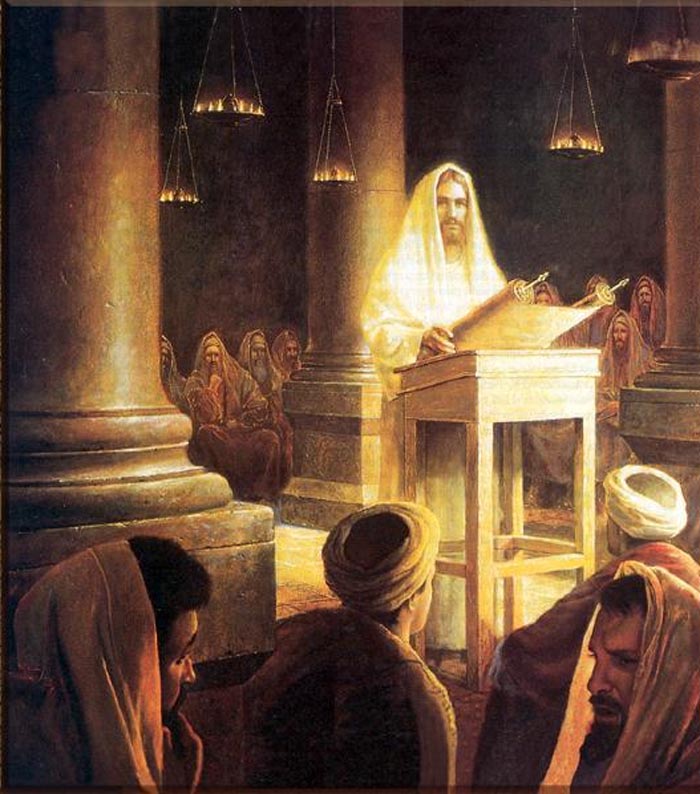
Rolling up the scroll, he handed it back to the attendant and sat down, and the eyes of all in the synagogue looked intently at him. He said to them, “Today this Scripture passage is fulfilled in your hearing.” (Luke 4:21)
If that audience was anything like one that I'm familiar with, somebody would have piped up at once: "Your development of doctrine has no basis in the text." To that, of course, Jesus could have replied: "I AM the text." And in his ministry, that is in effect what he asserted. To any Catholic familiar with conservative Protestantism, though, it should come as no surprise that most first-century Jews didn't see Jesus that way.

That brings up a point I have long pondered during my obscure career as an online Catholic apologist. Many Christian opponents of Catholicism often argue something like this: "Nowhere in the New Testament do we find your allegedly infallible Magisterium. The Magisterium's arrogant and self-serving claims for itself have no basis in the text." But it should go without saying that such a response proves nothing pertinent. It merely exhibits the fundamental difference between the conservative-Protestant interpretive paradigm (CPIP) and the Catholic interpretive paradigm (CIP).

On the CPIP, it is in and through the Bible alone, not something called "the Church," that we encounter and recognize that divine authority by which the public, once-for-all divine revelation is given to us. When we render the assent of faith in that revelation, we are believing God, the ultimate authority, by means of trusting a book as that secondary authority which embodies God's primary authority and conveys the content of his revelation. Thus, for conservative Protestants, the biblical canon as they acknowledge it is the formal, proximate object of faith (FPOF). As their FPOF, the Bible is the sole "infallible" medium of doctrine. That is the basic meaning of sola scriptura. Individual believers can accept ecclesial authority as such only to the extent that it conforms to "Scripture." In practice, that amounts to judging the orthodoxy of any church by means of one's own interpretation of Scripture. It is the individual believer who judges the conformity of any non-scriptural authority to the FPOF. Of course, many conservative Protestants do not see this, because they assume that their often-divergent interpretations of Scripture are simply "what the Bible says." And they say the Magisterium is arrogant!

On the CIP, however, it is the opposite. It is not the individual believer who gets to judge the Church's orthodoxy, but the Church that is the judge of the believer's orthodoxy. That is because, as the "Body of Christ" and "pillar and bulwark of the truth," the Church is a living embodiment of divine authority through her college of bishops, the successors of the Apostles, in union with the pope, the successor of Peter. On such an account, the FPOF is not the Bible alone, understood as self-attesting, but the triad Scripture-Tradition-Magisterium, understood as mutually attesting and interdependent. The first two together convey to us the content of divine revelation, and the last ensures that we identify and interpret that content reliably. The FPOF, as the Catholic Church understands it, thus bears the same divine authority of Jesus that is described in the New Testament.

The basic dispute between conservative Protestantism and Catholicism, then, is about whether divine teaching authority is limited to its embodiment in a book, or whether the two other authorities in question are also necessary for constituting the FPOF. That dispute is similar to the one most Jewish scholars had with Jesus and the Christians. And the beauty of it is that we can compare, contrast, and evaluate the two IPs in terms of the means they offer for distinguishing between expressions of divine revelation as such and merely human opinions about how to identify and interpret the data in which we are given that revelation. Protestantism invests that means in the individual; Catholicism, in the Church. I know which seems more biblical, as well as more reasonable, to me.


Friday, January 25, 2013


Tonight at St. Matthew's Church in East Syracuse, NY, we celebrated a Novus Ordo High Mass for the Feast of the Conversion of St. Paul. The pastor celebrated ad orientem those parts of the Mass addressed to God the Father. Our schola cantorum, in which I sing bass, sang the Ordinary in Latin and Palestrina's "Bonus est Dominus" as a communion motet. Instead of hymns, we chanted the "proper" antiphons in English.

This is is the "Ordinary Form" as it should be.


Monday, January 21, 2013

Friday, January 18, 2013

Better adult catechesis...again


Lately I've been hearing, online and off, still more plaintive calls for "better adult catechesis." I'll say it one mo' time: The problem is not so much that they don't know as that they don't care; they'll only come to know if they care enough to learn. Here I shall add that you can't make anybody care. Some will come to care when the right questions occur to them; some, when they realize they've paid dearly for playing; some, when they finally meet someone truly holy. But all of that is grace. No program can manufacture it.

+Roman Catholics 

Saturday, June 16, 2012

If the Church had the power...

...to support traditional marriage by means such as this, and used it, the result would be called a new "Inquisition."

Wednesday, June 13, 2012

The drama continues...


The trad world is on tenterhooks. An agreement with the SSPX is just around the corner.

Methinks it always will be. As Mark Shea commented on my Facebook wall: " It's really hard for me to work up any interest in "Will this prissy enclave of prima donnas finally have their fussy demands met to their exacting standards?" Who cares? Drama queens wear me out."

Tuesday, February 14, 2012

I want to be Mark Shea's war buddy

I've been accused of being too "liberal" by some traditionalist Catholics and some politically conservative Catholics. Well, I offer Mark Shea's reply to that, even though he seems to me to define and contemn "torture" with more severity than the Catechism of the Catholic Church:
So a conservative Catholic who opposes abortion, euthanasia, and gay “marriage”, hates Communism, regards Obama as a tyrant, voted for Reagan and Bush twice, supports just war, supports capitalism (within just limits), says that all that the Holy Catholic Church believes, teaches, and proclaims is revealed by God, stands for monogamy and rejects artificial contraception, and thinks Benedict XVI is the bees knees? Yes, I am a “liberal” because I oppose torture and pre-emptive war and think it obscene that the strong prey on the weak in this country with increasing impunity, while middle class incomes flatline and vast amounts of wealth accumulate in fewer and fewer hands. That makes me a socialist, doncha know.
Source: National Review vs. Caelum et Terra re: Me

Monday, February 13, 2012

Pinning "liberalism" down

My title has the word 'liberalism' in scare quotes because I want to discuss the sort of liberalism that has grown scarier and scarier over the last several decades. I'm not talking about the liberalism of Locke and the American founding fathers, which stressed respect for natural rights and the consent of the governed as necessary conditions for a legitimate polity. I'm not talking about "classical" liberalism, which called for individual liberty, private property, and a free market as the best conditions for promoting the common weal. I'm not even talking about the liberalism of the early-20th-century "progressive" movement, of which New Deal liberalism was the direct heir and whose achievements, like those of prior liberalisms, have the overwhelming support of the American people. As Walter Russell Mead has argued, such liberalisms, while not reducible to each other, intersected in ways that together explain why each unfolded historically within something recognizable as an American moral consensus. That consensus was strong enough to constitute, in Robert Bellah's felicitous phrase, a kind of "civil religion." Requiring both the free exercise and the non-establishment of religion strictly speaking, the old consensus could itself be called 'liberal' in a broad and now-hoary sense. But since the 1970s, it's been unravelling along with the mainline Protestantism that had been its traditional custodian. The result is what I call The Thing that Used to Be Liberalism ('TUBL' for short; with thanks to Mark Shea, who likes referring to "The Thing that Used to Be Conservatism."). As I shall illustrate, TUBL is now out of control.

For that reason, the label 'liberalism', like 'feminism', has become a net political negative. Contemporary liberals and feminists accordingly prefer to eschew those labels in favor of 'progressive', sounding such rhetorically effective themes as "equal rights" and "fairness." And by its very nature, TUBL is hard to pin down philosophically. The main purpose of this post is to show how and explain why.

It is not news to conservatives that, on matters of domestic policy, today's "liberals" are actually authoritarian about everything except sex. On that score, they are as laissez-faire as can be. (E.g., it's become all but impossible to get them to see what's intrinsically wrong with incest and bestiality, apart from the "ick-factor" and the health risks involved. But hey, childbirth can be messy and dangerous too...) It's that discrepancy that's got out of control, and it's not so much liberal as hedonistic. Today's "liberals" want Nanny State to regulate every aspect of life except what goes on in our bedrooms, so that life is safe for the pursuit of a "happiness" understood as maximizing one's preferences consistently with others' maximizing theirs.

In such a scheme, complete sexual autonomy (within the bounds of a vaguely defined "mutual consent") is so important that marriage and family themselves are to be defined simply as what enough people want them to be. They can no longer be seen as having a form or nature prior to what civil law, as the expression of popular will, specifies. And now that all means of birth prevention are available to everybody, nobody should be expected to incur the natural consequence of ordinary intercourse or even cover the full cost of preventing it--unless, of course, one brings a child into the world anyhow, in which case one should be made to pay dearly, especially if one is the father, who might otherwise get off scot-free. But really, there's no reason why things should reach such a pass; if you're poor, they positively should not. Contraception, sterilization, and abortion are much cheaper than children, and if you're poor you'd better have recourse to them, because there's every reason to expect that you and your children, if any, will be net burdens to society (and to yourselves, for that matter). That expectation is not the only reason why "the right to choose" abortion is central to TUBL, but it is why the Obama Administration has decided to require, in the name of "women's health," religiously-sponsored institutions who object to contraception, sterilization, and abortifacient drugs to utilize health-insurance policies covering such things at no charge to the user. Planned Parenthood--which, needless to say, does not help people plan how they will actually parent--is the very embodiment of this mentality. In the bedroom we should all pursue our own vision of happiness, if need be at others' expense; outside the bedroom a de facto utilitarian calculus, enforced by state policy, should govern moral decision-making quite generally.

Except when it shouldn't. I'm always amused when I hear Barack Obama and Hillary Clinton cite "universal values" against this-or-that foreign dictator. What makes them think that everybody ought to assign the same weight to certain values as they? The UN Universal Declaration of Human Rights? Why is that more than a piece of paper whose appeal today is understandably weaker than when it was composed? The dignity of the human person? But where are we supposed to find a coherent and reasonable account of human dignity? In philosophy, a discipline whose practitioners cannot agree on whether it affords us knowledge of anything at all? In science, which is morally indifferent in itself? And if in religion, why should we find the deracinated, social-gospel Protestantism of Obama and Clinton more rationally cogent than other forms of religion?

Even John Rawls, whose work has dogged philosophy graduate students for several generations now, admitted late in life that his vision of the ideal polity logically depended on a "comprehensive world view" he could not justify by reason alone. Many writers have indeed argued that secular liberalism is just living off the moral capital of the Judaeo-Christian tradition it's largely repudiated. As a more honest and radical sort of liberal, the late Richard Rorty knew that and admitted it, while rejecting not only Christianity but the very notion of what he called "Truth-capital-T." All that the acolytes of TUBL seem sure of, beyond the paramount importance of sexual autonomy, is that being an accredited "victim" gives one a special moral claim on one's "oppressors," who in most narratives are white, male, and Christian--a class which, by definition, cannot be victimized, because it represents everything about the past that victims are, and the rest of us should be, rebelling against. But that stance is just self-deconstructed Judaeo-Christianity. I postpone exploration of how the sense of sexual entitlement relates to that of victim-entitlement.

In any case, lust and sentimentality are not enough to explain what's going on here. Consider the following two, rather typical examples of TUBL thought.

Last fall, when the HHS contraception mandate for health insurers was drafted, Francis Beckwith argued that President Obama had thereby abandoned the liberalism he had embraced in speeches given in 2006 and 2009. Thus:
What one finds in these speeches are prescriptions for public discourse derived from a widely held understanding of liberalism that is often and correctly attributed to the late Harvard philosopher John Rawls. What the president is saying is that if you want to restrict another’s fundamental liberty based on reasons that those coerced would be reasonable in rejecting, your coercion is unjustified, even if it is not unreasonable for you to embrace those reasons for yourself.
That sounded reasonable enough at Notre Dame, when the President accepted his honorary JD by gamely defending the "pro-choice" position in essentially Rawlsian terms. But the new mandate abandons Rawlsian liberalism by defining 'religious organization', for purposes of granting "religious exemptions" from the rule, as follows:
(1) The inculcation of religious values is the purpose of the organization.
(2) The organization primarily employs persons who share the religious tenets of the organization.
(3) The organization serves primarily persons who share the religious tenets of the organization.

So, according to the U. S. government, a Catholic hospital, university, or charitable organization that believes its purpose is to actualize the moral commandments of Christ, to love its pre- and post-natal Catholic and non-Catholic neighbors as it loves itself, and to do so by welcoming with open arms all in need of its services, has ceased to be Catholic. The absurdity of this is palpable.
But here's the kicker. Not only does that absurdity, just by being absurd, abandon Obama's earlier espousal of Rawlsian liberalism; it contradicts his own current, stated understanding of the mission of religion in society! Recounting Obama's message at the National Prayer Breakfast not ten days ago, Charles Krauthammer points out: "To flatter his faith-breakfast guests and justify his tax policies, Obama declares good works to be the essence of religiosity. Yet he turns around and, through [HHS Secretary Kathleen] Sebelius, tells the faithful who engage in good works that what they’re doing is not religion at all."

Is such obvious inconsistency a sign of insincerity? Many would presume as much. But I think it more likely that Obama just doesn't see the inconsistency. Why not? Because he's "in the grip of a theory": TUBL. Thus one should not impose on people what they could reasonably reject, unless what's at issue is sexual autonomy, which is not just eminently reasonable but also, on utilitarian grounds, important enough to warrant full subsidy. If the religiously retrograde don't see that, then their "conscience" is so irrational as to be unworthy of consideration, save when giving lip service to it is politically unavoidable. Those in the grip of TUBL see nothing untoward about pretending to be Rawlsian when it suits them and dropping the pretense when it no longer suits them. Nothing must be allowed to get in the way of sexual autonomy.

Among so many I could pick, another example of TUBL run amok was brought to my attention by Paul Cella.

In his new book Coming Apart: The State of White America, 1960 - 2010, Charles Murray makes the following observation:
Data can bear on policy issues, but many of our opinions about policy are grounded on premises about the nature of human life and human society that are beyond the reach of data. Try to think of any new data that would change your position on abortion, the death penalty, legalization of marijuana, same-sex marriage or the inheritance tax. If you cannot, you are not necessarily being unreasonable.
To be sure, Murray is not in the grip of TUBL. And by 'data', he seems to mean the results of scientific research. If so, I should think that new data could be quite relevant to the questions whether marijuana should be legalized and when the death penalty could be justified. But no amount of new data would change my mind about abortion and same-sex marriage. New data cannot affect the questions whether the fetus qualifies as a person and whether same-sex "marriage" qualifies as marriage. Both are essentially philosophical and theological questions for which the pertinent empirical data are already to hand.

But last week, a correspondent for The Economist who signs him- or herself as 'W.W.' blogged thus about the Murray passage:
I found this exceedingly odd. I can easily imagine what evidence would cause me to change my position on any of these issues....Abortion is far and away the hardest one. I favour legal abortion. I don't think embryos or fetuses are persons, and I don't think it's wrong to kill them. I also don't think infants are persons, but I do think laws that prohibit infanticide are wise. Birth is a metaphysically arbitrary line, but it's a supremely salient socio-psychological one. A general abhorrence of the taking of human life is something any healthy culture will inculcate in its members. It's easier to cultivate the appropriate moral sentiments within a society that has adopted the convention of conferring robust moral rights on infants upon birth than it would be in a society that had adopted the convention of conferring the same rights on children only after they've reached some significant developmental milestone, such as the onset of intelligible speech. The latter society, I suspect, would tend to be more generally cruel and less humane. This is just an empirical hunch, though I feel fairly confident about it. But I could be wrong. And I could be wrong in the other direction as well. If it were shown that societies which ban abortion, or which ban abortion beyond a certain point, exceed societies which don't ban abortion in cultivating a "culture of life", which pays off in terms of greater general humanity and diminished cruelty, I would seriously weigh this moral benefit against the moral cost of reducing women's control over their bodies. Also, if it were shown that abortion tended to damage women's mental and physical health more than forcing women to carry unwanted pregnancies to term, I would tend to look more favourably on restrictions on abortion, especially for minors. [Emphasis added]
Now at first I found that passage as "exceedingly odd" as WW finds Murray's. WW never tells us why he doesn't think either fetuses or infants are "persons," but there's nothing to suggest that he finds the very concept of personhood open to revision by new scientific research. Whatever his concept--and I have a fairly good suspicion as to what it is--it's a philosophical one that's "underdetermined" by the data, which only matter for helping determine which entities actually fall under the concept. (I wouldn't be surprised if WW thinks, with Peter Singer, that adult dolphins make it while human babies don't.)

But even odder than such inadvertence is how WW simply takes for granted a particular view about the nature and basis of moral obligation. He thinks, e.g., that "society" can and should have essentially utilitarian reasons for having "adopted the convention of conferring robust moral rights on infants," who cannot be thought merit such rights by nature. But on WW's own showing, such reasons could conceivably be overturned by new data suggesting, somehow, that we'd all be better off for dropping that convention. And the question what counts as "better" cannot be answered, even in principle, by citing anything we should value as distinct from what we actually do value. What's better is simply what's apt to yield what "society" wants. But there's no transcendent criterion for assessing what society--ours or any other--wants. Ultimately, moral reasoning consists in discovering and prescribing the policies likeliest to yield what we want. "Ought" is always hypothetical, never categorical. And so, as Hume put it, reason is and ought to be "the slave of the passions."

The question for the WWs of the world is this: Are there, or are there not, "data" that could determine whether that's the correct view of moral obligation? WW doesn't seem to have considered the question, but those in the grip of TUBL would reject it. It's supposed to be self-evident that freely pursuing the maximization of preferences--whatever they are--is the best we can do, and there can be no obligation higher than, or inconsistent with, the best we can do. Such is the ideal of the radical autonomy of the imperial self. The only admissible limits on such autonomy are those which are necessary in practice for collective preference-maximization. Those turn out to be considerable, of course, which is why TUBL is rather authoritarian. Except about sex.

What makes TUBL so hard to pin down is that it combines sexual libertinism, which is distinctly not Judaeo-Christian, with a statism that's supposedly required for helping the unfortunate. As deconstructed Judaeo-Christianity, the latter requires a discipline and moral earnestness that are otherwise undermined by sexual libertinism and the calculus of preference-maximization generally. Since that combination is ultimately unsustainable, both theoretically and practically, the most fervent prescription of TUBL is to help the poor and the otherwise disadvantaged get rid of themselves by every means of birth prevention. Any amount of philosophical incoherence is accepted for the sake of implementing that prescription. We're only seeing the earliest stages.

Saturday, February 11, 2012

It's simple, really

Even some liberals wonder what Obama's been thinking with this HHS contraception mandate. So I'll lay it out simply.

When a church-sponsored organization provides "social services," that's good religion. When the church in question forbids abortion, contraception, and sterilization, that's bad religion. But we don't want to discriminate between types of religiosity. So we just say that church-sponsored organizations that do both good religion and bad religion aren't religious.

Simple, isn't it? But if you want to understand the contradiction thus resolved, go here.

Tuesday, February 07, 2012

A non-trivial way to infer 'ought' from 'is'?

A shibboleth of modern Anglo-American philosophy is a belief to the effect that "one cannot infer an ought-statement from an is-statement." The first explicit formulation of and argument for that occurs in Hume's Treatise on Human Nature, but there's much controversy about how to interpret the relevant passages. So it's not always clear what the statement is supposed to mean, whether it's true on this-or-that construal, or even what the argument for it should be. "No ought from is" just seems to be one of those slogans that entrenches itself in the mind of philosophers when they're young, so that the corresponding, deceptively clear dogma rarely suffers critical scrutiny. Taken seriously, it runs counter to moral philosophies that are both cognitivist and non-utilitarian.

But the matter does get critical scrutiny from time to time, such as in a post I've just come across from Catholic philosopher Alexander Pruss of Baylor University. Pruss uses his blog to germinate and sketch philosophical ideas, with which he positively teems. Here, the general thesis is that "We have prima facie reason to conclude from the fact that something ought to be so that it is so." If that thesis can be further developed, disseminated, and defended, it would go a long way to removing what I consider a major obstacle to doing sound moral philosophy.

It seems to me that Pruss' argument is valid, or can be made so on suitable restatement. What interests me is what his thesis, if true, says about philosophical argumentation generally. To say that one has "prima facie reason" to infer such-and-such is, I take it, to say that one is within one's epistemic rights to infer such-and-such unless a clear defeater is known. I'm uneasy about non-demonstrative arguments of that sort, for their conclusions are of interest less for learning what is the case than in learning what we have justification for believing is the case. It is possible to be justified in believing something that is not actually so, if one lacks grounds for inferring that it isn't so. But the interest of that lies more in its utility for defending one's intellectual virtue than in its utility for discovering facts.

And yet, Pruss' ambitions for this thesis are apparently bigger than that. Thus he muses: "It is an interesting question whether the is-from-ought inference is at all plausible apart from a view like theism or Plato's Platonism on which the world is ultimately explanatorily governed by values. There may be an argument for theism (or Plato's Platonism!) here." If that musing turns out to be true, then the truth of the original thesis would itself serve as a premise in an argument for the existence of God, as well as removing a major de facto obstacle to natural-law and virtue theory in ethics.

I need to think about this more. Do any readers have thoughts in the meantime?