"You shall know the truth, and the truth shall make you odd." ~Flannery O'Connor

Sunday, October 02, 2005

The pelvicists are at it again


As part of a magazine article I plan to make out of one of my posts, I pointed out: That it is “the pelvic issues,” more than any others, which corrode faith among Catholics today has become such a media commonplace that it is no longer the embarrassment to the bishops that it should be. It should therefore come as no surprise that the media resume harping on that theme as the Roman Synod on the Eucharist gets underway. After all, what else is there to talk about? The Eucharist? ZZZZZZZZZ...... Catholics only believe that it's the literal body and blood of Jesus Christ and that the liturgy wherein he is thus made present is the "font and summit" of the Christian life. What is that compared with sex?

No media attention has been given to what the Pope actually said in his homily for the opening Mass. I can't even find it at Zenit yet, though it will doubtless be there shortly. Here's what they're talking about instead: During the three-week synod, bishops are expected to discuss a range of controversial issues with the new Pope. Church attendance, divorce, celibacy and abortion rights are all expected to feature on the synod's agenda. OK, only three out of four of those issues are about sex, marriage, or procreation. I've got to credit the reporter, if not for her originality, at least for having a more-than-one-track mind. Other stories on the Synod that I've seen, though, don't bother mentioning any non-pelvic issue. They simply assume that, whatever the ostensible topic, it all comes down to the Church's attitude toward sex and directly related topics. I'm reminded of the Jewish joke about how civilization has, literally, declined: "Moses seemed to believe that life is all about what's in the head. Jesus taught and acted as though it's all about the heart. Marx thought it was all about the belly. And Freud thought it was all about the genitals." And that's pretty much where people stay focused. Of course we could go down further to reach the feet. But we won't, because feet aren't as interesting as genitalia—unless you're a foot fetishist, in which case it's mostly about the genitalia anyway.

This sort of preoccupation illustrates a paradox I've discussed before. The more people think of freedom as autonomy rather than as the healthy exercise of a faculty within the limits of the divine and natural law, the more enslaved to their passions they become and thus the less free they become. The less free they become, the more they insist that the Church respect their freedom by allowing lots of sex with few inconvenient consequences. Hence the demands to end the celibacy requirement for priests, for giving the Eucharist to the divorced-and-remarried who haven't bothered with the "hypocrisy" of annulment, for the distribution of condoms to teens and promiscuous adults, and of course for the rock-bottom option: legal abortion for those embarassing occasions when contraception fails.

The result is what John Paul the Great termed "the culture of death." We're not talking just about abortion, which kills millions of human beings each year. We're talking about the slow suicide of the West generally. The more sex is detached from marriage and procreation, the less life-giving it becomes—biologically and spiritually. Not only is the birth rate now below replacement level in all "developed" countries; people find it increasingly difficult to see sex in particular and life in general as having any purpose other than self-gratification. For the majority, that means physical self-gratification. Consequently, we are becoming fewer, richer, fatter, and incapable of countering the spiritual energy of militant Islam. Western humanity is becoming a maladapted species. If we don't change, we will die—and deservedly so.

The antidote is the Way, the Truth, and the Life: Jesus Christ, fully God and fully man. He gives himself to us, literally, in the Eucharist. Catholics at least should be able to appreciate that and follow the Synod accordingly.

Thursday, September 29, 2005

The Feast of St. Michael and the Archangels

For obvious and not-so-obvious reasons, today's date is a specially important one to me. It seems to have been St. Michael the Archangel's feastday from the earliest Christian centuries in Rome. Although the Catholic Church has combined the feast with those of the archangels Gabriel and Raphael, thus honoring the "Big Three" mentioned in the Bible, even now the Anglicans call today's feast "Michaelmas."

The name itself signifies. The original Hebrew meant "he who is like God;" in Christian traditon, that description morphed into a question: "Who is like God?" which in turn was held to be Michael's battle cry as he and his host ejected Satan and his host from heaven for a mass rebellion motivated by Satan's claim to God's throne. Thus Jesus said: "I saw Satan fall from heaven like lightning" (Luke 10:18). Now I know there are plenty of biblical scholars who explain that away, in context, as nothing but Jesus' approbation of the work of "the seventy-two" in rolling back evil. It was that, to be sure; but frankly, I don't buy the reductionistic 'nothing but' and have never been able to. With Tradition, I believe that Jesus was also describing what he witnessed in illo tempore, as God the Son, before his incarnation as a man. His copious talk of and conflict with Satan in the Gospels strongly suggest that the two go way, way back: further back than we can possibly imagine. God appears to have given Michael the place of honor once held by Lucifer, now Satan. As such, Michael is commander-in-chief of the angelic hosts and champion of the Church Militant on earth.

Many other roles, revealed in apparitions and miracles, have also been attributed to him. Google him, read about him, and learn. This saint is incalculably important, as are angels generally in the "economy" of salvation.

Some people are put off by the fact that he and the other archangels are called 'saint'. After all, Rome hasn't vetted and canonized any such being! That betrays a misunderstanding of the word. The lower-case 'saint' comes indirectly from the NT Greek hagios, meaning 'holy one'; the Latin for that is sanctus, the root of the Old French and Norman saint. Any "holy one" is a saint, even if the pope doesn't know it and say it. All the good angels are saints; they dwell in God's presence and do his bidding. Indeed, the very term 'angel' comes from the Greek for 'messenger'; in the Bible, that role is the most common one attributed to angels for the benefit of human beings.

I am devoted to St. Michael as protector, guide, and hopefully as healer. I concluded a novena to him today for those closest to my heart.

Wednesday, September 28, 2005

Amy Welborn on gay and not-so-gay seminarians

Even the New York Times is letting this very Catholic, accomplished author and doyenne of blogdom be heard on the ever-more controversial subject of admitting homosexuals to Catholic seminaries. Characteristically, her brief Op-Ed piece is impassioned yet wise, principled yet balanced. I welcome it all the more because, as a dedicated wife and mother, she doesn't elicit the charges of denial-based homophobia that orthodox Catholic men often face when saying the same things.

Amy just can't be Bulverized. Right on, sister!

Tuesday, September 27, 2005

The heretic dines with the inquisitor

My, my, my. How far we have come. It seems that, if you're a German-speaking theologian and an erstwhile buddy of the Pope, it doesn't much matter that you're a heretic. No, the Pope hosts you at a serene little dinner in the Vatican instead of meting out the Torquemada treatment, which you would have had good reason to fear centuries ago and which you all but accused him of plotting not long ago as head of the CDF. Hans Küng, I salute you as one survivor to another—though what I've survived is admittedly quite different.

Twenty-two years ago in New York, I interviewed Küng on videotape for a fledging Catholic media company. Alas, the firm's swift demise meant that the tape never saw the light of day. That was just as well. My performance was shaky: it was plain on the screening that the guy gave me the creeps. I had never seen such worldiness and naked lust for power in a theologian before; barely more than a kid, I was sweaty and hesitant; at the top of his form, he was toying with me. A few years later, he gave a speech to a convocation of clergy and theologians in New York for which I could have written the script. I wasn't there, but Fr. Richard John Neuhaus, editor of First Things, was. In 2003, Neuhaus recounted the occasion in passing as part of one my favorite articles of his:

It was at a conference in the mid–eighties that I listened to Hans Küng hold forth in triumphalist tones on the victory of the progressives. “We” control, he announced, the seminaries, the academic departments of theology, the catechetical and liturgical institutions, the publishing houses, the magazines that matter, and the chanceries. Most of the bishops, he said, are now on “our” side, and those who aren’t have been neutralized. Anyone who wants a future in the hierarchy or the Catholic academy has no choice but to cooperate, he observed. It was a clean sweep; all that was left were a few details; the disgruntled band of risibly reactionary dissidents from the new order didn’t understand what had happened and couldn’t do much about it. It was an impressive speech.

At the time, I accepted Küng's sociological analysis of Catholic intellectual and ecclesiastical life. Demoralized and fearful, I hoped to make a career in secular academia instead, where I could get away with being an orthodox Catholic so long as I didn't dwell on distinctively Catholic themes. As it turned out, though, I landed in quarters of Catholic academia where loyalty to the Magisterium was not only tolerated but expected. And as Neuhaus says next in the above-quoted article, referencing Küng's speech: "Almost nobody on the left is talking that way today. They are still largely in control of major institutions, notably the academy and some religious orders, but the more astute among them know that they are increasingly on the defensive." Indeed they are, and I'm increasingly optimistic that Catholicism will someday reign again in Catholic academia.

That's not to deny that theologians of Küng's stripe and generation have performed a signal service to the Church. A peritus at Vatican II along with Ratzinger, whom he had headhunted from the University of Münster's theological faculty for that of Tübingen a few years earlier, Küng is probably the best-known of the "progressive" theologians who dominated, if not the Council's deliberations themselves, at least its interpretation in the two or three decades that followed. Books of Küng's such as The Doctrine of Justification; Infallible? An Inquiry; and On Being a Christian, though not of the very first rank, were trenchant enough to force the orthodox to rethink their approaches and get creative. I rather doubt that authentically Catholic theology today would be anything more than a relic if it hadn't been for troublemakers like Küng and others. Though Ratzinger was right back in 1979 to help engineer Küng's de-certification as a Catholic theologian, he and John Paul the Great were also right not to excommunicate him.

Not all of Küng's stuff matters, of course. His Does God Exist? does not advance the discipline of natural theology; his book Eternal Life? deserved the treatment I gave it years ago in the pages of National Review. At this juncture, in fact, the 77-year-old Küng's ideas matter less than his persona. As a living symbol of what many Catholics think and feel, he remains a force for his old colleague, now Pope Benedict XVI, to reckon with. That Ratzinger has chosen to reckon with him by a sincere gesture of reconciliation isn't going to make the doctrinal issues go away, but it will help light prevail over heat.

I suppose I shouldn't be disappointed that, to that end, Küng been brought in from the cold. I just wonder whether he, along with his many admirers, will get the right message.

Monday, September 26, 2005

It seems a fitting occasion...

Given that I returned home yesterday from a Eucharistic congress, I can attest to the topicality of the following joke:

"The Work of the Parish Priest"

During a Eucharistic Congress, a number of priests from different orders are gathered in a church for Vespers. While they are praying, a fuse blows and all the lights go out.
The Benedictines continue praying from memory, without missing a beat.
The Jesuits begin to discuss whether the blown fuse means they are dispensed from the obligation to pray Vespers.
The Franciscans compose a song of praise for God's gift of darkness.
The Dominicans revisit their ongoing debate on light as a signification of the transmission of divine knowledge.
The Carmelites fall into silence and slow, steady breathing.
The parish priest, who is hosting the others, goes to the basement and replaces the fuse.

Source: http://catholicfire.blogspot.com/

Joking aside, it was a marvelous occasion, attesting to the vibrancy of the Catholic Faith in a region of the country where Catholics are still a small minority.

The Fellowship of Catholic Scholars meeting, held concurrently in Charlotte, was also a great tonic for me. I got to revisit with some old acquaintances, such as Msgr. William Smith, who is still teaching moral theology at St. Joseph's, Dunwoodie, New York's archdiocesan seminary; and Msgr. Michael Wrenn of the same diocese, now retired, who for three decades was a major force in American catechetics. I like to think that's why he hired me to teach a few courses at Dunwoodie back in the 1980s! I also got to meet and talk substantively with two men I have long read and admired: Prof. Ralph McInerny, who recently celebrated his 50th anniversary teaching philosophy at Notre Dame and remains as sharp and witty as ever; and Scott Hahn, the Catholic biblical theologian who often writes for a popular audience and has all the right enemies on the left and the right. Finally, I had a long chat over drinks with the Hitchcocks, Helen and James—the former a liturgical road warrior of Adoremus note, the latter a historian and apologist to whom orthodox Catholics need no introduction.

And those are just the highlights. I made some good new contacts, enjoyed a great banquet, and even got a few job leads to pursue. Thank you, Holy Spirit.

Friday, September 23, 2005

Off to Charlotte

This weekend I'll be in Charlotte, North Carolina attending two events: the annual meeting of the Fellowship of Catholic Scholars, and the diocese's special Eucharistic Congress. I am certain that the Holy Spirit is putting me there. Those who are with me in spirit, please pray that the occasions are fruitful.

The Feast of Saint (Padre) Pio

Today is the liturgical feastday of a man whom I am by no means the only Catholic to consider one of the greatest saints in the Church's history. He died thirty-seven years ago, a few days after writing Pope Paul VI to express his support for the recently published encyclical Humanae Vitae, probably the most widely execrated papal document ever (save, perhaps, for Unam Sanctam).

Padre Pio was from the same part of Italy as my father's family. A stigmatist for fifty years, his vow of obedience led him to submit to several scientific examinations that failed to uncover any natural explanation. By all accounts from Catholic and non-Catholic alike, his Mass was transporting, a palpable symbol of the sacrifice he presented in persona Christi. He had the gift of reading souls, hearing confessions many hours per day for decades and tolerating no hint of dissembling. His bilocations were well attested, as were his miracles of healing. The hospital he started at San Giovanni Rotondo, near his monastery, now has few rivals for size and quality of care. I ask him regularly to obtain a miracle of healing for those closest to my heart.

I'm only giving you a bare taste. Of course he provoked bitter opposition and misunderstanding as well as the devotion of millions. For a long time the Holy Office treated him with reserve, even contempt. All the accusations against him, which were many, proved unfounded. That only increases my identification with and devotion to him. He remains very active today among his "spiritual family."

A good introductory book on him is Meet Padre Pio: Beloved Mystic, Miracle Worker, and Spiritual Guide, by Patricia Treece. For those a bit better acquainted, try Padre Pio: A Man of Hope, by Renzo Allegri.

Get to know him. You'll be glad you did.

Thursday, September 22, 2005

The job never was any easier....

This rumored to be in the presses at the New York Times (courtesy of Fr. Richard John Neuhaus):

Pick Seen as Sign of Contradiction

By Ian Fisher

CAESAREA PHILIPPI (20 Kislev). Yesterday's surprise announcement that doctrinal hardliner Jesus of Nazareth had been anointed "messiah" provoked mixed reactions in the diverse and sometimes fractious Israelite community, ranging from cautious disappointment to frank despair.

"I see it as a missed opportunity," said Herodias Schneidkopf, a Galilean incest-rights activist. "Many of us were hoping for someone more open to leadership roles for women and more appreciative of our experience. I don't feel valued."

Respected archpriest Caiaphas Bar Nun agreed. "Above all, the messiah should be a good listener. How can we as a faith community keep credibility among the youth of today if we cling to every jot and tittle of an outmoded social code while thousands die of leprosy and hunger? Today's highly educated Judahite community isn't satisfied with the old answers. I'm afraid it's a missed opportunity."

Even some members of the Messiah's personal entourage expressed misgivings. The Rev. J.E. "Dimples" Iscariot, S.J., a media consultant, did not hide his regret. "A missed opportunity, I'm afraid. We in the Society of Judas traditionally enjoy a special relationship to the messiah, but we'll find this choice very hard to explain to gays and lesbians—I mean, of course, to gomorrhaists and sodomitesses as well as to the divorced and the marginalized. Why just the other day I saw 300 denarii, which might have been used to help find a cure for leprosy, squandered on wholly unnecessary ritual excesses."

Fighting the spread of leprosy is a vexed issue among contemporary Palestinians. Most polls show Israelites widely ignore official teachings on ethical matters, preferring to follow their own conscience. Some see Jesus' moral conservatism as a rigidity that leads to disfigurement and death in at-risk populations and that may ultimately doom his movement to irrelevance. "Yesterday's unction was an opportunity missed," insisted real-estate broker Sapphira Glass. "Today's young professionals don't find their own experience reflected in a one-size-fits-all morality that limits options and encodes patriarchal bias. I mean, sacrificing one's newborns to Moloch is a tragic but often necessary choice, and many of us find the language of apostasy alienating and judgmental.' [NYT copyeditor's note: Need some quote from supporter—J.L.]

"It all comes down to power," countered maverick theologian Fr. Richard Maccabeus, retired professor of applied autology, who pointed out that the successful candidate had almost no pastoral experience. "What we're seeing is a right-wing restorationist fantasy in its death throes. Intelligent Israelites aren't buying. We want to be heard. We want someone who speaks not with authority but like us academics—I mean, of course, like the scribes and the pharisees. One can only call it a missed opportunity."

The Procurator of Judea was unavailable for comment.

Tuesday, September 20, 2005

Pope approves barring gay seminarians

As I hoped, Benedict is bringing it on. I posted on this general topic both last month and a few weeks ago, eliciting some thoughtful comments. If you now have any to add, please add them here.

Limbo, believe it or not

At one time, I didn't think this relatively peripheral theologoumenon would occasion much passion today. I was wrong. See my article on limbo at Pontifications.

Monday, September 19, 2005

The baby trade

Reports from several sources, none of which can be considered biased in favor of pro-life views, indicate that throughout the world, trade in fetal and even born-baby parts is growing. My only surprise is that it hasn't happened sooner. What can one expect when the personhood of conceived children is denied, or allowed to be denied, for the sake of justifying abortion and infanticide? If you're "pro-choice" but object to what's happening, it might be time to re-examine your premises.

Sunday, September 18, 2005

The latest round in the Pledge slugfest

It now looks like the Supreme Court will no longer be able to dodge the issue about the Pledge of Allegiance's "under God" clause the way it did last time round. A federal District Court judge has ruled that requiring schoolchildren to recite the Pledge with that clause violates their right to be "free from a coercive requirement to affirm God." Though the mover behind the suit was the same atheist, Michael Newdow, whose case the Supremes threw out on the ground that he had no legal standing to do so on behalf of his biological child, Newdow has got round that problem by bringing a group of custodial parents into the latest suit. So if, as is likely, the Ninth Circuit upholds the latest ruling, the case will once again be appealed to the Supreme Court.

Maybe I'm naïve, but the ruling seems absurd to me on the merits. If it's unduly "coercive" to require recitation of a phrase that is fully in keeping with the explicit language of the Declaration of Independence about God, in whom the vast majority of citizens believe, then why is not at least as unduly coercive to require pledging allegiance to a "flag" and asserting that there is "liberty and justice for all"? The former requires veneration of a mere symbol, not of God, and the latter is arguably if not clearly false. If we're going to leave God out of the Pledge for the reason given, we had better ditch the whole Pledge for consistency's sake. Maybe that's what some people want after all; but if that's what ends up happening someday, they had better come up with a better way to instill proper love of country in children, or this country will be in even bigger trouble than it is.

Of course, maybe nothing much will happen. Maybe the Supreme Court will dodge the bullet this time by just refusing to hear the appeal. That would be understandable if pusillanimous. For the past half-century at a minimum, the Court's jurisprudence on matters of religion and the state can charitably be described as incoherent. In its attempt to balance the free-exercise and anti-establishment clauses of the First Amendment, the Court has succeeded only in undermining the former without giving a clear sense to the latter. The Framers intended both only as a means of preventing the federal government from legislating or encroaching on what the states chose to do about religion. The Court would have done better, purely from the standpoint of intellectual respectability, to stick with that. This is where the originalists have an unassailable point.

When this latest case is appealed to the Supremes, John Roberts will be Chief Justice. As a good Catholic, he gives reason to hope that he will at least understand the importance of taking the case on the merits and using it to clear up the mess. As a member of the Catholic men's organization that led the campaign to get Congress to adopt the "under God" clause back in 1954, I sure hope so.

Saturday, September 17, 2005

Outside the Church there is no salvation?

I apologize to my loyal band of readers for letting this blog lie dormant for a bit. I've been heavily absorbed in a debate over at Pontifications about my article Development and Negation II: extra ecclesiam nulla salus. That topic touches a nerve that is raw for many people, which is why I expected the article to be the blockbuster it was. If you're one of those people, check it out. But if you wish to comment, please do so here rather than there. After well over 300 comments, the discussion there is best left as is.

Sunday, September 04, 2005

They're co...mmm..ing: but will it matter?

The long-awaited apostolic visitation of American seminaries and other houses of clerical formation is gearing up and coming soon. Given the hugely damaging sex-abuse scandal—so damaging partly because so assiduously publicized, unlike similar problems in public-school systems and other spheres—it is certainly needed. But as Diogenes over at Off the Record suggests, there seem to be as many Church professionals who hope it won't work as hope it will. More even than the scandal itself, that explains why the visitation is so necessary.

With not a little dismay, I have written before about the apparently inability of the American bishops as a whole to attack the roots of the dispiriting problems confronting the Church in this country. One of those roots is the self-serving unwillingness of many to even admit what one of the roots is: homosexuals in the priesthood. Progressives have no problem repeating that the inexcusable coverup and belittling of so many sex-abuse cases was self-serving on the part of the offending bishops, who were more interested in covering their own and the Church's posterior than in protecting the young. Yet it has become all too apparent that, in some cases, the problem is that bishops were either homosexuals themselves or otherwise more inclined to sympathize with homosexual priests than to rein them in. Speaking as a former seminary adjunct professor as well as a former victim, I can state unequivocally that the intellectual and social tone of many seminaries during the 60s, 70s, and early 80s contributed to that problem as much as it reflected it.

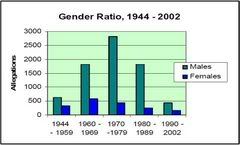
One symptom thereof is the fact that, in the last several years, half-a-dozen American bishops have been forced to resign on account of their own sexual improprieties. Four of them committed homosexual improprieties—none of which were with pre-pubescent children. But many Church types like to deflect attention from the fact thereby illustrated: the majority of sex offenses committed by clerics were not cases of pedophilia, i.e. sex with pre-pubescent children, but of ephebophilia, i.e. sex with adolescents. Most of those adolescents have been boys. The National Review Board's report (PDF; 4.9 MB) shows as much literally graphically:

Image hosted by Photobucket.com

Yet even the film "Protecting God's Children," distributed by the USCCB and required of all who would work with children in a Catholic setting, totally downplays the problem of homosexual ephebophilia in the priesthood. It presents four specific cases of abuse, only two of which involve male victims and only one of which involves an adolescent boy. Thus, even though the majority of abuse victims have been such boys, both the title and the content of the film show that is not where the bishops are correspondingly focused. And that is in keeping with the general approach of the media, in which the victimization of "children" and thus pedophilia is taking to be the main problem.

Of course pedophilia is a horrible crime and should be most vigorously prevented. I can't blame most people for focusing on that. But not even most homosexual priests are pedophiles; and by focusing on the pedophilia problem, the bishops are addressing only one symptom of the larger problem rather than its main cause. That permits them to continue skirting the formation issue of admitting homosexuals to the seminary and allowing them to form circles of mutual sympathy even when many do not actually violate celibacy. That's just the sort of clubbiness we can no longer afford. Some, such as Archbishops Chaput of Denver, George of Chicago, and Burke of St. Louis have admirably come to grips with the larger issue. But many more have not. And that's the negligence which the apostolic visitation needs to focus, laser-like, on addressing.

Like the last one actually was, this one threatens to become just another bureaucratic charade. The visitees will put on their best faces; curricula, procedures, and numbers will be reviewed; seminary faculty and rectors will enjoy some fine meals with Vatican bigwigs. But will the unvarnished facts be made clear, discussed frankly, and acted on effectively? I hope so, and there's more reason for hope now than in the past. But let the passive resistance not be underestimated.

Saturday, September 03, 2005

The Thomism Blues

I haven't had this much fun in weeks!

For full effect, hit the bumper before every line.

Now, when I was conceived,
Though my momma didn't know,
My body was infused
With a rational soul.
Now I'm a man
With one final end:
Eternal beatitude
With God as a true friend.

Chorus
I'm a man
Spell it M
A
N
Man
Ah
Ah
Ah
Ah
Y'all listen to me,
'Cause you know I ain't teasing.
I'm an individual substance
Of a nature with reason.

Repeat Chorus

Ain't just made of matter.
Ain't spirit trapped in mud.
I ain't just my soul,
I'm my soul plus my flesh and blood.

Repeat Chorus

I stand at the top
Of the material order,
But I also cross
The spiritual border.

Repeat Chorus

Bows and nods to the author, Tom Kreitzberg of Disputations!

Thursday, September 01, 2005

Is abstinence immoral?

I know, you wouldn't think I would raise a question like that. And I wouldn't—in earnest, anyway. I made it my title to start focusing your attention on what's really interesting about those who would answer "yes."

During the heyday of the so-called "sexual revolution," in New York a generation ago, I did encounter that answer from a few people I knew. Having observed my sometimes successful efforts to be chaste, they assured me that ongoing success would endanger my mental health. If that were true, I suppose chastity would be immoral. But that viewpoint, there and then, was only to be expected. What I've never expected is to see it becoming conventional wisdom. Apparently it is.

Ted Olsen at Christianity Today's "Sexuality and Gender" forum has posted some interesting tidbits in support of the following trenchant observation:

Can we be good without God? The question seems somehow abstract, a topic for Atlantic Monthly cover stories and college seminars more than practical applications. So here's another question: Can we keep our pants on?

Ironically, the group that often answers "yes" to the first question says "no" to the second. And some believe that not only can't we stay chaste, but we should not.
(Emphasis added.) Olsen proffers many tidbits in support of those last two assertions. Typical is this: "An abstinence-until-marriage program is not only irresponsible," U.S. Rep. Barbara Lee, D-Calif., said last year. "It's really inhumane." My eyes are still bulging; she actually said it is inhumane to counsel and educate young people to avoid fornication. The only humane thing would be to give them condoms and winks.

Such abject surrender to hormones seems like conventional wisdom only because the MSM promote it tirelessly, though more through spin than through philosophical argument. Yet the philosophy is most instructive.

Olsen is right, and there's an obvious inference to be drawn. People who like to point out that one can be good without believing that there's a God who requires us to be good tend to have a different moral code than those who believe that morality has some foundation in God. That some atheists and agnostics are virtuous, to a degree, goes without saying; that secular and religious morality intersect at various points also goes without saying. So what's the difference that accounts for Olsen's ever-more-accurate point?

The difference is that secular morality, at bottom, is relativistic. Sure, there have been rather fastidiously moral people, including some philosophers, who were neither theists nor relativists. There still are. But once ethics are unmoored from God, then a moral philosophy that is absolutist in principle becomes relativistic in fact. For all such morality is, ultimately, a matter of opinion; and opinions in turn are affected more by culture and its evolution than by any philosophia perennis or religious authority. Thus, once contraception and abortion both became widely available, especially to the young, the sort of sexual morality once sustained by Judaism and Christianity, and retained by the Victorians regardless, became far weaker than the appeal of sex without apparent consequences. Only God, and a life sustained by a relationship with God, can definitively resist the power of that appeal in a person's life.

Okay, I admit that STDs convince some here and there to get back on the straight and narrow—the ones who don't seek cheap grace in the form of condoms. But that actually segues into my next point. The elements of traditonal morality that secular liberalism retains are those which don't require much inner self-denial, have some clear utilitarian value, and make us feel good about ourselves. That's why the morality of secular liberalism is actually harder on certain sins, such as neglect of the poor and the sexual abuse of minors, than traditional morality. Championing obvious victims and vilifying the victimizers makes us feel good about ourselves, reduces the amount of overt nastiness in society, and doesn't require much sacrifice of us as individuals beyond government action—i.e., laws and taxes. But the same people who execrate non-consensual sex also execrate the voluntary renunciation of consensual sex outside marriage. People can't be expected to deny themselves to that extent, can they? We're only human, after all; and aren't humans just animals with speech and creativity?

Which brings me to the ultimate irony in such morality. These people are always chanting "Choice, choice," as though we have some sort of freedom of the will that mere animals lack and as though such liberty were an inherent, not just a socially constructed, right. And we do have some such liberty: as creatures of God subject to God. But once freedom is unmoored from God along with morality it becomes, literally, autonomy. Humans, either individually or collectively, thus legislate for themselves without reference to a divinely bestowed natural law whose precepts are written in the collective conscience of the race. Once that happens—and the many Barbara Lees of the world take it as a fait accompli—then expectations descend to the least common denominator toward the bestial. That's what's happening in our society with sex. If it doesn't stop, we'll find that it happens with everything else too.

My argument is essentially the same as that of C.S. Lewis' The Abolition of Man. I always used to require it in my undergraduate ethics courses because, written in the World-War-II era, it was one of the most prophetic books of modern times. Read it if you haven't already.

Tuesday, August 30, 2005

Prayer for New Orleans and all Katrina victims

Father in heaven, as events unfold, it now seems that the City of New Orleans is unlikely to survive in anything like its current form. Many there and in the surrounding regions have already either died or lost everything they have. Although, in your inscrutable designs, you have chosen not to stay this catastrophe, I beg you to extend your merciful hand now over all affected so that anarchy does not victimize the innocent further. Send your Holy Spirit to inspire the authorities and all decent folk to act as your Son's hands and thus embody your mercy as well as your justice.

I ask you this through that same Jesus Christ Our Lord, who lives and reigns with you in the unity of the Holy Spirit as one God, now and for ages of ages. Amen.

Another thing to like about B16...

And I don't mean the vitamin, which I also acknowledge as a Good Thing.

Apparently, the Pope met secretly last Saturday with Oriana Fallaci, the acerbic Italian author who most recently ran afoul of a court in her country for her highly critical book about Islam's relations with the West. She faces a warrant for her arrest on a hate-crime indictment, which is why she now spends most of her time in New York. Having read the book, I would say that the charge is absurd because, even though it is arguably merited under the applicable law, that law is so broad that its application in a case such as this is a violation of basic human rights. It is probably because the Italian Government is sensitive to such criticism that, even though they doubtless knew of her arrival in Italy, Fallaci was not arrested at the airport. Deference to the Pope probably had something to do with that as well. Kudos all around!

Of course I don't know what was said in that meeting, and probably no more than a handful of people other than Fallaci and Benedict do. But I'm certain the meeting shows at least two things: the Pope's pastoral solicitude for a baptized Catholic whom, even though she now professes atheism, he still considers part of his flock; and his willingness to seek input from people who have no particular Catholic axe to grind. He's evinced the latter with some professional philosophers too; but the problem of Islamic jihadism is very concrete and serious in the world today, and the Pope's remarks during World Youth Day(s) indicate that he is thinking about it with unflinching realism. As if his past didn't prove as much already, this is not a man who shies away from the hard issues just because they are controversial.

As I've said before elsewhere, B16 seems to be just the vitamin for the Church now.

Monday, August 29, 2005

The struggle continues...

Just as everybody with e-mail grapples with the problem of e-mail spam, so we bloggers grapple with that of "comment spam." In order to keep such spam off this site, I now require those who would post comments to type a brief word to verify that they are not spambots. It's a bit of a nuisance for which I apologize; but we'll all be better off for it.

Thanks.

Sunday, August 28, 2005

The rumblings: will there be a quake?

Although Pope Benedict XVI has apparently made no firm decision yet, the alarm is already going up about a Vatican plan to ban homosexually inclined men from admission to seminary training for the priesthood. In yesterday's issue of the British periodical Guardian Unlimited, it was suggested that the hammer has yet to fall because the Vatican did not wish to "tarnish" World Youth Day or, more broadly, sabatoge its so-far-successful effort to "soften" the image of the man called by many—and not always with affection—"The German Shepherd." If the draft document is eventually published and contains anything resembling such a ban, the explosion of outrage will exhibit the same intentional spin and the same unintentional irony.

The spin in such words as 'tarnish' and 'soften' is plain as a pikestaff. If the envisioned policy is adopted, it would amount to no more than a pastoral attempt to address two major problems, one of which is known to all the world and one of which is undeniable once one thinks about it. The more widely known problem is that the majority of minors sexually abused by Catholic priests are (or were, since most cases are fairly old) adolescent boys; the other problem is that homosexuals in the seminary live in close quarters with other men, some of whom are gay themselves and some of whom, gay or not, must pose a temptation. A new policy of keeping homosexuals out of the seminary would go a long way toward solving both problems. Is that so objectionable in itself? I am far from alone in thinking it is not. But what we hear so far is that announcing such a policy would spoil the Pope's PR efforts, as if that is what he and his advisors are mainly worried about. Since it's taken for granted that that is what every public figure is supposed to be most worried about, it does not occur to the writer that the Pope might have bigger fish to fry—like reducing the amount of sodomy on boys and preventing the perpetuation of homosexual cliques among priests.

And that points up the unintended irony in all this. For perfectly understandable reasons, nothing has provoked greater contempt for the Catholic Church in the last several years than the sexual abuse of minors by priests. Yet "progressives" never, ever say that part of the solution might to keep homosexuals, a good number of whom fancy adolescent boys, from entering the seminary—where they could and do fancy each other—or keep them from being ordained—a status that makes their pickings far wider. That would be so intolerant, so unenlightened, so "homophobic." No, their prescription is the same one they've been peddling since Vatican II—ordain women and married men too, thus making gender and marital status as well as sexual orientation irrelevant as criteria for ordination. The idea seems to be that, if the pool is dirty, you just add more water rather than remove the contaminants. We know how well that works. Is there any evidence that the clergy of the Episcopal Church in the U.S. and Canada, which includes women and married men as well as avowedly active homosexuals, is in better shape morally than the Catholic priesthood? Given the slope built by media bias, one has to labor uphill to learn that the answer is actually no.

To compound the irony, the very policy being contemplated and feared was actually adopted by the widely beloved Pope John XXIII in 1961! It has never been rescinded, but neither have most bishops paid it any notice. Some traditionalist Catholics, embittered by much that has taken place in the Church during the intervening years, blame John XXIII himself for such negligence. Whatever one may think of his policy of keeping the sins of priests as private as possible, largely by utilizing the seal of the confessional, there can be no doubt that one of its effects was to render his ban on homosexual seminarians a dead letter. But of course, some such sins have long been felonies under secular law and have recently been prosecuted as such in criminal courts. Now that they've occasioned huge civil-damage awards as well, the Church can literally no longer afford to avoid owning and attacking the deepest root of the problem. But the progressives are outraged by the very idea that said root is anything other than the tendency of bishops to dodge accountability and "openness." Thus if they had their way, the Church would remain permanently between a rock and a hard place.

For those who understand why, no explanation of that is necessary; for those who do not, no explanation is possible. The only objection I find worth considering is that renewing John XXIII's ban would substantially reduce the pool of candidates for the seminary. No doubt it would, at least in the short term; but it is at least arguable that such a pruning would facilitate new growth in the long term. My only fear is that the bishops, who seem collectively incapable of radical reform without Roman intervention, would find yet another way to make the ban a dead letter. It wouldn't be so hard: just take a man's word for it that he isn't gay. Lying to get what one wants is human nature, after all. Accommodating that wouldn't be good enough in today's climate; but refusing to accommodate it might expose the bishops to more bad PR than most seem to have the belly to handle.

So I say to Benedict: bring it on!

The single "vocation"

One of the questions I've been exploring on this blog is whether there is such a thing as "the single vocation" distinct from those of married or consecrated life. Like that of limbo, an affirmative answer to that used to be taken for granted in the Church but no longer is. Teresa over at Blog by the Sea has been commenting here and there about that. Herein is my latest response to her.

I agree that much hinges here on definition. I propose the following.

The baptismal vocation is to die and rise in Christ, thus being incorporated into his Body and being given eternal life. Thus Christians all "called" out of darkness into His marvelous light. Living out such a vocation can, however, take many specific forms that are also called vocations.Those in consecrated life are "called" to bind themselves to Christ in a more explicitly visible form that most believers. Clergy and religious are thus meant to represent for the Church what the Church as a whole is meant to represent for the world. Those in married life are also "called" to bind themselves to Christ by making an irrevocable gift of themselves to a particular person. Sacramental marriage thus signifies, and helps to make concrete, the relationship between Christ and his Church. That is not as explciit a sign of Christ as the consecrated state because, outwardly and visibly, it is not as different from what unbelievers do. Hence the term 'vocation' has often been used for consecrated life as opposed to marriage: the consecrated are called out of the ordinary course, i.e. marriage, to something more visibly and objectively Christlike.

Both consecrated and married life are "avowed" forms of vocation: they are constituted by specific promises. As such, they are recognizable forms of the baptismal vocation. By contrast, those who are called to neither consecrated nor married life have total flexibility in answering the baptismal vocation. There are no "vows" specifying for them what form the answer is to take. So we might define the "single" vocation as simply the Christian vocation unspecified by vows.

"You have duped me, Lord..."

So reads Jeremiah 20:7, from the readings at Mass celebrated in the normative rite of the Latin Church today. Indeed the entire reading from Jeremiah today is one of my favorites from the Bible; I like to meditate on it in conjunction with Isaiah 55: 6-11, which is my absolute favorite reading from the Bible. But today I want to focus on a central theme of the Mass readings.

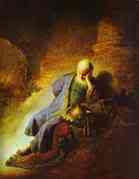
Jeremiah and the Apostle Peter (see today's Gospel reading, linked above) had in common an initial, and of course quite natural, inability to understand or appreciate the importance of suffering in the spiritual life. In that respect, they represent all of us. We abhor suffering and thus tend to flee it; if we didn't, it wouldn't be suffering. Jeremiah's prophetic words, which he knew were from God and felt compelled to proclaim, earned him fierce opposition and derision; according to rabbinical tradition, he was eventually murdered by his countrymen in Egypt, where he had taken refuge from the conquest and razing of Jerusalem by King Nebuchadnezzar of Babylon. But well before that he had to struggle not to become bitterly cynical about the God he obeyed. He didn't quite get the point of being rewarded for his fidelity with as much misery as he predicted, correctly, his fellow Jews would get for their infidelity. But he apparently never lost the conviction that there was a point.

Peter didn't get it either in the case of his beloved friend and master, Jesus of Nazareth. Naturally, Peter want Jesus to triumph as the king he was by right rather than be killed as a public nuisance. Peter didn't understand until after the Ascension what is now a flip truism: "No cross, no crown"—or, to put it in debased secular form: "No pain, no gain." No more than Jeremiah did he appreciate the ironic sense of humor shown by a God who saved his people, indeed the whole world, by getting himself tortured and executed by them and thus taking the punishment that was theirs.

But of course the logic of the thing is unassailable once the premises come from God not man. As Jesus said: For whoever wishes to save his life will lose it,but whoever loses his life for my sake will find it. Why? Our life in this vale of tears is fatally flawed by original and actual sin; clinging to it—i.e., living "in the flesh" rather than "in the spirit"—implicates us hopelessly in the spiritual death that caused physical death to enter the world. To enjoy the life God has planned for us from all eternity, we must accept suffering as the negation of what is fatally flawed about ourselves. That is what teaches us the detachment necessary for dying to self in order to live for God. The seed must "fall to the ground and die" before it can bear lasting fruit.

Such, in effect, is St. Paul's advice in today's second reading:

I urge you, brothers and sisters, by the mercies of God, to offer your bodies as a living sacrifice, holy and pleasing to God, your spiritual worship. Do not conform yourselves to this age but be transformed by the renewal of your mind, that you may discern what is the will of God, what is good and pleasing and perfect.

The "renewal" of our minds Paul urges is a radical re-orientation, entailed by repentance and conversion, about suffering. Our supreme rule of living is no longer to be the pleasure principle but rather the high priesthood of Christ, who is as much victim as priest and is priest precisely because he has been victim. That is the pattern to be emulated by all the baptized, who form the Mystical Body of Christ. That is what the "priesthood of believers" consists in. It is not an opportunity to wield authority in the Church, though a few are granted that privilege and should accordingly tremble. It is an opportunity to become like Christ in the large and small matters of everyday life.

An attitude like that doesn't come naturally; it is a supernatural gift that must be gratefully accepted and earnesty cultivated. Most of us fail often to do so; I know I do. But I pray for the help to get up and resume the renewal of my mind; the more God grants that prayer, the more abject my failures seem, both large and small; yet the more glorious the real potential for growth also seems. Each of us knows how to enter into that pattern if we're willing to listen to the Holy Spirit. Like many men in this world, I find that my job helps.

The work is the pain; the paycheck is the gain; and even a substantial portion of the latter goes, directly or indirectly, not for my own gratification but for the needs of others to whom it is due as simple justice. All that is normal and apparently unremarkable. But I wouldn't be able to get through a day without remembering that it is a very important way in which I exercise my priesthood. Each in their own fashion, everybody has the opportunity to die and thus live. Suffering is unavoidable; we can either use it well or bring more of it on ourselves by our refusal to use it well.

For the sake of finding our true lives and homes, we must take the opportunity early and often.

Saturday, August 27, 2005

A fresh perspective on Catholic singles

Here's a link to the fourth of a five-part series on Catholic single life at Catholic Exchange. It's easily digestible and well worth it.

I especially like the distinction between the "avowed" state, whether in the form of marriage or consecrated life, and the charism of freedom that characterizes the state of those who are called to singlehood.

Part V comes next week.

Friday, August 26, 2005

The borderline between spirit and psyche

Some of the questions most vexing to spiritual counselors, and to mental-health professionals who take the possibility of the supernatural seriously, have to do with the relation between "spirit" and "psyche." The question poses itself most acutely with maladies such as depression, dissociative identity disorder (more popularly known as "multiple-personality disorder"), and what the DSM-IV calls "narcissistic personality disorder." There is no consensus about what the various causal factors in such maladies are or about how they work together. But since psychiatrists in general are a pretty secular lot, all such maladies are classified as forms of "mental illness" and are generally treated as such. And then there's the question of homosexuality. The reigning orthodoxy among gay activists and secular liberals is that homosexual orientation is something inbred, over which the subject has no control. And that seems likely in many cases. But it is by no means clear that all such things merely "happen" to people, like the flu or shingles; in at least some cases, it seems likely that some element of choice is involved. Once such a possibility is entertained, the question arises whether the categories of good and evil, instead of or in addition to those of wellness and illness, apply.

I have encountered some mental-health professionals who, despite their training and official professional doctrine, definitely do apply the categories of good and evil. I shall leave aside the debate about homosexuality, which in the present state of things is more about competing ideologies than scientific fact. But depressed people, narcissists, and multiple-personality sufferers, among others, are sometimes held morally accountable for their condition. Sometimes such people are held accountable for letting themselves get into such a state; other times, they are held accountable for continuing to be in such a state. When it's both, we have full-blown moral judgment. Even granted Jesus Christ's wise injunction "not to judge"—i.e., not to claim knowledge that only God can have—such a judgment is doubtless objectively true in some cases; in others, it doubtless is not. But the mere fact that it naturally suggests itself puts the lie to the widespread claim that the conditions for which people are sometimes judged are just mental illnesses. Such "illnesses"—sometimes in their origin, sometimes in their persistence—can themselves be symptoms of evil choices made in the heart, ones that could have been otherwise.

I do not suggest that we deal with such persons merely as "sinners" rather than as "patients." We know too much about brain chemistry and other influences to dispense with treatment in the familiar sense. But it seems reasonable that, if people must want to get well in order to get well, then obversely, something evil that they want accounts for their getting or staying sick.

M. Scott Peck, of The Road Less Traveled fame, has had some interesting thoughts on this. He does not pretend to have an all-encompassing theory, and of course neither do I. But one thing I'm sure of: Satan, who is real and personal, is especially active among the mentally ill.

Monday, August 22, 2005

The Infallibility of the Ordinary Magisterium

In the archived thread over at Pontifications entitled Newman on Papal Infallibility, one of the most important ideas discussed was that of the infallibility of the ordinary "teaching authority" (magisterium) of the Catholic Church. From my perspective, that is certainly a key theological issue facing the Church today; I would even say that, in one respect, it is the most basic. Ever since Vatican II's aggiornamento, which opened the Church to the world just when the world was going crazy, there has arisen a virtual habit of faith among many Catholics that I can describe no more economically than as the obverse of that legalistic minimalism which afflicted equally many Catholics prior to the Council. Instead of seeking, like the old legalism, to base one's spiritual life only on what the Church says one must believe, do, and avoid, the new legalism seeks complete freedom in all areas where theologians do not agree on what the Church says one must believe, do, and avoid. The key to removing the intellectual underpinnings of that newly prevalent, and in some ways worse, bad habit is further development of the doctrine, authoritatively but only briefly propounded in Lumen Gentium § 25, of the infallibility of the ordinary magisterium ('IOM' for short).

The far better-known dogma of papal infallibility, formally defined by Vatican I, concerns the exercise not of the ordinary but of the "extraordinary" magisterium, of which it is also an instance. The ordinary magisterium is simply the teaching authority of the Church as exercised in ordinary, day-to-day circumstances. The extraordinary magisterium is the teaching authority of the Church as exercised in special circumstances calling either for resolution of a disputed question or clarification of traditional doctrine in more precise and authoritative terms; almost always, that occurs by means of the decrees of a general council or a unilateral papal definition. The ordinary magisterium proposes for our belief the entire deposit of faith entrusted to the Church by Jesus Christ himself for preservation and ever-deeper but never-exhaustive understanding; the extraordinary does not add to that deposit, but expresses this or that aspect of it in terms that may never be repudiated even if and when they can be improved. Traditionally, and not terribly controversially, Catholic theologians acknowledge the exercise of the extraordinary magisterium as manifesting the infallibility of the Church as a whole. And in theory at least, most will now grant that the ordinary magisterium can also be exercised infallibly by the bishops as a whole, with or without formal papal confirmation. Thus Lumen Gentium:

Although the individual bishops do not enjoy the prerogative of infallibility, they nevertheless proclaim Christ's doctrine infallibly whenever, even though dispersed through the world, but still maintaining the bond of communion among themselves and with the successor of Peter, and authentically teaching matters of faith and morals, they are in agreement on one position as definitively to be held [definitive tendendam].(40*) This is even more clearly verified when, gathered together in an ecumenical council, they are teachers and judges of faith and morals for the universal Church, whose definitions must be adhered to with the submission of faith.(41*)


Prima facie, one might think that that passage obscures our issue somewhat. The last sentence refers to the extraordinary magisterium even as the former refers to the ordinary; after all, the intent of the bishops in council was to teach about their own infallibility, whether teaching ordinarily or extraordinarily; and whether the quoted teaching is itself "ordinary" or "extraordinary" is itself a matter of debate among theologians. But whoever has the better of that debate, the teaching in question binds Catholics and actually illuminates an important similarity, beyond just its exercise by bishops, between the ordinary and extraordinary magisterium of the bishops.

Whether the infallible exercise of the magisterium described in the quotation be of the ordinary or the extraordinary kind, it entails the bishops' collectively proposing something for belief "definitively." That was a real and vital clarification. It means that infallible exercises of teaching authority need not consist in either the pope's unilaterally or the bishops' collectively propounding formal dogmatic definitions. Something short of that sometimes suffices, in theory at least, for definitiveness and thus infallibility. That puts the lie to the claim, common even among educated Catholics, that only formal dogmatic definitions by popes or by councils ratified by popes require from Catholics "the assent of faith." (The scope of that "religious assent" for which Vatican II called is a separate matter that should be discussed, but which space prevents me from discussing here and now.) What remains controversial, however, is the question by what criteria instances of IOM may be identified. More briefly: just how do we know what is definitive tendendam, short of dogmatic definition?

To a certain extent, the answer seems clear enough. Thus, e.g., in his book Creative Fidelity, whose title is the same as that of a book by Catholic philosopher Gabriel Marcel, ecclesiologist Fr. Francis A. Sullivan argues that the Apostle's Creed, the virginal conception of Jesus, and certain other doctrinal statements fulfill the relevant criteria. Indeed they do; and pointing that out is helpful for appreciating the importance of Vatican II's teaching on IOM. But one may well ask whether sticking to such relatively uncontroversial examples suffices. Given the properly catechetical role of infallibility in general, I don't think it does.

The point of invoking infallibility is to assure the faithful that what is said to be taught infallibly is true. Given as much, of what use is claiming that some person or group is teaching infallibly unless there's some edge to and question about what is being taught? After all, if the bishops each said they were going to die, they would be teaching infallibly but idly. Less trivial but still instructive, Catholics of late have not exactly been in an uproar over the infallible proclamations of the Immaculate Conception and Assumption of Mary. Few Catholics are offended by those dogmas; fewer still dispute them or the claim that they are infallible. Indeed, that is why not a few commentators have said that the dogma of papal infallibility is too radical to risk applying to any but uncontroversial cases and is, for that very reason, all but useless. With IOM too, the cases in which invoking it would be most useful are precisely the most controversial. So is IOM also to be kept under wraps and brought out only when hardly anybody would care?

Some would say so. For a generation after Vatican II, theologians in general and the Vatican in particular said virtually nothing about IOM. (A notable exception is the lengthy article by Germain Grisez and John Ford, "Contraception and the Infallibility of the Ordinary Magisterium," Theological Studies 39, No. 2, June 1978, pp. 258-312.) Such silence was itself notable as debate raged in the Church about the usual issues of sexuality and gender, which remain controversial at least in the mutually reflective eyes of the media and the aging "progressive" wing of Church professionals. But what has gone relatively unnoticed even amid all the controversy is that the previous pope, in concert with the aide of his who is now pope, have actually invoked IOM in at least two cases that can hardly be said to be uncontroversial: women's ordination and abortion.

In his peremptory 1994 "letter" to the bishops on women's ordination, Ordinatio Sacerdotalis, John Paul the Great made the following celebrated (or notorious, depending on one's viewpoint) statement:

Although the teaching that priestly ordination is to be reserved to men alone has been preserved by the constant and universal Tradition of the Church and firmly taught by the Magisterium in its more recent documents, at the present time in some places it is nonetheless considered still open to debate, or the Church's judgment that women are not to be admitted to ordination is considered to have a merely disciplinary force.

Wherefore, in order that all doubt may be removed regarding a matter of great importance, a matter which pertains to the Church's divine constitution itself, in virtue of my ministry of confirming the brethren (cf. Lk 22:32) I declare that the Church has no authority whatsoever to confer priestly ordination on women and that this judgment is to be definitively held by all the Church's faithful [emphasis added].


And on October 28, 1995, the Congregation for the Doctrine of the Faith's responsum ad dubium on OS's teaching asserted:

This teaching requires definitive assent, since, founded on the written Word of God, and from the beginning constantly preserved and applied in the Tradition of the Church, it has been set forth infallibly by the ordinary and universal Magisterium (cf. Second Vatican Council, Dogmatic Constitution on the Church Lumen Gentium 25, 2). Thus, in the present circumstances, the Roman Pontiff, exercising his proper office of confirming the brethren (cf. Lk 22:32), has handed on this same teaching by a formal declaration, explicitly stating what is to be held always, everywhere, and by all, as belonging to the deposit of the faith [emphasis added].


Now of course, the dissenters always point out that Ratzinger's responsum was not an "infallible" statement and therefore cannot be cited to establish that JP2's declaration in OS was itself infallibly made. But that reflex reaction misses the point altogether. It is true that neither document is the sort of document, or utilizes the form of statement, to which Catholics are accustomed as media for infallible teaching; but that is because Catholics traditionally expect, for that purpose, definitions that are acts of the extraordinary magisterium, whereas the two documents were meant to be taken jointly as establishing that the ineligibility of women for priestly ordination has been infallibly taught by the ordinary magisterium. Trying to establish that by means of an act of the papal extraordinary magisterium would accordingly have been self-defeating. Doctrines taught with IOM are, by definition as it were, not defined as dogmas. So if there is such a thing as IOM at all—and there is—then the Magisterium of the Church has to be able to say where it applies without thereby evacuating it. That's just what John Paul and Ratzinger did on the question of women's ordination. An equally impressive, if somewhat less controversial, example of the same sort of move may be found at Evangelium Vitae § 57ff, which I commend to the reader's study.

That such was the previous pope's intent in OS is made abundantly clear by his clause therein: "in order that all doubt may be removed." Doubt was being removed not in the sense of silencing all dissenters but in the sense of establishing, by a definitive act, that IOM here applied. Subjective doubt cannot always be dispelled, but in some cases a teaching can be presented in such a way as to remove all objective grounds for calling it doubtful. The dissenters continue to dissent because some don't believe there is such a thing as IOM at all and others believe that, if there is, it applies only in relatively uncontroversial cases. But as Wojtyla and Ratzinger have also made plain in all the pertinent documents, there are criteria for identifying where IOM applies even in controversial cases: those where the teaching in question "has been preserved by the constant and universal Tradition of the Church and firmly taught by the Magisterium." Such a criterion may dispense with poll-taking or with quibbles about how big the poll's percentage-in-favor must be; a synchronic consensus is not sufficient in itself—as the case of limbo showed—and isn't even necessary if a diachronic consensus ab initio can be identified. Where application of the quoted criterion is controversial even among bishops as well as theologians, the controversy can be settled by an act of the ordinary papal magisterium viewed as itself an indispensable part of that of the bishops as a whole. As Cardinal Dulles has rightly said, the pope can and may "solidify" the relevant consensus "by giving voice to it" in a definitive act that does not define dogma but does indicate what is definitive tendendam.

By such means, OS and EV have helped bring some Catholics into line. That they have not succeeded in doing so for all is only to be expected, for the approach employed is new and based partly on the not-much-older formulation of Vatican II. But that approach has a signal advantage that should be exploited in other controversial cases, such as that of the similarly traditional and unbroken teaching against contraception understood as direct, voluntary interruption of the generative process. By utilizing their magisterium in the way John Paul the Great did, the present and future popes can exercise the Petrine ministry of unity collegially and thus without resurrecting old disputes about the wisdom of unilateral papal definitions of dogma. Surely that is not only of great ecumenical value but also an invitation to Catholics to re-immerse themselves in the riches of their tradition and assimilate more thoroughly to the true mind of the Church. Such is a needed, long-overdue antidote to the left-wing legalism of the progressives that competes with, and has largely supplanted, the right-wing legalism of the traditionalists.

Friday, August 19, 2005

When the basics pack punch

Image hosted by Photobucket.com
The following from the Pope's first address at World Youth Day is surprisingly basic for such an academician:

"The Ten Commandments are not a burden, but a sign-post showing the path leading to a successful life. This is particularly the case for the young people whom I am meeting in these days and who are so dear to me. My wish is that they may be able to recognize in the Decalogue a lamp for their steps, a light for their path (cf. Ps 119:105). Adults have the responsibility of handing down to young people the torch of hope that God has given to Jews and to Christians, so that “never again” will the forces of evil come to power, and that future generations, with God’s help, may be able to build a more just and peaceful world, in which all people have equal rights and are equally at home."

Basic, but politically subtle. "Equal rights" must be based on the Ten Commandments. How well that resonates with the American Declaration of Independence's reference to "the laws of nature and of nature's God," which specify the "self-evident" truth that "all men are equal" and certain of their right are "unalienable"! So much for secular liberalism. We may and probably should keep church and state separate; but when we thrust God so far out of public life that bedrock moral norms may no longer be acknowledged by the state as anchored in him, then any and all rights are fully reduced to claims that some people not only can but may choose, for reasons of their own, to grant or deny others. There is no middle way. That's a message the EU, and increasingly the US, need to hear. Which will it be?

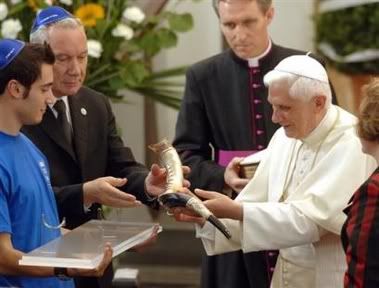
Following the Decalogue also would help people feel "equally at home." That's why the Pope made such a point of addressing Jews, and the topic of Jewish-Christian relations, as he visited an ancient city in his own homeland. If the German people had truly remembered and cared about the Decalogue, there would have been no Nazi regime and no Shoah. And nowadays there are more nations than the Germans who need to hear the message that all humans equally—the most depraved of malefactors, the innocent in the womb, even the most handicapped—belong in God's world.

There's no better way to get the message heard than to deliver it to young people with the conviction and enthusiasm that can truly touch their hearts. The Pope's full address can be found here.

Tuesday, August 16, 2005

The "theology" of gay marriage: Part Deux

Recently on this blog, I criticized an argument for gay marriage that I found noteworthy because it is theological not secular. Only after composing that post did I discover that its author, Todd Bates, wrote his PhD thesis in philosophy in the same department, and even under the same professor, I did! That it occurs in such a small world makes the debate partly personal for me. As an Episcopalian, of course, Bates does not operate with quite the premises I do as a Catholic; so for me, the rest of his argument's interest has come to lie mostly in how its premises illustrate some of the larger theological problems in the Anglican Communion. Yet now I note a rejoinder to my criticism that defends Bates' argument and comes from a Catholic: Joe Cecil of In Today's News. Hitting at home, that presents something of renewed interest.

Stated baldly, JC's thesis is that I have failed to show Bates' key premise to be false. I appreciate the implicit acknowledgment that I have in fact identified the key premise; but like another critic of mine to whom I've replied at Pontifications, JC seems to have things precisely backwards. Since the very concept of same-sex marriage is incompatible with the unbroken teaching of the Church, as sustained by Scripture, Tradition, and natural law-arguments, the burden is on the concept's proponents to show that the teaching of the Church is false. That I did not, in my reply to Bates, show that the teaching of the Church is true is no criticism of my claim that Bates failed to show his key premise, which is incompatible with said teaching, to be itself true. Interestingly, Bates has indicated that he is quite circumspect about the potential success of carrying the burden of proof; but JC says some things that can be construed as beginning to do so. So it is to JC's arguments that I shall now briefly address myself.

JC begins his argument with the apparently unexceptionable claim that the author of Ephesians starts with the collective relationship between Christ and the whole Church, and from that relationship, he draws the image of what Christian marriage should be like. (That JC is careful not to identify St. Paul as the author is itself a sign of an education whose premises I would question; but that is an issue for another day.) Thus, the author does not start with the concept of monagamous permanent committed consensual sacramental marriage between persons who possess equal dignity, and draw conclusions from that concept about Christ's relationship to the Church. That much is true. The concept of marriage so understood is distinctively Christian and was not the prevailing social norm in any pre-Christian society. But what is said to follow?

Consider:

He [the author] is drawing from the collective experience of the whole to formulate moral directives for the several or the individual. Interestingly, what the author of Ephesians is doing is saying that Christ is united to the body in such a real way, that this is why Christians cannot divorce: "the two become one flesh."
And now the punch line:

...precisely the relationship R between Christ and a man that becomes the basis for a heterosexual man to be mutually submissive to his wife and consider himself in union with her. Thus, if it is the relationship R between Christ and a man that is the basis for a hetersexual man to consider himself in union with his wife, how much more so does R serve as the basis for a homosexual man to consider himself in union with his lover? (Emphasis added.)
That is interesting and important. It shows that the Pauline and Christian concept of marriage does indeed depend, to some extent, on how Jesus modelled for men in marriage the kenosis (self-emptying) of which the author of Ephesians, by tradition, also spoke in Philippians 2. The only question is whether gay men can imitate that model just as well in committed homosexual relationships as straight men do in sacramental marriage as traditionally understood by the Church.

The Church's answer is clearly no. In keeping with Paul's very traditional abhorrence of sodomy, unmistakeably expressed elsewhere in his epistles, the Church has always taught that legitimate genital activity must be confined not only to marriage as she has always understood it but also—this is essential—must be of the inherently procreative sort even if, per accidens, procreation happens not to be possible. The ways in which the New Testament and the Church developed the concept of marriage have always assumed that. Accordingly, and following what she understood to be the mind of Christ, the early Church believed that her concept of monogamous, indissoluble, and thus sacramental marriage was simply restoring how things were "in the beginning." From the standpoint of prevailing norms, both Jewish and pagan, marriage so understood was indeed a social innovation; but it was one which was meant to restore what every human society had corrupted, including but not limited to homosexual liaisons. The Church has always insisted—though not always, to be sure, with the same language and emphasis—that the procreative dimension of marital sex must not be separated from the unitive. Somehow the procreative has been understood to be inseparably connected with the unitive as described in Ephesians 5. On such a premise, gay marriage is simply a null hypothesis that, as such, cannot model R as Christ intends.

People nowadays question said insistence largely, I believe, because until very recently it has never been adequately explained. JC, of course, implicitly rejects it, as do almost all "progressive" Catholics. And natural-law explanations, though valid as far as they go, do not go nearly far enough. But a fuller, remarkably profound and beautiful explanation is at hand in John Paul the Great's "theology of the body." It actually explains why the unitive significance of genital activity cannot dispense with the procreative. In so doing, it sublates the old natural-law approach into a richer, higher, more appealing synthesis characterized by a thoroughly biblical personalism. I do not have time or space here to get into the details, but people like JC would do well to explore them before rejecting a premise the Church has always held and is not about to abandon.

In conclusion I note that JC's procedure is, at best, dubiously Catholic. If his position is correct, then the Church has been in error for nearly 2,000 years about a matter of great moral and sacramental importance: the very nature of marriage. Now that consequence by itself would not disturb JC inasmuch as he has elsewhere argued that the Church's refusal to ordain women to the priesthood is "immoral and heretical." (See his post to that effect at Pontifications along with my reply.) But the fact that any person could claim loyalty to a church that he believes has always been in error about at least two matters of great moral and sacramental importance beggars my understanding. That holds quite generally; but in particular I have never understood "progressive" Catholics. If one wants to be progressive in the sort of way JC does, there are mainline Protestant denominations that would make one feel very much at home.

Monday, August 15, 2005

The Feast of the Assumption

As has become their wont, most of the U.S. Catholic bishops are not requiring the faithful to attend Mass today. After all, the Feast of the Assumption of Mary falls on a Monday this year; going to church two days' running is apparently too onerously ascetical for contemporary Americans with cars. And we wonder why there's been a sex scandal among priests? Why the rates of divorce and abortion among Catholics roughly matches that of the general population? I'm no saint either, but that's precisely why I'm going to Mass today. As I age and meditate on the truths of my faith, I am more and more awestruck by the Mother of God and want a little of her to rub off on me. And there's something about this feast which attracts even some secular thinkers.

The great psychologist Carl Jung, for example, regarded Pope Pius XII's bull Munificentissimus Deus, defining the Assumption as a dogma of the Church, as the most important spiritual event since the Protestant Reformation. Thus:

The logic of the papal declaration cannot be surpassed, and it leaves Protestantism with the odium of being nothing more but a man’s religion which allows no metaphysical representation of woman. In this respect it is similar to Mithraism, and Mithraisim found this prejudice very much to its detriment. Protestantism has obviously not given sufficient attention to the signs of the times which point to the equality of women. But this equality requires to be metaphysically anchored in the figure of "divine" woman, the bride of Christ. Just as the person of Christ cannot be replaced by an organization, so the bride cannot, be replaced by the Church. The feminine, like the masculine, demands an equally personal representation (Answer to Job [Routledge & Kegan Paul, London, 1954], pp. 170-71).

As Jung realized, the proclamation of this dogma heralded the rise of the feminine in modern Western culture by emphasizing that it is a woman who is, par excellence, what each of the faithful is called to become. What's more, I've often wondered why women almost always outnumber men in church settings. Having pondered Jung's words, I think it's just because the feminine in each of us is more apt to receive the man Jesus Christ into our hearts. In a sense, we are all feminine to God's masculine.

Satan, leader of all who rebel against God, is both frightened and shamed by the Queen of Heaven. That's all the more reason to attach ourselves to her.

Sunday, August 14, 2005

The Real "Matrix"


Get this from The Washington Times: "An edgy poster showing a somber Catholic priest in full black cassock and sunglasses posed like "The Matrix" star Keanu Reeves is proving so popular that the U.S. Conference of Catholic Bishops has snapped up 5,000 of them." Those copies are arriving in Cologne for World Youth Day, which starts tomorrow. I hear the scoffing, of course: another feeble marketing gimmick to arouse interest in a life with long hours, no sex, and commitment to preaching unfashionable doctrines. But something is stirring; incredibly enough, it's been gaining momentum since the clerical sex-abuse scandal exploded in 2002.

The article also notes what nobody denies: "The Rev. Edward Burns, executive director of the USCCB's secretariat for vocations and priestly formation, said 544 men were ordained by U.S. dioceses in 2004, compared with 449 men ordained in 2003. " Judging from the rate of seminary applications, the uptick is almost certain to continue. That doesn't just reflect the increase in what used to be called "late" vocations; it runs across all eligible age groups. Many of the younger men are motivated by the ideal of heroism imbibed from movie icons such as Neo of "The Matrix" and Gandalf, leader of the forces of good in The Lord of the Ring trilogy. (Those of us who were reading Tolkien decades ago apparently didn't get it well enough.) Think about it: these guys actually see the priesthood as a hero's life of fighting for good against evil. No stuffed shirts looking for sinecures, they. And they're right: if one loves Jesus Christ at all, then one takes his mission and his doctrine seriously enough to embrace heroism as what's required to dedicate one's life to him. In a world where the contrast between good and evil is ever starker, the seminary and ordination stats are starting to reflect such renewed motivation.

For Catholics of my generation, the baby boom, this is nothing short of amazing. Most of us were too caught up in the sexual revolution even to consider, much less handle, the idea of celibacy for the sake of the Kingdom. Our parents hardly discouraged us as they muttered bitterly about the bad old days of no birth control and no divorce. Well, a generation of birth control, divorce, materialism, and assorted other ills has produced a backlash among Gen-X and even younger men. They find nothing inspiring in the ethos of secular hedonism. The best of the recent epic and adventure movies are clearly speaking a different message to their hearts. Some actually want to give themselves as gifts to The Mighty and Eternal One. And the gifts are falling right into the laps of the often-hapless bishops.

"Where sin abounds, grace abounds still more."

Saturday, August 13, 2005

Newspeak is not fantasy

In abortion politics, language is everything. Not even the good, grey New York Times can sustain the pretense of objectivity in reporting about the topic. And you don't have to take that as just another "propaganda" thrust from the "pro-life crowd." No less a balanced, veteran religion journalist than Newsweek's Kenneth Woodward says that the way the Times treats the topic of partial-birth abortion is irrefragable evidence for this conclusion about its halls and cubicles: It is a strange world where “women” carry “fetuses” but where it is forbidden to ever write that “mothers” carry “babies.”

Such is one outcome of documented, across-the-board efforts at the Times to maintain fairness and objectivity in how it reports on controversial issues. On many issues such efforts bear fruit, but not on this one. Try as they might, they just can't bring themselves to make the slightest concession to ways of speaking about abortion that might humanize the conceived child in the womb. That is why, says Woodward, when legislation on abortion is the news, it is almost always depicted in the media as “restricting” abortion rights, when in fact such legislation could, with equal justice, be described as “protecting” unborn life. In the MSM generally, it apparently won't do to acknowledge that there could be a life objectively worth protecting whether or not the mother sees it that way. An unborn child is only a person if its mother, for reasons of her own, chooses so to regard it; if she doesn't, it isn't. (Gee, there's a whole bunch of things I wish I could make so just by wishin' and believin'. Anybody in favor of equal rights for men in that department?)

Coverage of partial-birth abortion has made such ideological use of language particularly clear. Proponents and opponents are speaking different languages. The language of the opponents is closer to the physical reality. All across the larger abortion debate, it is closer to the spiritual reality as well. Which is why the proponents of abortion won't use such langauge themselves.

Similar tactics by pro-life groups are considered evidence of "fundamentalism." Tu quoque?

Thursday, August 11, 2005

Blackmailed for existing


It would appear that the Chinese Government's one-child-per-family has had two major effects beyond population control. (See the Zenit story.) One has been fairly widely noted by sociologists: because of the traditional preference for boys, the number of men in the rising generation will be markedly greater than that of women, thus leaving many decent men all but unmarriageable. Large numbers of unattached and unattachable men is by itself a recipe for considerable social unrest. But another effect has gone virtually unnoticed: many children of both sexes who are not their parents' first are born but, given mandatory legal abortion for any conceived children beyond the first, are left entirely unregistered with the authorities. Their very existence is illegal. That has begun to create an underclass easily exploited through blackmail. Taken together, the two classes of rejects cannot but constitute a powderkeg.

That may well have far more lasting and far-reaching effects than the religious persecution and bureaucratic corruption that also characterize the current regime. I used to worry that China would establish itself as a superpower to rival or surpass the United States. I now worry that it may do so in terms of social disintegration.

A bright spot: At least the number of Christians now outstrips the number of Communists.

Wednesday, August 10, 2005

Irony-deficient editing

How about this for a juxtaposition?

A 13-year-old giant panda gave birth to a cub at San Diego Zoo, but a second baby died in the womb, officials said Wednesday."--Associated Press, 3 August 2005

A cancer-ravaged woman robbed of consciousness by a stroke has given birth after being kept on life support for three months to give her fetus extra time to develop."--Associated Press, 3 August 2005

Sigh. Hat tip to Diogenes at Off the Record.

"The more things change..." department

From one of the most prominent 20th-century British philosophers:

Christianity taught that men ought to be as chaste as pagans thought honest women ought to be; the contraceptive morality teaches that women need to be as little chaste as pagans thought men need be.

—G.E.M. Anscombe, "Contraception and Chastity" (1972).