"You shall know the truth, and the truth shall make you odd." ~Flannery O'Connor

Thursday, April 20, 2006

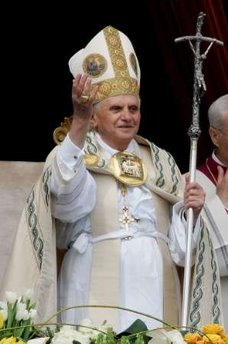
Is B16 nasty enough?

I raise that question in an ironic spirit because, after this pontificate's first year, the consensus among aggressively orthodox Catholics—of whom some consider me one—is that Benedict is not kicking enough butt. In his anniversarial summary, NCR's Vatican correspondent John Allen speaks as wisely as usual, and speaks well of the Pope; but he notes that the Right is somewhat uneasy.

Needless to say, the butt that such Catholics want to see kicked is progressive butt, and progs are generally relieved that they have not felt the boot—at least not nearly enough to propel them out the door. But the progs also think the Pope too accommodating toward the traditionalists, who want a "universal indult" for Roman Catholics to worship according to the Tridentine Rite. Though they have not got that—at least not yet—negotiations with the SSPX are earnest and ongoing. And of course he has repudiated none of the moral and ecclesiological teachings that so outraged the progs while he headed the CDF. Clearly this pope is nobody's ideological hatchet man. But neither can he be said to pull punches when punches are called for.

On the question of Islam, for example, he has taken a harder line than his predecessor. While by no means giving up on respect and interreligious dialogue, he insists on "reciprocity." That means that if Muslims expect and enjoy the right to practice their religion freely and openly in non-Muslim lands, then Christians and others should enjoy, even if they do not expect, the same right for themselves in Muslim lands. Needless to say, such reciprocity is not forthcoming in most Muslim lands and probably won't be for a very long time, if ever. That is a clear violation of the UN Charter—not to mention the UN Universal Declaration of Human Rights—to which most such lands ostensibly subscribe. And that very disparity affords the Church and the West a moral high ground that secularist "tolerance" of other cultures does not. A very smart move.

Then there's the question of Western decadence, about which Muslims often have uncomfortably accurate things to say. In his Passion (Palm) Sunday homily, B16 addressed himself especially to young people thus:

The cross speaks of sacrifice, it was said, the cross is a sign of the negation of life. We, however, want a full life, without restrictions and renunciations. We want to live, we just want to live. We do not let ourselves be limited by precepts and prohibitions -- it was said, and continues to be said -- we want wealth and plentitude. All this seems convincing and attractive; it is the language of the serpent that says to us: "Do not be fearful. Eat calmly from all the trees of the garden!"

You just can't get more explicit than that. Then, on Good Friday, there was this meditation on the Seventh Station of the Cross:
Our arrogance, our violence, our injustices all press down upon the body of Christ. They weigh upon him ... and he falls a second time,to show us the unbearable burden of our sins. But what is it that today, in particular, strikes at Christ’s holy body?

Surely God is deeply pained by the attack on the family. Today we seem to be witnessing a kind of anti-Genesis,a counter-plan, a diabolical pride aimed at eliminating the family. There is a move to reinvent mankind, to modify the very grammar of life as planned and willed by God.
[1]

But, to take God’s place, without being God,is insane arrogance, a risky and dangerous venture. May Christ’s fall open our eyesto see once more the beautiful face, the true face, the holy face of the family.The face of the family which all of us need.
I suppose one could get even more explicit than that, but why bother once more? Everybody knows what's being referred to.

The Pope appears unlikely to clean house by showing the door to unruly family members. As I've often suggested before, demographics are at least as likely to winnow the chaff as juridical measures and would be far less costly. Instead, Benedict proposes the true, the good, and the beautiful; he calls the false, the evil, and the ugly by their right names; and he invites all, by example as well as word, to conversion of heart. Unlike some of my fellow conservative Catholics, I've come to believe that, for the moment at least, that's about as nasty as he needs to be.

Wednesday, April 19, 2006

B16 on Intelligent Design: mathematics

Yesterday I quoted a bit of the Pope's recent Q&A philosophizing on intelligent design. One commenter noticed that B16 thinks of mathematics—at least at a certain level—as something we invent rather than discover, so that its remarkable fit with the structure of the laws of nature suggests an explanation in terms of a grand designer. Since there is an alternative view of mathematical ontology, I think the commenter was right to be surprised by that.

Philosophers of mathematics divide roughly into "platonists" or "realists" and "nominalists" or "anti-realists." (If you have studied some philosophy, go here for background.) The realists are those who take the indispensability of mathematics for science as evidence that mathematical entities (which I shall call "M's" for short) belong in our ontology, our inventory of what-there-is, so that M's can be said to "exist." But we need to be clear about what that means. There's a sense in which M's exist whether we've discovered them or merely thought them up. If the former, they exist "objectively" like natural objects such as water and the Sun; if the latter, they are only mental entities, objects of thought, i.e., what the scholastics called entia rationis. So, M's clearly exist; the question is what sort of existence they have.

Given that question, mathematical realists face a further one: if M's exist objectively, so that we discover rather than invent them, how do they exist other than as mere objects of thought? They aren't material objects; they aren't spirits, like God or angels; indeed, they neither act nor change. If one grants that there are different kinds of existence, there doesn't seem to be any good answer to that question. Yet some realists, such as the late W.V.O. Quine, field the difficulty by saying that existence is univocal, so that it's not something you get in different sorts at all. Thus, to say of such-and-such that it "exists" is simply to say that it is the value of the variable in a true statement of the form: "For some x, x is F" or "There is an x such that x is F', where 'F' stands for a predicate. Such-and-such exists, therefore, just in case we can say something true about it; in the strict sense, that's what it means to say that such-and-such exists. If that's so, then it doesn't matter whether M's are invented or discovered. Even if M's are invented by human thought, they exist objectively just like artifacts such as chairs and computers.

But that solution comes at a price: existence itself is taken as a logical rather than a metaphysical notion. Thus, to exist is to belong to a universe of discourse in an n-order predicate calculus. While some 20th-century and contemporary philosophers in the tradition broadly called "analytic" don't have a problem with that, others do, and it certainly does seem counterintuitive. Rather than commit to defending mathematical realism by means of ontological univocity, then, some philosophers would rather be mathematical anti-realists and leave the broader ontological issue open.

The problem faced by anti-realists is to explain how it is that a mere human invention works so well in the discovery and expression of the way the world works, sometimes called "the laws of nature." Some try to do it by appealing to those laws themselves. Given the mathematical structure of the laws of nature, it would be surprising if evolved beings intelligent enough to understand those laws did not think up M's. But it's hard to see how that appeal is any different, in the final analysis, from realism. If the laws of nature are mathematical, then M's are there to be discovered, and what we think we think up are really just the formal features of what's already there. Our intelligence does not invent M's but merely abstracts them from natural objects. That's pretty close to the view of Aristotle and St. Thomas Aquinas.

Now if, in face of that, we persist in being mathematical anti-realists, then the only explanation on offer for the fit of mathematics with nature is the kind the Pope suggests. But of course one would then have to have very good reason to be an anti-realist about M's to start with. I can't think of any.

Tuesday, April 18, 2006

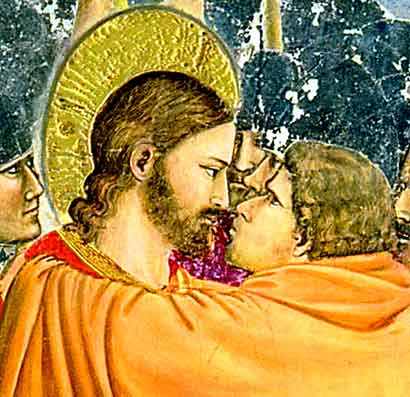
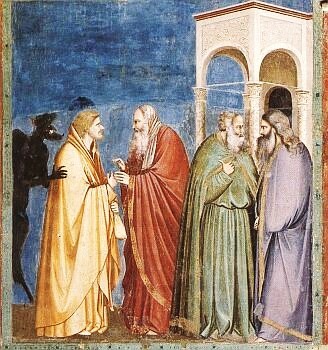
Judas: a fitting secular saint

Several Catholic bloggers have noted and praised a trenchant article posted at American Digest entitled "Judas: A Saint for Our Seasons." I share most of their enthusiasm. While overheated in spots, the author's main point cuts right to the quick of our society: the point of publishing the Gospel of Judas is to "sanctify treason." The editors of National Geographic would scoff at that, of course. But their hearts have reasons that their reason does not know.

The educated élite of our society, for the most part, worships Self and hates God. That's why we have rampant materialism, no-fault divorce, legal abortion, hatred of country, and do-it-yourself religion. It's all about "my needs" and my ideas; the result is betrayal of loved ones, of our cultural patrimony, of God, and ultimately of our very nature. Betrayal is our meme under various names. That's why, over the last several years, very old heresies are regularly resurrected by the media around Christmas and Easter time. Something similar was operative with Judas. He betrayed the Son of God because the latter didn't present the divine as the former thought he should. A Messiah who wouldn't tackle the Romans was a deluded disappointment that had to be put paid so that we could "get on with our lives."

In the end, of course, the treason served God's purpose. Jesus saved us by being killed and rising from the dead, even as Judas killed himself by losing his soul and lost his soul by killing himself. Demographics suggest that the same is happening to the West. Only a saving remnant will know and care in time. The cultured despisers won't be around.

B16 on Intelligent Design

Hardly anybody seems to have noticed that the Pope has said something intelligent about ID. It is not terribly original but it does cast a more interesting light on the topic than one usually finds. I quote in full before commenting further.

The great Galileo said that God wrote the book of nature in the form of mathematical language. He was convinced that God gave us two books: that of Sacred Scripture, and that of nature. And the language of nature – this was his conviction – is mathematics, which is therefore a language of God, of the Creator.

Let us reflect now on what mathematics is. In itself it is an abstract system, an invention of the human spirit, and as such in its purity it does not really exist. It is always realized approximately, but – as such – it is an intellectual system, a great, brilliant invention of the human spirit. The surprising thing is that this invention of our human mind is truly the key for understanding nature, that nature is really structured in a mathematical way, and that our mathematics, which our spirit invented, really is the instrument for being able to work with nature, to put it at our service through technology. It seems an almost incredible thing to me that an invention of the human intellect and the structure of the universe coincide: the mathematics we invented really gives us access to the nature of the universe and permits us to use it.

[...] I think that this intersection between what we have thought up and how nature unfolds and behaves is an enigma and a great challenge, because we see that, in the end, there is one logic that links these two: our reason could not discover the other if there were not an identical logic at the source of both. In this sense, it seems to me that mathematics – in which God as such does not appear – shows us the intelligent structure of the of the universe. Now there are also theories of chaos, but these are limited, because if chaos had the upper hand, all technology would become impossible. Technology is trustworthy only because our mathematics is trustworthy. Our science, which ultimately makes it possible to work with the energies of nature, presupposes the trustworthy, intelligent structure of matter, [...] the “design” of creation.

To come to the definitive question, I would say: either God exists or he doesn’t. There are only two options. Either one recognizes the priority of reason, of the creative Reason that stands at the beginning of everything and is the origin of everything – the priority of reason is also the priority of freedom – or one upholds the priority of the irrational, according to which everything in our world and in our lives is only an accident, marginal, an irrational product, and even reason would be a product of irrationality. In the end, one cannot “prove” either of these views, but Christianity’s great choice is the choice of reason and the priority of reason. This seems like an excellent choice to me, demonstrating how a great Intelligence, to which we can entrust ourselves, stands behind everything.

But to me, it seems that the real problem for the faith today is the evil in the world: one asks oneself how this is compatible with this rationality of the Creator. And here we really need that God who became flesh and who shows us how he is not only a mathematical logic, but that this primordial reason is also love. If we look at the great options, the Christian option is the more rational and human one even today. For this reason, we can confidently elaborate a philosophy, a vision of the world that is based on this priority of reason, on this trust that the creative Reason is love, and that this love is God.
Wow. These were off-the-cuff remarks at a Q&A session! An enormous amount of ground is covered here with the sure-footedness of an old professor who hasn't lost his edge. The reference to "the great Galileo" should tip one off that one is not dealing with a dogmatist, only with a defender of dogma. I don't have time to discuss particulars right now, but I do invite comment and will say more in subsequent posts.

Monday, April 17, 2006

Is Cardinal Mahony a criminal?

Anybody who knows me, either personally or by my writings, knows that I do not raise such a question lightly or out of any deep-seated hostility to the Church. When I remember that Jesus Christ himself was condemned and crucified as a criminal, I do not want to use such a term for a successor of the Apostles, the majority of whom were martyred as criminals. But I can think of no way to avoid raising the question in the case of the Archbishop of Los Angeles, Roger Cardinal Mahony.

Leave aside my problems with his theological and liturgical predilections, which fall on what one might call the moderate left of the spectrum. I am thinking simply of his confrontations with the secular authorities about clerical sexual abuse and immigration. On the former, his record has not been encouraging. Until forced to do more, he arguably did almost as little as Cardinal Bernard Law did in Boston. Law was eventually forced by pressure from below and above to resign; yet Mahony has repeatedly stonewalled the efforts of local courts and prosecutors to gain access to diocesan records about such goings-on. The U.S. Supreme Court has just refused to let him continue to do that. We'll see what happens next. On immigration, he has effectively taken the line that current Congressional efforts to regain control of our borders are immoral and that, in effect, any broad-based restrictions on immigration are immoral. That encourages parishes and church agencies to disobey even current laws. That the Church of Los Angeles is not prosecuted for that is testimony only to the political influence of Hispanics in California and on President Bush.

I do not want here to debate the wisdom of the aforementioned stances of Mahony or judge him personally. I think it's both a theological and a political mistake to draw the lines in the sand where he has, but that's beside the point. The question at issue is a purely objective one: is he a criminal or not? I wish I felt certain the answer is no.

How much can the smoke of Satan be dispelled?

In 1970, lamenting the many ills that followed upon the Second Vatican Council, Pope Paul VI asserted that "the smoke of Satan has entered the sanctuary" of the Church. Apropos of that, the Pertinacious Papist, Dr. Phil Blosser, has posted about a recent interview with that treasure of the Church, Dr. Alice von Hildebrand, on the occasion of the publication of her new biography of her late husband, The Soul of a Lion. That's of interest because Pope Pius XII, informally but in my view rightly, called Dietrich von Hildebrand "a 20th-century doctor of the Church," and the latter was the first prominent German intellectual to denounce the Nazis. Of course, the combox discussion following Blosser's post is all too typical, with the prog priest Joseph O'Leary sneering at AVH and her defenders. But the substance of the interview is well worth pondering.

One of the most interesting aspects of AVH's discussion was her account of opposition the beatification of Pope Paul VI. Apparently, she and Dietrich had told him, to his face and as a couple, that his failure to make the teaching of Humanae Vitae explicitly de fide had permitted great harm to come to the Church, especially to the credibility of her teaching authority. I agree. That, combined with his butchering of the Roman Rite, actually visited great harm on the Church. The effects are very much with us. While Montini personally was both orthodox and humble, his policies were generally disastrous.

The disaster consists in what is a de facto, three-way schism in the Church today. On the "Left" we have the progressives, whom I call "progs" for short, and on the "Right" we have the traditionalists, often called "rad-trads." (The political categories of left and right are only an analogy, but often apply literally to individuals; thus the majority of progs are political leftists and the majority of trads political rightists, though there are notable exceptions because the underlying categories of ecclesial politics far transcend those of secular politics.) As Fr. Richard John Neuhaus of First Things has pointed out, progs and trads agree that Vatican II represented a decisive break in the story of the Church, so that we may now speak in effect of a new Church discontinuous with the old one. The main difference between them is that the progs think the new Church is a good thing and want her to become newer still; the rad-trads think she's a bad thing and want her to recover her lost virtue. Neuhaus calls progs and trads respectively the left and right "branches of the party of discontinuity." (The article of his I've linked above appears, in slightly revised form, as a chapter in his trenchant new book Catholic Matters, which I highly recommend to everybody for whom the Catholic Church matters.)

In the "Center" are the continuants, called "neocons" by progs and trads. They think the post-Vatican-II Church is the same Church as before, needing today only a "reform of the reform." The best representatives of the Center, the continuant party, are of course popes John Paul II and Benedict XVI. The truly loyal Catholics are those who follow them. But among active Catholics, it cannot be taken for granted that the Center is the majority. The progs who do not believe what the Church has always taught, and the trads who believe that the Church no longer teaches what the Church had always taught before, are together at least as numerous. The majority are not in formal schism, but refuse to have anything to do with each other and, for good as well as bad reasons, are most dissatisfied with the current hierarchy. While a few trad groups have long been in formal schism with Rome, a small but growing number of prog groups are now too, founding churches presided over by ex-Catholic priests and a few women who have been "ordained" for the purpose. To the trads, the loyalists are the Left; to the progs, the loyalists are the Right. The loyalists caught between such extreme viewpoints considers themselves just—well, Catholics.

This mess has come about because of Paul VI's mistakes. John Paul II tried to deal with the de facto schism in various ways, many of them quite impressive. His encyclicals alone—even aside from his media stardom and evangelizing travels—are sometimes breathtaking. But he failed to impose discipline on many of the clergy and, by extension, imposed almost none on the laity. Perhaps he and the present pope are waiting for demographics to do slowly what confrontation would do quickly. For obvious reasons, the progs don't produce many babies or priests, and the trads only have only so many sympathetic bishops to accommodate them. In the meantime those senior loyalists who, like Alice von Hildebrand, remember the old days as the good old days can only pray for the next generation.

Sleeping and dying

Tom Kreitzberg at Disputations has posted an interesting meditation on those. It seems to be more a product of Good Friday and Holy Saturday; but on second thought, it's appropriate for today.

Tom makes clear that sleeping and dying, when done prayerfully, entail an act of trust in God. Of course it is quite possible, indeed it happens all the time, that people sleep and die as unbelievers. They do both just because they have to, attaching no further significance to them. Even so, sleep as opposed to fitful dozing does entail a kind of trust. One who sleeps well trusts that nobody is going to come and victimize them as they sleep. Perhaps that's a kind of natural catechesis about death. If we trust that reality is ultimately beneficent, we can die well even if we don't know a benevolent source.

The Resurrection enables believers to have that trust. Most unbelievers don't have it, and when they do it's because they know the truth under another description. Maybe that's why so many health-care dollars are spent on people in the last few weeks of life. But it doesn't have to be that way. The late pope showed us the right way.

Sunday, April 16, 2006

An argument for the Shroud's authenticity

This is one I haven't heard before. It seems powerful to me. Comments?

Two good Easter homilies

How much Easter will you have?

Following up on the preaching of an abbess, Tom Kreitzberg of Disputations has made one of those analogies of faith that I so much love.

He points out, correctly, that the joy one can have on Easter Sunday depends on how much one has denied self during Lent. The more genuine the crucificixion, the more genuine the resurrection: a kind of metaphysical chiaroscuro. He then extends that point to one's eternal destiny.

Speaking of death, the good sister said: "The measure in which we are faithful is the measure in which we will be ready to embrace the physical actuality when it comes." Tom adds:
...it is also the measure in which we will be ready to embrace the spiritual actuality when it comes. Good Friday comes once a year, and then comes Easter. Our own deaths will come once, and then comes the Day that has no evening. What it means to you when that Day comes depends very much on what you did on the days given to you in this life.
I can think of no more economical way to sum up the dialectic of Christian life. It enables me to face my sufferings and duties, without despair, as the means of that self-diminishment for others which I need to make room for Christ. How much glory I attain when I die will depend on how well I made myself such a living sacrifice.

If only I could remember that the next time I'm ready to complain about the unfairness of life.

Happy Birthday B16!


Many more years!

Christos Aneste! Alethos Aneste!


Let all pious men and all lovers of God rejoice in the splendor of this feast; let the wise servants blissfully enter into the joy of their Lord; let those who have borne the burden of Lent now receive their pay, and those who have toiled since the first hour, let them now receive their due reward; let any who came after the third hour be grateful to join in the feast, and those who may have come after the sixth, let them not be afraid of being too late, for the Lord is gracious and He receives the last even as the first.

He gives rest to him who comes on the eleventh hour as well as to him who has toiled since the first: yes, He has pity on the last and He serves the first; He rewards the one and is generous to the other; he repays the deed and praises the effort.

Come you all: enter into the joy of your Lord. You the first and you the last, receive alike your reward; you rich and you poor, dance together; you sober and you weaklings, celebrate the day; you who have kept the fast and you who have not, rejoice today. The table is richly loaded: enjoy its royal banquest. The calf is a fatted one: let no one go away hungry. All of you enjoy the banquet of faith; all of you receive the riches of his goodness. Let no one grieve over his poverty, for the universal kingdom has been revealed; let no one weep over his sins, for pardon has shone from the grave; let no one fear death, for the death of our Savior has set us free: He has destroyed it by enduring it, He has despoiled Hades by going down into its kingdom, He has angered it by allowing it to taste of his flesh.

When Isaiah foresaw all this, he cried out: "O Hades, you have been angered by encountering Him in the nether world." Hades is angered because frustrated, it is angered because it has been mocked, it is angered because it has been destroyed, it is angered because it has been reduced to naught, it is angered because it is now captive. It seized a body, and lo! it discovered God; it seized earth, and, behold! it encountered heaven; it seized the visible, and was overcome by the invisible.

O death, where is your sting? O Hades, where is your victory? Christ is risen and life is freed, Christ is risen and the tomb is emptied of the dead: for Christ, being risen from the dead, has become the Leader and Reviver of those who had fallen asleep. To Him be glory and power for ever and ever. Amen.

St. John Chrysostom

Saturday, April 15, 2006

Shadow and light

The Church's liturgy for the morning of Holy Saturday is called Tenebrae, meaning "shadows." A shadow is a patch of darkness made by a body's blocking of a light that is present and effulgent. That is why this day is my favorite of the liturgical year.

Holy Saturday begins with the apparent defeat of God by the Devil: the burial of Jesus' ravaged, bloody corpse; his rocky tomb guarded by soldiers; the women weeping nearby for him; the utter dismay and despondency of the scattered Apostles; the body of Jesus' well-paid betrayer hanging from a noose made by his own hand. Holy Saturday ends with the bursting forth of a supernal light driving away the darkness, conquering death and fear with eternal life and boundless love. In between are the shadows thrown by our flawed selves in that light, selves destined to be broken and remade in glory. By taking our flesh and letting his body be killed, in the most humiliating way possible, Jesus empowered us to transcend the limits the flesh holds for us under the thralldom of sin. Someday, many of us will have transcended it, thus becoming what we are re-created to be. Some, having apparently fallen asleep, have done so already. Some, preferring the hell made by their own pride to the heaven made by humble submission to God, might never do so. But in the meantime, so many of us stand between light and darkness, throwing shadows we take for reality.

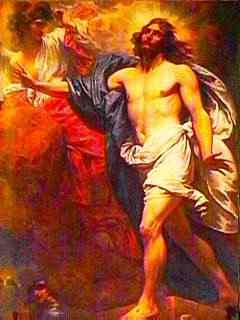
We are not so enslaved by sin as to believe that the darkness alone is reality. But neither do we love God enough to believe that the shadows are insubstantial, that they would disappear if only we surrendered ourselves enough to become beacons of light ourselves. So much of life consists of sufferings to which we are led by the shadows we remain content to throw. That, one must admit, is inevitable in a world still warped by the Fall. But as the Pope said on Maundy Thursday, evil does not have the last word. The great restoration, the apocatastasis, has begun with what we shall celebrate tonight: Jesus' resurrection from the dead.

Let us not be like the Apostles, who had to have the Good News announced to them by a faithful woman not given their office—and even then would not believe until they had seen for themselves what she was talking about. Let us be like that faithful woman, eager to believe what God reveals to us of little faith. In the meantime let us repent of being throwers of shadows.

Friday, April 14, 2006

The Pope's Way of the Cross


This stuff certainly does hit modern society hard, as did then-Cardinal Ratzinger's Good Friday meditations last year. I'm sure it would be too sanguine to hope for less Mr. Nice Guy from here on out, but at least it's clear that the Pope will take the occasion of the Lord's crucifixion to note how we crucify him today.

I'm about to use these at my own personal Stations of the Cross at my parish church today. The weekend reaction from the prog media will be quite enough to amuse later.

An American Good Friday

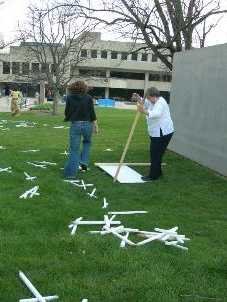
Michelle Malkin today relates and comments on the serious antics of one Sally Jacobsen, a professor of English at Northern Kentucky University. Apparently, Jacobsen was so outraged by a pro-life display of crosses on campus that she took her class to the site and strongly suggested that they trash it. They did. You may find the story here.

We don't even have to wonder what the reaction of somebody like Jacobsen would be if a Christian (as distinct, natch, from a Muslim) group on campus were to destroy advertising for, say, The Vagina Monologues. Only the politically correct may express themselves through destruction of property, you see. Here's how the thought process—not to be dignified by the name of 'reasoning'—goes: "If I, a defender of women's rights, am confronted with a public expression of religiously motivated opposition to abortion, then violence is being done to me and I have the right to defend myself with violence. If, on the other hand, a religiously motivated group is confronted with a public expression of feminism and uses violence to eliminate that expression, then violence is being done to me and to all women, and we have the right to defend ourselves by suppressing it." Conceited though it may be, this sort of thing is no mere academic conceit.

Essentially the same ideological irrationality is played out every day in domestic-violence cases. In most states, a woman can get a DV "protective order" merely by saying that she fears the possibility of violence or has been verbally abused. By such means, and many times per day across this country, husbands and fathers who have committed no crime are ejected from their homes and lose the right to contact their children as well as their wives. Because it gives the mother an overwhelming advantage when custody is considered in the ensuing divorce, the DVPO is becoming a common tactic for ending marriages. Though the laws are written in gender-neutral fashion, men de facto rarely have such recourse—and if they try to have it, they are usually laughed out of court. Similarly, when police get a DV call, the man can be arrested merely on the woman's word that he threatened her, whereas the reverse does not hold. Worse, the man can be and often is arrested for defending himself from physical violence he hasn't initiated, whereas the woman will only be arrested if it is unmistakably clear that she has committed such violence without any being committed against her. I don't need to document such assertions: any police officer would tell you essentially the same thing. I know their truth firsthand. This is not to deny that domestic violence is a serious matter; people who physically harm those they live with should be punished—when there is clear evidence that they have done so. It is simply to criticize the ludicrous double standard beloved of feminism and the courts.

Feminism is crucifying the family in this country: from the most innocent, i.e., unborn children, to the least innocent, i.e., abusive husbands as distinct, of course, from abusive wives. In crucifying the family, it is crucifying the Lord. If we let it continue to crucify reason as well, our society has no future.

Thursday, April 13, 2006

Why is this night different from any other night?

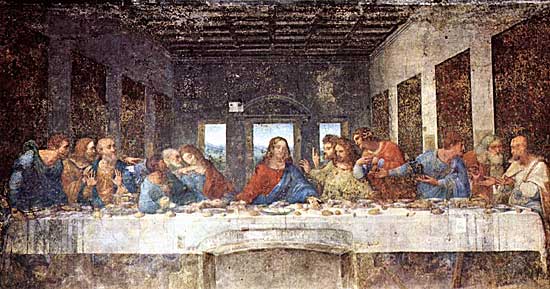
That I pick for Holy Thursday the question that Jews pose to their children at the Passover seder should require no explanation. We need not concern ourselves with whether The Last Supper was truly a Passover seder or only a chaburah meal, marking a formal gathering of spiritual friends of a kind well-known in the Judaism of Jesus' time. What makes tonight different is that the institution of the Eucharist on this night marks the Passover of the Lord and equips us for our own.

That is often overlooked on a day when the focus is very often on all the controversies surrounding the ministerial priesthood and the liturgy. Too many of those about the former concern sex and gender; too many of those about the latter are matters of taste. Both tend to distract in the wrong hands, i.e., the usual hands. The real significance of tonight is that the Old Covenant is fulfilled in the New with the manna that is the Eucharist. That food is God himself in the flesh, given so that we might each be nourished on our exodus from slavery to sin into the glorious freedom of being his children.

The Gospel reading tonight was John 13: 1-15. Lay people sometimes wonder why St. John, unlike the Synoptics and even St. Paul (1 Corinthians 11: 23-26), does not mention the actual institution of the Eucharist, and presents instead Jesus' washing of the Apostles' feet and a long "priestly prayer" that almost certainly is a literary interpretation of what was actually said. Scholars who lack faith sometimes argue that this shows how John's community thought the main tradition needed correction. But there is neither a mystery nor a problem with such a substitution. John is presupposing the standard account of the Eucharist's institution and is, rather, offering a more mature theology of it for the instruction of the Church.

It's amazing that, for the most part, Christians still don't take in such instruction. In the way members of the Church interact with each other as such, I rarely see the humility and sacrificial love Jesus modelled on that night. Those virtues are often shown within families and between friends, but not to people merely because they are brothers and sisters in the Lord. That lack must be filled if the Church is to survive as an intentional community. To that end, let us hearken to Jesus' "priestly prayer" (John 17) and become what we receive at the Eucharist.

Holy Thursday: God or the Girl?

Thanks to the good offices of a friend, I've previewed the A & E "reality" miniseries God or the Girl, which premieres this Easter Sunday. While better than most media productions that touch on the topic of priesthood and celibacy, it is all too typical of the world's reaction to the interest of some young men in becoming Catholic priests: Why on earth would you want to be celibate? Have you gone off your meds and out of therapy? As somebody remarked over at Amy Welborn's blog, Barbara Walters and her producers can't quite close their gaping mouths on that subject. Alas, neither can the masses of nominal and not-so-nominal Catholics. It's time for that to change.

The show isn't bad as such things go. It is respectful even if barely comprehending. That is why it provides an ideal opportunity for the hard core of Catholics to explain to young people, women as well as men, why consecrated celibacy's value is as great as its rarity. Toward that end, I have two points to make as a man who wanted to be a priest in youth and has taught as an adjunct in three seminaries—one of which had refused to admit me as a student. (Irony du jour, that.)

First, "the world"—which here includes nominal and not-so-nominal Catholics—doesn't get the celibacy thing for one simple reason: it does not grasp that one can respond to Christ's love with a loving gift of one's whole being, so that the opportunity to serve him by giving oneself to directly to the whole Church turns celibacy into a positive vehicle for precisely such a self-gift. Thus the self-gift entailed by celibacy "consecrates" as a space for grace and service what would otherwise be a mere absence, a hole in one's being. Men with a true vocation involving celibacy experience the sacrificial part of it as a mystical participation in the life of their Lord, and are accordingly nourished by it. Unless one is a well-formed and utterly committed Catholic, one cannot understand this. If one is, then one does—and one laments only its too-great rarity these days.

Second, and as the series' title suggests, it must be admitted that the Church has been doing a lousy job of presenting both consecrated celibacy and marriage as vocations. For devout Latin-Rite Catholic men, the real choice is not "God or the girl" but rather that between "giving oneself completely to God by giving oneself completely to the Bride of Christ, His Mystical Body, the Church" and "giving oneself completely to God by giving oneself completely to a particular woman belonging to that Body." The difference between those two ways of living the baptismal vocation is simply one of scope. But a further distinction is in order.

Priesthood is not, of itself, a spiritually higher state than marriage. Both are ways for men to represent, by living, the headship of Christ. Nevertheless, (consecrated) celibacy is in a sense "better" than marriage even though the latter is one of the "seven" sacraments and the former is not. Thus the Council of Trent defined:

"If anyone says that the marriage state is to be placed above the state of virginity or celibacy, and/or (atque) denies that it is better and more blessed to remain in virginity or celibacy than to be united in matrimony: let him be anathema" (Session 24, Decree on Matrimony, Canon 10 [1563]).

How can that be, if marriage is a sacrament and celibacy is not? Simple: by affording wider scope in the Church for one's gift of self, consecrated celibacy (assuming one is called to it) is of clearer and greater evangelical signficance than marriage. The latter can and often does makes sense in secular terms; celibacy does not. Its witness to the Kingdom that is already and not yet, if faithfully maintained, is more effective than that of marriage.

Perhaps some adults who watch and discuss the show will get this across to a few young people. God knows the Church needs more of that to happen.

Wednesday, April 12, 2006

Spy Wednesday and Gnosticism

I just learned today from my pastor, who presided at Mass, that today during Holy Week is called "Spy Wednesday" inasmuch as the readings are about Judas. He took the occasion to preach about the Judas in each of us and, almost as important, about the current buzz over the Gospel of Judas. (See my post about that issue.)

Though I can't say the same for the congregation of mostly elderly women, I was deeply impressed with what he said about the Gnostic background and motivation of said gospel. Everything he said about Gnosticism's theology and spiritual effects was true and timely. If anybody there needed inoculation against the Gnostic gospel, they got it.

I wonder how many other priests are giving that shot. In the big cities and affluent suburbs, they should be giving it out freely.

Pennsylvania priest driven out by gays....in the priesthood

I know, it sounds sensationalistic and self-serving. But my experience as a student, a seminary adjunct prof, and a parish DRE confirms everything this unfortunate man says. Ponder it and learn.

The putative primacy of conscience

I've gotten good feedback from prominent ecclesiastics for an article I wrote for Pontifications: "The Primacy of Conscience: Real and Imagined." The imagined primacy of conscience has probably been the single biggest justification used by Catholics, clerical as well as lay, for dissent from definitive Church teachings, especially on moral issues. The real primacy of conscience is indeed definitive Catholic teaching. But it's vital to understand the difference.

At Zenit yesterday and today, Fr. Jospeh Koterski, Professor of Philosophy at Fordham University, has given an interview in which he applies the real teaching to some controversial issues of the day. Both Part I and Part II are well worth reading. A lot of confusion would be dispelled if people took such words to heart.

Tuesday, April 11, 2006

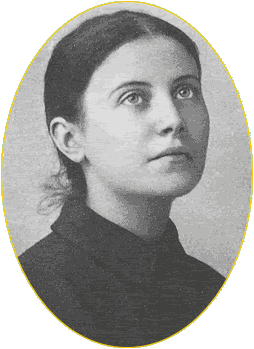
Today's saint: Gemma Galgani


This is the sort of saint that most non-Catholics find incomprehensible and even many Catholics find embarassing when they bother to think of such people at all. That's one reason why I love her.

Best described as a "victim soul," she was miraculously cured in childhood by the archangel Gabriel of spinal tuberculosis. Persistent health problems got her consistently rejected by religious orders, so she lived a life of prayer, service, and penance, first in her own family and then, from age 21, in the home of a another family who generously took her in after she was orphaned. She conversed regularly with her guardian angel and was eventually granted the "stigmata," ongoing physical manifestations of the five wounds of Christ on the Cross. Demons regularly harassed her, physically and spiritually. She died, exhausted, at 25.

Her apostolate was one of prayer and example. She had little education, never preached or wrote anything for public consumption, and had no following of spiritual devotees in her lifetime. But Satan hated her so much that he abandoned his customary strategy of stealth to attack her openly and observably. In other words, she's the complete opposite of me. That's the other reason I love her.

Saint Gemma is a patron of orphans and pharmacists. Her intercession is also efficacious for "temptations" in the classical sense of the term: trials of any kind, especially those that draw one toward sin.

Alpha indeed

For the Archdiocese of Boston, Cardinal Sean O'Malley has just authorized the use of a new adult faith-formation program called "Alpha." Having been an adult faith-formation director in the past, I was curious about the program. And having perused the creating organization's Web site, I must say it's too bad that O'Malley is right.

Appropriately named, the Alpha program ought not to be necessary. It's like going back to the beginning that often never was: an adult version of what Catholics should be getting from the Church when they are in high school or college. By framing and motivating the fundamental questions of life, to which traditional Christianity provides the God-given answers, it gives the legions of ill- or non-evangelized adult Catholics a reason to care about church. They learn why a personal relationship with God, expressed and nourished by the Eucharist, is what gives lasting meaning to life. They even hear a little about how to have such a relationship. Imagine that! With admirable realism, the Alpha approach does not presuppose much knowledge of theology or even of distinctively Catholic doctrine. So we now have an excellent springboard for parish, family, and individual efforts already made in many parishes but are appreciated by only a few.

I'd love to lead such a thing on either a volunteer or paid basis. Thank you to the creators.

The Lord's Prayer for lawyers

I found this in a post up at the Catholic discussion group I used to manage. The person posting it does not give a source, but whoever the author is, they deserve some sort of award.

Our Father, whose predominant residence pattern is widely perceived as being in an exo-atmospheric environment, your name shall be treated, as a matterof course, in a reverential demeanor appropriate to existing protocol guidelines. It is to be hoped that, as an optimal result of the ongoing situational development, your form of governmental institution may be, in accordance with the appropriate procedures, finalized within the foreseeable future, in forms applicable to both bilateral and multilateral fora. It is therefore to be hoped that you will undertake the creation of the necessary administrative modalities to ensure the provision to recipient entities of requisite alimentary sustenance. Help our antagonists to recognize that any temporary, unvalidated, and erroneous presumptions of instances of our apparent non-compliance with duly undertaken obligations arise from their refusal to objectively assess the broad parameters of our clearly-demonstrated-over-time, historic pattern of full commitment and, most importantly, have no bearing on our relationship while noting that their consistent unquestionable pattern of non-compliant behavior introduces substantial concern over the sustained viability of their willingness to observe so essential a set of international obligations. We call upon you to reduce the availability of opportunities for any perceived deviation on our part from proscribed norms, both substantive and procedural, and reduce the willingness of our opponents to examine closely the facts of our position. For it is the Father, who has complete jurisdiction, and all encompassing authority indefinitely. Provide us with appropriate modalities for coming, with all deliberate expeditiousness, to closure, unless otherwise agreed between the parties.

Monday, April 10, 2006

Bullseye quote on today's young women

Over at Jimmy Akin's blog yesterday, Tim Jones came up with a marvelously astute observation:

For decades, girls have been taught how stupid (if not evil) men are, and then they are taught that if they want to really be a success in life, they should act more like men.

The context was a review of Pink's new, parodic music video "Stupid Girl," and he does not at all indulge himself with the childish generalization that all girls are stupid. In fact, Jones' point was that the fashionably tartish dress that girls—and, increasingly, not-so young-women—seem to be going in for is largely a reaction to the above-described double bind that females in our culture find themselves in. Read the post. Jones's points jibe perfectly with my own observations of life on the front line of the gender wars.

As of now, for example, there are as many female as male students in law, medical, and business schools, and there are far more women than men in college preparing for professional careers. Before the baby-boom generation has died out, therefore, women will likely be the majority of well-paid professionals. In traditionally male fashion, the stress in our society is on competition for prosperity, status, and power; women are about to win that competition. On the home front, women initiate divorce at least twice as often as men; when there are children involved, the wife usually gets the house and child custody and the ditched husband is forced to pay support; and of course, women have the sole legal say in whether or not to bring pregnancies to term. Marriage and family are thus looking like an increasingly raw deal for men. But are women happier as they accumulate power and wealth?

There's no evidence that they are. For one thing, and for easily understood evolutionary reasons, even highly successful women would rather not marry down; yet that's exactly what many women will have to do if they expect to marry at all; at the same time, men are slowly but steadily turning off to marriage and high-powered careers. Is it any wonder that increasing numbers of women despair of ever finding a stable marriage partner and turn to lives of fornication and/or single parenthood instead? Indeed the majority of women who initiate their divorces end up as single parents. Single parenthood is a tough row to hoe no matter how much money one has—I know, I've been one, and I was better off than many. Yet most divorced women would rather hoe that row than be with the men who are the fathers of their children. Says a lot, does it not?

Mind you, it does not say that men are any more evil or stupid than they ever were. Human nature just doesn't change like that. What it does say is that, for a variety of reasons of which the most basic is economic progress, women now expect more and tolerate less from men than they have throughout most of human history—and their standards, by and large, are not being met. Nobody is happy with such a state of affairs, whatever they may say. If it continues, our society is doomed.

As Jones has indicated, one of the ways in which females, especially younger ones, have reacted is by tarting themselves up. Girls want to be girls, women want to be women, but the only way our society seems to facilitate that anymore is by steering them into trashy sexuality. The irony, of course, is that women thus resume being the sexual objects for men that feminism supposedly freed them from being. The only difference is that, thanks to widespread contraception, legal abortion, and no-fault divorce, women can now treat men the same way. If they want to, that is. But do they really?

Again, I see no evidence that most do, and the few that do are not happy people. What I see all around is mass confusion and demoralization resulting from our culture's studied refusal to respect the natural differences between the sexes and its insistence on "liberating" everybody from pre-defined roles. Men don't know how to be men and women don't know how to be women anymore. Our intellectual élites can't even admit that there is such a thing as what-it-is-to-be-a-man and what-it-is-to-be-a-woman. There's no validation for achieving healthy gender identity because we've lost all but the most superficial ideas of what that might consist in.

For a thoughtful alternative to the mess, read this.

Suffering from the Church

I generally dislike collections of quotations. When followed as such, they tend to draw attention more to the speakers than to what is said. But in my rounds of the blogs last night, I stumbed on two isolated quotations that are just too good to pass up and comment on. This post is about the first.

It is from Flannery O'Connor, one of the best and certainly one of the most quotable writers of Catholic fiction in the twentieth century. My favorite quote of hers used to be her riposte to the lapsed Catholic Mary McCarthy. At a New York cocktail party crammed with cultured despisers of Christianity, McCarthy sensitively conceded the beautiful "symbolism" of the Eucharist. O'Connor could only say: "Well, if it's just a symbol, to hell with it"—a reply all the more effective for being unstudied and unpolished. That was the Holy Spirit at work, driving quite a stake through a vampire's heart. But here's an O'Connor quote just as good:
I write the way I do because (not though) I am a Catholic....I think that the Church is the only thing that is going to make the terrible world we are coming to endurable; the only thing that makes the Church endurable is that it is somehow the body of Christ and that on this we are fed. It seems to be a fact that you suffer as much from the Church as for it but if you believe in the divinity of Christ, you have to cherish the world at the same time that you struggle to endure it.
That is now my favorite O'Connor quote. Even I, a far lesser talent, can say the same for myself. If it would not mean betraying confidences, reopening old wounds, and indirectly impugning a few innocents, I would be quite specific about how I've suffered from the Church. But my own sob story is not needed to establish what's important. What's important is that O'Connor's observation ought to apply to every adult Catholic even if it doesn't.

In fact, any serious, faithful, cradle Catholic has suffered from the Church. Some suffer because, having grown beyond emotional and spiritual adolescence, they find that their faith is at once more mature and less compromising than that of their own clergy. Some, by contrast, have suffered in such a way that they have never matured beyond spiritual and emotional adolescence. These days especially, it is evident that we suffer as much from the Church as for her. But we do so willingly because she is the body of Christ, in which our old selves are being crucified for the world's sake as well as our own. Don't forget that when the next ecclesiastical outrage surfaces.

Sunday, April 09, 2006

The Gospel-of-Judas thing

A couple of old friends have asked me what I think of the current discussion about the Gospel of Judas. Many bloggers have already commented, some brilliantly. Examples: Mark Brumley (via Carl Olson) and Al Kimel. They express my overall attitude, but I think it important to highlight something we're seeing over and over again in this post-Christian age.

Many people seem to imagine that all this earnest talk is theologically significant. It is not. The Church knew quite well about the Gospel of Judas, and for that matter the gospels of Thomas, Mary Magdalene, and a few others dubbed by Elaine Pagels as "the Gnostic gospels." In the second century many people read them and some put credence in them. In response, the Church determined that such "gospels" did not accurately convey the faith of the Apostles. There's really no good reason to doubt that. And I said as much to Elaine when I took New Testament from her at Columbia way back in 1979 when she was finishing The Gnostic Gospels, which is still in print and has influenced millions.

Remember that, throughout that century, there were people who personally knew people who had personally known the Apostles. The question whether the Gnostic gospels were faithful accounts of Jesus, his life, and his teachings could accordingly be answered fairly and accurately in a recognizably human way. We know the answer given: only the four "canonical" gospels were judged reliable as records of the apostolic faith despite their evident divergence on some points, which were of course also known at the time. In the case of the Gospel of Judas, we have the testimony of St. Irenaeus (circa 180) that the Catholic Church even then considered it unreliable. Thus:

Others again declare that Cain derived his being from the Power above, and acknowledge that Esau, Korah, the Sodomites, and all such persons, are related to themselves. On this account, they add, they have been assailed by the Creator, yet no one of them has suffered injury. For Sophia was in the habit of carrying off that which belonged to her from them to herself. They declare that Judas the traitor was thoroughly acquainted with these things, and that he alone, knowing the truth as no others did, accomplished the mystery of the betrayal; by him all things, both earthly and heavenly, were thus thrown into confusion. They produce a fictitious history of this kind, which they style the Gospel of Judas.

So, what we have here is a case of Christianity vs. Gnosticism, an argument that took place nearly 1,800 years ago and whose result we have known almost as long. Gnosticism was deemed bunk in the second century, and it's still bunk. Why, then, is it now being revived as though it were something new and exciting?

Simple: many people are bored with Christianity and prefer almost any of its competitors, including but not limited to Gnosticism. Hence the rage for The DaVinci Code, a piece of shoddy anti-Catholic propaganda masquerading as fiction. Almost anything, fact or fiction, that can be used to cast doubt on traditional, "mere" Christianity gets played up in the media and discussed in every quarter. The buzz thereby generated is then taken as evidence that something important is afoot and that the Church in on the defensive. It's the same thing one sees in lots of other areas. The mere fact that something is controverted, no matter how bad the reasons why, makes into a "controversial" issue something that, objectively speaking, there is no good reason to controvert. I shouldn't have to multiply examples of that.

I suppose that's part of the price we pay for living in a free, secular society. But it sure gives Old Scratch a wide opening indeed.

Bible memed

OK, I'm one of the privileged few whom Al Kimel at Pontifications has memed with Bible questions. My ego having been duly massaged, my answers follow each question.

1. How many Bibles are in your home?

Seven, all translations. I've thought about getting a Greek NT and Septuagint; but as those are available online now, I decided to save the money.

2. What rooms are they in?

Well, since I live in one room, using a garage to store the spillover, the answer is all too simple. I have only the NAB in my living space since, while not the best, it's the Catholic liturgical translation and thus makes it easiest to read with the Church.

3. What translations do you have?

NAB, Jerusalem, NIV, RSV, NRSV (Catholic), Douay-Rheims, and KJV.

4. Do you have a preference?

Sure: the Jerusalem, with Study Guide. The Catholic Study Bible, based on the NAB, is also OK, but the translation is pedestrian.

5. Nominate an interesting verse.

Isaiah 55:11.

Palm Sunday homiletics

Over at Open Book, Amy Welborn has asked for answers to a question from Fr. Martin Fox of Bonfire of the Vanities, namely, how long the homily on Palm Sunday should be given the length of the Gospel reading. I'm giving my answer here for two reasons.

First, Fr. Fox is a frequent commenter at Pontifications, where he and I often support each other in controversies. And so I want to give him more exposure. He is a solid priest and a useful blogger. Second, I am concerned about the content even more than the length of Palm Sunday homilies. So as not to derail Amy's thread, I'll declaim on the content issue here.

Because of the Gospel reading, the introit procession, and the blessing of palms, the Palm Sunday Mass is much longer than most. That alone is hard on parents of young children, for whom even a regular Mass is often taken up with fitfully successful efforts to keep their children well-behaved. That's a good argument for a shorter-than-usual homily at Masses attended by such families. But it's not a good argument for such a homily at other Masses. I know it's often said that standing during the long, dialogical Gospel reading is hard on some people; but if they can't stand that long without inviting a night of joint or foot pain, there's no good reason why they can't sit.

Even so, that issue is sometimes much ado about little. Of more concern to me is the issue of content. Since the readings are about the Passion, so too the homilies tend to be. I think that's a mistake. We have Holy Thursday and Good Friday to focus homilies on the Passion; on Palm Sunday, however, we are commemorating Jesus' triumphal entry into Jerusalem. The contrast between that and the Passion is so obvious as to be a given; the focus should be on explaining it—a rich theme indeed. I found a good example here, but I'm sure some reader can point me to an even better one. I've looked at Augustine and Chrysostom, but their Palm Sunday homilies are on the passion narratives from Matthew and John, whereas today's Gospel was Mark's Passion.

The contrast in question has always hit me hard. So often in life I've seen people be acclaimed, even loved, only to be turned on later by some of the same people for understandable but wrong reasons. It's happened to me; and if it hasn't happened to you, you're lucky. Jesus of course knew what would happen to him, but he also accepted the adulation of the crowd as his due even as he rode into town on a donkey to signify that true royalty is attained by humility. He would need infinite humility not only to accept the suffering he faced, but even more not to become cynical in face of it. I know that I would be tempted to the deepest cynicism, and thus to despair, if I knew I was going to save people by letting them condemn, torture, and execute me as a grave threat to public order. Only a man who is God could fail to let that embitter him.

Since he didn't let it, he has provided an example for us all and empowered us to emulate it. What example? Are we all to be messiahs? No, and it would be foolish to try. The example is that of detachment: we are to enjoy the gift of life without expecting as our due that any temporal good will last. At any moment one can lose health, job, the love of spouse, one's good name, or anything else one rightly values; and eventually, one dies. The trick is to live in such a way that physical death is a gateway into eternal life rather than eternal death. As one Orthodox saint put it: "If you die before you die, then you won't die when you die." I think Jesus approached his entry into Jerusalem that way. It was his funeral before his death because he, unlike his admirers, knew as he rode what he was going to face. If we learn to approach the real pleasures and triumphs of life as mere foretastes of eternity, as ready to surrender them as to enjoy them, then they won't get in the way of our dying before we die. One might even learn to experience them in such a way that there will be no need for a funeral when one dies.

Back in the saddle

Sorry for the past week's dearth. I've been so busy at work that it's been all I can do, other than that, to eat, sleep, answer e-mails, and reply to a few particularly juicy things at Pontifications. Also, and much to my surprise, the Holy Spirit has been speaking to me in my dreams. I usually don't remember dreams and have never been the sort to put much stock in them. Dreams are often so ambiguous that interpreting them is a form of eisegesis guided more by wishful thinking than by the unvarnished truth. But I haven't had either problem this past week. There's been much to meditate on and learn from.

Now that Al Kimel has put discussion at Pontifications into hibernation for the next two weeks, I'll have more time for this blog. Look for daily posts. Also, I'm planning a new format with my blog guru. Don't be surprised if you see it in the next week or two.

Sunday, April 02, 2006

Mary and the non-ordination of women

Note: this post also appears at Pontifications.

Defenders of the Catholic doctrine, and the Orthodox sense, that the Church has no authority to ordain women to the priesthood often point to Mary as evidence of her divine Son's will in this matter. They note, correctly, that Mary is revered in Sacred Tradition as the greatest and most powerful of mere creatures, "higher than the Cherubim, more glorious than the Seraphim," yet did not receive any formal office in the Church even as the all-male (and often rather disappointing) Apostles did. I have heard it said here and there that such a fact signifies something very important: in the divine economy, women are not to be ordained because none "need" to be, whereas some men do. I think that's true in a sense, but I have not yet seen it explained as cogently as it should be. This is my initial attempt to work toward such an explanation. The collaboration and research of others would be most welcome.

The appeal to Mary makes the valid point that sanctity and its summit, theosis, which are after all the point of being Christian, have nothing intrinsically to do with ordination. There have been many holy lay people, especially women, and many not-quite-holy clergy, who are all male. So if one can attain the summit of the Christian life without being ordained, why do some women (and men) consider ordination so important for themselves? Well, they believe they are "called" to it, so that the Church's recognizing said call seems to them a simple requirement of justice. Thus, advocates of women's ordination often dismiss the appeal to Mary as ill-disguised, ideological special pleading that offers put-upon women a mere sop as an insult to their just and legitimate aspiration to ordination. Yet what first led me, in the 1970s, to smell something fishy in that argument was the undeniable feminization of the Church.

Throughout her history, women have usually been the majority of adults in church and done the bulk of the actual work of the Church. Indeed, every parish priest knows how little—at least of a visible nature—he could accomplish without them. Nowadays, that is more true than ever, in the Catholic Church and particularly in those ecclesial communities that "ordain" women to the ministry—so much so that, if we did have women's ordination in the two communions that can plausibly claim historical and confessional continuity with the Church of the Apostles, I suspect the demographics would not take terribly long to yield a "priesthood" composed disproportionately of middle-aged and elderly women. (Among Catholic priests there would also be, I am convinced, a disproportionate number of gay and/or effeminate men, as there seems to be even now. But that issue is for another time.) Presided over exclusively by men nonetheless, the Church already has a hard time attracting laymen to church in numbers matching their proportion of the nominally Christian population. I don't even want to think about would happen if the Church were presided over by females in the same proportion in which females now populate congregations.

But such considerations only explain a suspicion. They do not prove that there would be anything intrinsically wrong with women's ordination even if what I and others suspect became reality. What would be cogent—even if not probative, inasmuch as arguments premised on articles of faith cannot compel intellectual assent any more than the articles themselves can—would be to show how WO advocates fundamentally misconceive the nature of the Church, of women, and of the priesthood. That's what I'd like to suggest. And it is on just such points that the example of Mary is supremely relevant.

The main theological point about Mariology is simple enough but seems to be curiously unmarked in most discussions: the Marian doctrines point up how Mary is always and pre-eminently what every disciple is called to be. We are all called to be God-bearers into and for the world; we are all called to be perpetually virginal, in the sense that we are destined for an eternal union with our divine Bridegroom that involves not sexual intercourse but something infinitely greater; in virtue of being reborn in baptism, we are all immaculately conceived for new and eternal life in the Spirit; in the general resurrection, all those who have accepted Christ in their hearts will be assumed body and soul into the eternal life he enjoys with the Father and the Holy Spirit. In all those ways, Mary is the figura, the type, of the Church and can only be understood in relation to the Church.

With that in mind, we can now deploy Hans Urs von Balthasar's seminal distinction between "the Marian charism" and "the Petrine charism" in the Church. The Marian charism is that of every Christian: loving submission and witness to God, in and through Jesus Christ, through which each of us made in the image of God, male and female, become by adoption what he is by nature. As such, the Marian charism is the more fundamental of the two. It constitutes that priesthood of all believers by which they make of themselves and their lives a "spiritual sacrifice" and thus share in the priesthood of the One High Priest, Jesus Christ. The "sacerdotal" or "ministerial" priesthood, which is a manifestation of the hierarchy's Petrine charism of teaching, sanctifying, and governing authority, exists solely to serve and facilitate the Marian charism of all believers. This becomes clearer on the analogy of faith.

The Church is one body with her Lord, with her as Bride and him as Bridegroom in a mystical marriage. Mary represents us all as, collectively, Bride; the bishops, priests, and deacons, bearers of the Petrine charism, collectively represent Christ as Bridegroom. Both poles are essential for the unity, efficacy, and fertility of the Church. But they do not merely represent: they help to bring about what they represent. Thus the hierarchical constitution of the Church is itself, like consecrated celibacy, sacramental even though not numbered among the official sacraments. As with everything sacramental, what the sexes are by nature, and as understood in mutual complementarity, is what makes them "fit" to be used by divine grace as sacramental signs. Thus the female is more apt by nature to represent how humanity in general is related to God and how Christians in particular are related to their Lord; the male is more apt by nature to represent how God relates to humanity in general and how Christ in particular is related to the Church. That is the only possible significance I can find in God's choice to become incarnate as a male. Everything God does is mysterious, but nothing God does is accidental or arbitrary. We cannot say that things had to be so; but it makes perfect sense that they are thus and not otherwise.

Now the Church, as Vatican II pointed out in Lumen Gentium, is the universal "sacrament" of "salvation" and "unity." Her purpose is to bring Christ into the world for its salvation and unity. As Mother of God, the pre-eminent "God-bearer", Mary is thus the pre-eminent member of the Church, indeed is the Mother of the Church, which is her Son's Mystical Body. In this she does what women in general are to do for the Church and the world. They, like she, are called to be the "heart" of the Church and the world by their loving, unreserved reception of the divine gift of Himself. Thus women precisely qua female signify how every disciple, man as well as woman, is called to relate to God. Men, on the other hand, are called to signify the divine self-giving itself, and thus signify qua male God's relation to the Church and the world. By bearing Christ into the world, women do that too, as all are called to do. To the extent we participate in the divine life by grace, we all do so merely as persons baptized into Christ in whom, and in that sense, "there is neither male nor female" (Galatians 3:28). But as Tradition has taught us from the beginning, our sexuality, our mutually oriented identities as male and female, each retain their special significance in the economy of salvation. Each represents what all are called to, but each does so in polar tension with the other.

It is precisely by emulating God's self-immolation in Christ that husbands as well as priests are called to exercise the Petrine charism of headship in the Church for the world. Within the Church, the chief sacramental means by which priests do so is offering the Eucharistic sacrifice which participates, across time, in the once-for-all self-immolation of Christ and yields for us, in the transubstantiated bread and wine, Christ himself as the food that transforms us into Him. By such means, some men are elevated by grace to a dignity that faithful women, like Mary, enjoy merely as God-bearers. Men, it seems, have to be given some specific and formal role in the oikonoumia so as to signify God as they are meant to; women just have to be, and thus to love, as they are naturally inclined to. Both sexes are used by God; but the male seems to require being given something objective and external to do, like the sacerdotal priesthood and the formal sacraments that only it can confect; whereas for the female, as for Mary, just being what she is seems to suffice. We have no record of anything specific Mary did after her Son's Ascension. No, she was just the holiest member of the young Church; all instinctively revered and looked to her. Sort of like my recently deceased Aunt Rachel in that domestic church known as her extended family.

The reservation of the ministerial priesthood to men, then, seems to be one of God's ways of elevating men to spiritual equality with women. This is anticipated in traditional Judaism, where women, unlike men, are not required to perform religious acts at set times. As Rabbi Jonathan Sacks has pointed out, women are as much the recipients of the divine promise and love as men, but partly for that reason, nothing is allowed to interfere with their ability to make home and family, the heart of society with many associated demands, their top priority. That holds for all women, even those women who are more successful at work and career than their husbands or male relatives. By their maternity, be it spiritual only or also physical, women by nature bear the divine within themselves in a more fundamental way then men. They are where God is, as it were, as distinct from just what God uses—though of course he uses women too.

When I was a boy, I always thought it unfair of God that women got to have babies while men didn't, and that men had to die in combat while women didn't. (The latter of course, thanks to the spiritual blindness of our culture, is no longer the case.) What Aunt Rachel told me in reply has always stayed with me: "Michael, God spares men the pain of childbirth because they wouldn't be able to take it, and he lets them be priests because if he didn't give them something specific and important-looking to do, they would become intolerable." Indeed. And the example of Mary explains why the same does not hold for women.

You shall be as gods....

Today's second reading, from Romans 8:8-11, has always been one of my favorite passages from the Bible. Here it is:

Brothers and sisters: Those who are in the flesh cannot please God. But you are not in the flesh; on the contrary, you are in the spirit, if only the Spirit of God dwells in you. Whoever does not have the Spirit of Christ does not belong to him. But if Christ is in you, although the body is dead because of sin, the spirit is alive because of righteousness. If the Spirit of the one who raised Jesus from the dead dwells in you, the one who raised Christ from the dead will give life to your mortal bodies also, through his Spirit dwelling in you.
Before we get into what "in the flesh"means, and the difference between 'spirit' and 'the Spirit of Christ', note how different the emphasis here is from most Western Christians' preoccupations as Christians. Most tend to think of the attainment of eternal life in juridical or even forensic terms: you believe P, Q, etc. and do A, B, etc. so as to get to heaven; refuse, and you don't get to heaven. That's an immature moral universe to live in, and it's very thin gruel. Unfortified, it causes sterility, boredom, and resentment that in turn make "backsliding" inevitable. What Paul is really on about is a new, abundant life: one infinitely more valuable, joyful, and lasting than life as we normally experience it, which is life "in the flesh." The doctrines and rules, and the deeds that go along with them, are merely expressions of that new life.

To be "in the flesh" in the sense contrary to "in the spirit" does not mean to be disembodied or to live as though the body doesn't matter. The body matters a great deal, else God would not have become truly incarnate and lived as such. The point of the things of this world, including the body and all that goes with it, is to be vehicles for what God is trying to make of us: little Christs, gods in fact, whose origin and destiny far transcends this world. To be "in the flesh" is to fail to get that point and live as though the things of this world had value and meaning apart from it. That way leads to death—eternal death, in fact. To be "in the spirit" is to get the point and live accordingly "in the world but not of it."

The Holy Spirit, who is God, empowers our souls, which are spiritual, to do just that. To the extent we accept and use that power, our very bodies and selves are transformed along with our own respective corners of the universe. Isn't that so much more exciting, and motivating, than wealth, sex, and power, which are so ephemeral? In fact, isn't it so much more realistic than the serpent's deceptive promise in the Garden of Eden: "You shall be as gods, knowing good and evil"?

In the form of the serpent, Satan promised that to our first parents as their reward for disobeying God and deciding for themselves what's right and wrong. He told them they "would not die" if they did that. But of course they did; and because they did what they did, we die too. Spiritually, in fact, we're born dead. But the real way to become gods is to die in Christ and be reborn in the Spirit, in subjection to God and to the whole Christ, i.e., the risen Jesus and the Church with which he is one body. As an obscure Orthodox saint said: "If you die before you die, you will not die when you die." That's the law of the spirit as opposed to the flesh. Obeying it is true freedom.

Saturday, April 01, 2006

Follow-up to "Where are the boys?"

Yesterday at Pontifications, I was deeply struck by a comment made by somebody with the handle 'Marcy On' in a thread about male headship in marriage:

Where patriarchal dignity is not respected, human males refrain more often from marrying, (though not necessarily from fathering children) and more women therefore live unmarried, too. American Black culture is a contemporary example
of this disaster.

And, aside from some in the feminized elite classes, most males will avoid institutions where their male dignity is not respected. Consider the gender demographics of the clergy in “mainline” churches. There is no demographic future in this.

From an evolutionary psych point of view, Christianity is certainly a feminization of religion, because it hypervalorizes love, ie, affiliation, over rank…among humans. It may have been (and likely was) a powerful and necessary softening of the patriarchal impulse. BUT, it was enacted within a larger frame of patriarchal Deity. So-called Christian feminism, by de-masculinizing the Christian God, has eroded the frame in which the revelation was meant to function. And the end result is, at best, Unitarianism in drag (ie, the Episcopal Church).

And if you have erased the significant differences between the father and the mother (and functionally made both of them mothers, one talented at it, one pathetic at it), why not erase the difference between parents and children, and make them all parents, or all children? Watching TV these days, you can see it played out. It’s not pretty. Or funny.

One way to look at contemporary liberalism is that it is the revenge of the primitive mother on the father, since it (publicly, anyway) makes affiliation trump rank in every situation. (Covertly, of course, the mother uses affiliate to create rank, as she always has). Perhaps Marduk killed Tiamat for a reason? Is there a segement of this worldview that does not either pathologize or devalue classical, ie real and actual, experience-able maleness? And when western liberal culture has reached its apogee, say, in modern Western Europe, who shows up to challenge it? The most misogynistic, violent, and patriarchal religion in history, unapologetic and ravenous, dressed in the clothing of a race-victim. Who do you think will win that one?

Burnham was right, I think, and liberalism may be the ideology that justifies and accelerates the suicide of the West. And the castrating animus hidden inside almost every form of feminism is central to it. Wouldn’t it be charming if the logical (that is, naturally and historically logical) outcome of Betty Friedan is the Burka?

Just thinkin’ out loud. St Paul is by no means a hero of mine, but I think he had a point here.

I think he did too; the Pauline point in question may be found in Ephesians 5. Marcy herself has many other stunning ones. Frankly, her (I presume the writer is female) comment inspired my post of yesterday Where are the Boys? She articulated my thoughts better and more courageously than I ever have or still have.

Thanks, Marcy. I don't know who you are, but I hope you see this.

A hearty "Vaffanculo!"

Right now, my two favorite Catholics (besides the Pope, of course) are SCOTUS Justice Antonin Scalia (left, gesturing in a manner I'll get to in a moment) and Bishop Fabian Bruskewitz of Lincoln, Nebraska. Within the past week, both have in effect said "Vaffanculo!" to their critics, which is Sicilian for a phrase everybody on earth (well, almost everybody; it begins with 'F') understands very well.

The Boston Herald describes the occasion and context of Scalia's gesture very well. It is a gesture that usually accompanies the utterance of "Vaffanculo!" Nobody who's grown up in an Italian-American neighborhood, as I did, needs any introduction to this. I love the fact that Scalia did it with great gusto and humor while emerging from Sunday Mass. But that's only the latest reason why he's my favorite lay Catholic at the moment. The main reason, which is why I welcome the latest one, is that he's a jurist who thoroughly understands natural law and why it is the basis of this republic's moral legitimacy. He has been joined on the bench lately by two fellow Catholics, John Roberts and Samuel Alito. The former's moral views are definitely pro-life; for good reasons, he's been too cagey so far to let on what he'd like to do about Roe v Wade. As for Alito, his professional nickname is 'Scalito'. Enough said. Everybody who cares knows that all they need is one more vote to start the counter-revolution. Oremus.

Then there's the doughty bishop, who has just defied the USCCB-appointed National Review Board's attempt to force him to use sex-abuse-education materials that he deems morally inappropriate and in any case mistargeted. Here's his statement:

Some woman named Patricia O'Donnell Ewers, who is the Chair of something
called "A National Review Board for the Protection of Children and Young People", has said that her Board "calls for strong fraternal correction of the Diocese of Lincoln." The Diocese of Lincoln has nothing to be corrected for, since the Diocese of Lincoln is and has always been in full compliance with all laws of the Catholic Church and with all civil laws. Furthermore, Ewers and her Board have no authority in the Catholic Church and the Diocese of Lincoln does not recognize them as having any significance.

It is well known that some of the members of Ewers' Board are ardent advocates of partial birth abortion, other abortions, human cloning, and other moral errors. It is understandable then how such persons could dislike the Diocese of Lincoln, which upholds the moral teaching of the Catholic Church.

The words attributed to Ewers seem to confirm the suspicion that the members of her Board are unfamiliar with Catholic teachings, Catholic ecclesiology, and even the basic rudiments of the Catholic Catechism. Rather than concerning themselves with the Diocese of Lincoln about which they appear completely ignorant, Ewers and her colleagues would occupy themselves in a better way by learning something about the Catholic religion and the traditions and doctrines and laws of the Catholic Church.

The Diocese of Lincoln does not see any reason for the existence of Ewers and her organization.

I culled the statement from here, where you can also read some of the comments people have made.

Now I will be among the first to admit that both Scalia and Bruskewitz have been a tad excessive. But all the same, it's the right sort of excess—just the sort needed in a time and climate when the other side grants itself license for far greater excess. (If you don't believe me about that greater license, just read what's said on secular-liberal and liberal-Catholic sites about the President of the United States and the Supreme Pontiff of the Catholic Church.) My heroes du jour have issued the plain talk, and gesturing, that is occasionally needed. Bravo!

Let us all pray for such courage as well as praise it.

Sex and the City of God

For anybody interested in gaining a brief, painless, and reliable overview of the Catholic understanding of sex and marriage, philosopher Phil Blosser's talk (linked in my title) is one of the best out there. Read it all.

You know, there's a lot of good, unsung evangelical work being done by Catholic lay people who believe and are excited by what the Church teaches about these topics. The clergy, however, seem to be divided largely into those who don't know about that and those who, though they know, either don't care or don't agree. None of that is a reaction to the work's quality, which on the whole is quite high, like Blosser's. I could come up with sociological explanations, but they would be almost beside the point. The real reason, I believe, is that most clergy feel futile about this range of topics.

Most are celibates who are often told, by lay dissenters, that their celibacy disqualifies them from comment. And it is true that, to the extent they are faithful to their vows, they cannot speak from direct, ongoing experience. But many vocations these days are coming from men who have had the necessary experience. And in any event, modelling the truth about sex and marriage does not require such experience. The truth is that sex and marriage, rightly undrstood and engaged in, are forms of the Christian vocation. They signify, and help bring about by signifying, that personal intercommunion of love made possible only by complete, mutual self-gift. Priests and religious who live their vocations well both understand that and model it, which is essential as a witness for the married. In the years during and after Vatican II, many abandoned such vocations or re-interpreted them so radically as to obscure that witness. And in my experience since, only a minority of priests witness to it with enough enthusiasm and conviction to be credible. The cohort of priests my age and older seem, in particular, to be dominated by men without the necessary enthusiasm and conviction. The younger priests tend to be different and better, but they are still a minority and mostly lack assignments that carry authority beyond that of the priesthood itself.

Still, things are slowly improving as those in the Church, lay and clerical, who remember what they consider "the bad old days" are replaced by those who remember only John Paul the Great. His theology of the body will only take off in the decades ahead.

Jesus Decoded

Thanks largely to the tireless work of Catholic author and blogger Amy Welborn, the U.S. Conference of Catholic Bishops now has an effective anti-Da Vinci Code website up. I thought it well to call attention to that when the mass-market paperback of the book has just come out.

Fr. George Rutler, one of the most effective writers in contemporary American Catholicism, says it well:

I am not habitually speechless, but I find myself almost tongue-tied at the number of sane and intelligent people who take seriously the claims of the popular novel, The Da Vinci Code. Discounting the self-deluded who use it as an excuse to "lose" the faith they never truly had, the situation points up the deep ignorance of many nominal Catholics. This is not an indictment: It is a summons to knowledge.

The United States Conference of Catholic Bishops has a new website (
www.Jesusdecoded.com) designed to help save people from the gossamer bliss that comes from the anesthetic quality of ignorance. The Da Vinci book creates a fantasy about Mary Magdalene, while claiming to base this on serious research. It develops a half-baked version of the heresy of Arius, who was more erudite, if less entrepreneurial, than the novel's author. The book makes ridiculous and anachronistic speculations about the Emperor Constantine and the Christian creed. All this is exposed on the bishops' website, and is treated at even greater length in various pamphlets and books by other writers who have made something of a cottage industry out of showing the delicacy of the novel's familiarity with history.

We might expect that a generation the majority of whose college seniors cannot identify Lincoln or Churchill might confuse St. John and St. Mary Magdalene. One can only hope that when a best-selling novel flaunts ignorance to a pyrotechnical degree, readers will realize how easily they are duped and how much they must learn. Lent is an appropriate time for such learning. G. K. Chesterton devoted a book to the mystery of Catholicism called The Thing. Anyone who allows his brain a little exercise from time to time will face the fact that the Catholic Church has been the most important "Thing" in the annals of civilization. But if it is only a "Thing," and not Christ among us, it will haunt to distraction. Catholicism haunts the minds of men as the Ethical Culture Society or Anti-Vivisection Society does not, and haunted men do not write books about albino Unitarian assassins. The whole world was haunted until it was inspired by the Holy Spirit who leads into all truth. Of course, we are free to remain ignorant, as Pontius Pilate preferred to do. It is only speculation, but he may have spent his retirement back in Italy reading some morbid novels.

The difficulty with that is that most of the people likely to understand it are those who don't need it in order to be inoculated against the TDC virus. Sort of like sacramental confession.