"You shall know the truth, and the truth shall make you odd." ~Flannery O'Connor

Monday, October 09, 2006

Marriage and vocation

Last Sunday's Bible readings for Mass got me thinking about the sense in which marriage, as distinct from celibacy for the sake of the Kingdom, can be called a vocation. It's not as easy a question as many seem to think, and not everybody is going to like the answer I've tentatively come up with.

It is now common, at least among pastors and pastoral theologians, to speak of marriage as a vocation. But it wasn't until at least the mid-20th-century, around the time of Vatican II, that such language came to be widely used. Indeed, I can find hardly any use of it between New Testament times and the last fifty years or so. And for more than one good reason, IMHO. Which is why I find the newfangled language rather odd.

For one thing, marriage is what most people are supposed to go in for. So it doesn't seem that there's anything there to be "called" out of in order to serve God. If a vocation is a call from God to serve him and him alone, fully and explicitly, then marriage can't be called a vocation in that sense. For as the Apostle says:

The unmarried man is anxious about the things of the Lord, how to please the Lord. But the married man is anxious about worldly things, how to please his wife, and his interests are divided. And the unmarried or betrothed woman is anxious about the things of the Lord, how to be holy in body and spirit. But the married woman is anxious about worldly things, how to please her husband. I say this for your own benefit, not to lay any restraint upon you, but to promote good order and to secure your undivided devotion to the Lord.

But of course that doesn't settle it. Paul wrote as he did to the Corinthians at a time when the Lord's return in glory was expected within the lifetimes of the believers being addressed. The resulting sense of eschatological urgency made it natural to recommend that one not marry if one was not already married, so that one could devote oneself exclusively to the spread of the Gospel. But some Christians—many in fact—were and are married. That's why Paul also wrote to the same believers: "Only let each person lead the life that the Lord has assigned to him, and to which God has called him." Thus the question whether marriage is truly a "vocation" remains open from a scriptural standpoint, so that we should ponder the question from another angle.

In the same letter, and purely in the spirit of pastoral advice, Paul tells "the unmarried" and "widows" that "it is better to marry than to burn." The question whether widows should remarry appeared to be a rather significant one for the early Church, for male life expectancy at the time tended to leave many rather young widows in its wake. Paul gave what appears to be a natural answer: if a given widow's sexual needs are such that she is unable to remain continent, then she should remarry rather than fornicate. And we're not just talking widows here, for he also says: "... because of the temptation to immorality, each man should have his own wife and each woman her own husband" (emphasis added). Now if we content ourselves with saying the primary point of marriage is to avoid sexual immorality, then marriage seems to consist more in spiritual prophylaxis than vocation. But of course Paul didn't content himself with that, and neither has the Church.

Clearly, spiritual prophylaxis is one point of marriage, and the Church has always presented it as a "secondary end" of marriage. Under St. Augustine's influence, it was of course long taught that the "primary" end of marriage is procreation, which is what justified the self-indulgence entailed by sex. Whether or not sex needs such justification, it is obviously true from a purely natural point of view that the primary end of marriage is procreation. But there is no such thing as pure nature, and marriage is in fact a sacrament; so the old language of primary and secondary ends isn't quite adequate.

Indeed, if we take seriously what Paul says in Ephesians 5 about marriage, we cannot but see the primary goal of marriage as that of being an icon of the mystery of Christ's relationship with the Church—one that is sacramental because it helps to bring about what it signifies. Procreation does not so much compete with such a goal as get subsumed under it. Just as giving new and eternal life to his people is why Christ came, so the transmission of life in the form of children is a spiritually momentous consequence of imaging, in marriage, his relationship with his people. From that point of view, it seems that marriage and family do indeed constitute a vocation. Such is how most Catholic clergy, and not a few theologically educated Catholic laity, now talk.

But there remains a difficulty, closely related to what I call "the paradox of specialness": if everybody is special, then nobody is. In a sense, every Christian is special just in virtue of their baptismal vocation. They are "called" out of the world, of this age, to bear Christ into the world as part of his Mystical Body, the Church, and thus begin their journey into eternal life. In that sense, every Christian has a vocation, and every other "vocation" is but a specification of the baptismal vocation. But if we're all special in relation to "the world," we're not all special in relation to each other. Most Christians are not called either to priesthood or to "consecrated" celibacy, i.e. celibacy for the sake of the Kingdom. The bulk are meant to marry, and some are meant neither for marriage nor for consecrated celibacy. And so it seems best, when speaking of 'vocation' from within the Church, to reserve the term for those called, within the Church, to a special form of service to the Church. Otherwise we can't distinguish what's special about the baptismal vocation from what's special about certain specifications of it.

I'm all the more convinced of that because of what I've heard many priests, celibate or married, and many "religious," all celibate, say about their vocations. Whether or not they started out "wanting" to be priests or religious, they all eventually got the sense that such was what God was calling them to be. Many priests in particular will tell you that they resisted such a vocation at first, taking a long time to surrender to God and finally to answer his call. Of course some always "knew" they would be priests. But the point is that becoming a priest or religious, whether or not one finds the idea initially attractive, is less a matter of what one wants or comes to want than a matter of coming to recognize and accept what God wants from oneself. And that, it seems to me, is essential to the idea of vocation within the Church.

Now with a few rather amazing exceptions, I don't think people usually approach marriage like that—and when they do, there's usually something wrong. Marriage is not the sort of thing one is likely to succeed at if one goes in for it primarily because one believes God wants one to. Sacramental marriage entails a wholehearted gift of self to another in both sexual intercourse and in life as a whole. Accordingly, if one does not sincerely and wholeheartedly desire to do that, and desire it for its own sake as a way of being one with one's beloved, then one is not really going in for it and is unlikely to make it work. I am convinced that such is one reason why there are so many failed marriages among Catholics today. Now that there are far fewer social and economic impediments to divorce than there once were, the sorts of factors that used to keep people in marriages where they never made a true gift of themselves to their spouses have dissipated— and we're seeing the consequences. That should teach us that the desire for marriage has to be originally and primarily autonomous rather than heteronomous: one has to want to marry, and marry this person, wholeheartedly and for their own sake, else one isn't going to make a truly sacramental go of it. And that makes marriage unlike priesthood or religious life, where the vocation comes primarily from above, from God, and must be recognized and confirmed as such in order to be authentic. One can succeed in marriage only if it's primarily something one wants, even if God wants it too; whereas one can succeed at priesthood or religious life only if it's primarily something God wants, and is seen to be such, even if one wants it too. For clarity's sake, I think we should reserve the term 'vocation' for the latter.

So here's what I'd say about marriage as "vocation". Sacramental marriage is a noble specification of the baptismal vocation, and as such is one way of living the Christian vocation. But it is not a vocation in the sense that one is "called" to it out of the normal course of things. Vocation in that sense is had only by those within the Church who are called out of the normal course of things to devote themselves exclusively to the Kingdom by serving the Church as a whole. We need the latter more than ever today.

Limbo: Doctrinal Development in Action

Click the title for Al Kimel's (the Pontificator's) foray into this topic, and comment here.

As his conclusion, he cites several other recent blog articles on this topic, among which is one of my own. Since my previous entry here on limbo has caused a long discussion that has veered into other issues, it's best to re-focus the discussion here and base it on Al's latest article.

Sunday, October 08, 2006

Hard but Good

Fr. Martin Fox's homily on today's Bible readings from Mass, which are on the indissolubility of marriage, is spot on. Click the title.

Nonetheless, the divorce rate among American Catholics roughly matches the general population's. I don't think the problem is that American Catholics, at least in general, don't care what the Church teaches in this regard. Most people don't get married planning to bail out when things get tough, and most Catholics understand why they shouldn't. I think the problem is that our secular, materialistic, and individualistic culture dominates people's sensibilities and thus forms their hearts more powerfully than any principles taught by their churches.

Perhaps that's why then-Cardinal Ratzinger was right to speak of the future of the Church as lying in small, intentional communities rather than the standard institutional settings.

Familiar, and deadly

Consider this from Jody Bottum's wide-ranging discussion of contemporary American Catholic culture at First Things:

“You remember how, you know, the old hippie types used to say, ‘Never trust anyone over thirty’? Well, they were right. Only it was their own generation they were talking about,” the thin, quiet one in the back announced as we pulled up to the hotel. “You can see it clearly out here in California. That whole generation of Catholics in America, basically everybody formed before 1978, is screwed up. Left, Right, whatever....The best of them were failures, and the worst of them were monsters.”

There’s something disturbing about that line, although one hears it often enough. Last year, a young seminarian used a version to dismiss the revelations of the priest scandals—day after day of news reports about heart-wrenching vileness: “Yes, yes,” he told me, “it was sickening and evil, but what did anybody expect? Those are just the worst examples of everything that generation did wrong.”


This quick, irritated impatience seems common in the emerging Catholic culture. You find it in the parishioners of the Polish Dominicans working at Columbia University, and in the conservatives gathered around the political theorist Robert George at Princeton. For that matter, it is present among the graduate students at such places as Notre Dame and Boston College, and among the younger theology professors around the country. The public figures of the new culture—the Catholic lawyers, magazine writers, and think-tank analysts—have it in spades: an intolerance, an exasperation, with everything that preoccupied an entire generation of American Catholics.

For the development of a new Catholicism, this doesn’t look the most-promising start.

Agreed. What do you say?

World Series of Catholic Theologians: vote!

Saturday, October 07, 2006

The Feast of Our Lady of the Rosary


This feast calls to mind two needs.

One of course is to pray the Rosary. I used to do it regularly, and keep telling myself I will again. The daily regimen of it is not for everybody, but it does most people good. Pope John Paul II explained it all for us.

The second is the need to combat militant Islam vigorously. This very feast was established by Pope Pius V in 1573 to commemorate the victory of the Catholic fleet over that of the Sultan at the Battle of Lepanto less than two years earlier. It was touch-and-go, and many had been fearing the end of Christendom. Their fear was well-founded. But that battle, as well as the Christian victory against all odds at the Great Siege of Malta, spelled the beginning of the end for Ottoman power. What we need to realize today is that the old conflict is re-emerging. We are already fighting, and will doubtless be doing so for a long time.

Now as before, the outcome is not guaranteed. While we are right to have ceased believing that we should kill, torture, enslave, or otherwise deprive people of their basic human rights because of religion, it cannot be said that the same attitude prevails among Muslims. Islam has yet to learn, and perhaps will never learn, what Christianity took over a millennium to learn. Some Muslims are behaving accordingly; and in few Muslim-controlled countries do we find the sort of "reciprocity" in freedom that the Pope constantly calls for. So, peace will not come about by a misplaced tolerance any more than by the old crusader mentality. It will only come about if we resist force and threats while respecting consciences.

Our Lady will help if we ask her, just as she did centuries ago.

T.W. Allies on the Papacy

Al Kimel (aka The Pontificator) has posted an article calling our attention to another 19-th century Anglican convert to Catholicism, saying:

Unlike Newman, Allies converted precisely because he became convinced that the Catholic claims about the supremacy of the See of Rome were demonstrably true. In the preface of his book The See of St. Peter, the Rock of the Church, the Source of Jurisdiction, and the Centre of Unity (1850), written shortly before his conversion, Allies relates how the patristic evidence for papal supremacy finally persuaded him of the truth of Catholicism...
Allies' books on the papacy are now available in downloadable form. Click the title of this post for Kimel's full article and the needed links.

Dr Scott Carson on the Pontificator on predestination

"I have always found that mercy bears richer fruits than strict justice"

So said Abraham Lincoln, a great man who presided over a long, bloody fratricidal war. My limited experience confirms it. The Amish are confirming it again.

While lots of people would probably say that the murderer was psychotic, that's too easy. He might have been literally demon-infested, or he might have been just a blackheart looking for an excuse. In any case, even one's own heart is mysterious to oneself; and our present state of general knowledge is most unclear about how the spiritual and the psychological interrelate. Speculation thereon doesn't address the most important question: would we rather curse or bless?

Can anybody doubt that the forgiving attitude being shown by the families and town of the recent mass-murder victims is better, and will bear richer fruits, then cursing the murderer? I've heard it remarked that it's too bad he killed himself to climax the bloodbath, because that deprived society of two important possibilities: either kill him ourselves (judicially of course), or send him to prison for life, where he would certainly have been sodomized for a long time before dying or being killed himself. And I'm sure plenty of others wish that, in any event, he's roasting forever in hell, since what we would have done to him if given the chance would have been too good for him. It's understandable that many people deal with their emotions in that sort of way. But it only makes things worse.

The paramount task, of which the grief process is a needed part, is always spiritual healing. Indulging negativity does not aid that process. The Amish are showing us what really needs to be done. If we took the lesson, perhaps the Church's wisdom about capital punishment would be more widely heeded.

Friday, October 06, 2006

What in blazes is "Godself"?

So the Pontificator and Donald D. Hook ask, a bit more moderately. As they say, it's a linguistic and theological abomination. Some of us have always known that. Their service is to briefly and profoundly explain why.

As further proof, Fr. Stephen Freeman calls our attention to an article informing us that, according to some Church of England clerics, using masculine pronouns for God encourages wife-beating. (Such clerics would never of course say that using feminine pronouns for God encourages husband-beating; only violent husbands encourage husband-beating, you see.) Freeman's reaction: "The Brave New World is crashing down upon us. Someone needs to send for the boys at Monty Python because it’s all become too silly.”

Indeed.

Thursday, October 05, 2006

France: Teacher on the run after criticizing Muhammad

It gets worse and worse. And I especially hate it when a fellow philosopher has to twist in the wind like this.

This movie is coming soon to a theater near you. Only it won't be just a movie.

The paradox of evil

Consider the following from Orthodox theologian George Florovsky:

One defines evil as nothingness. Certainly evil never exists by itself but only inside of Goodness. Evil is a pure negation, a privation or a mutilation. Undoubtedly evil is a lack, a defect, defectus. But the structure of evil is rather antinomic. Evil is a void of nothingness; but it is a void which exists, swallowing and devouring beings. Evil is a powerlessness; it never creates--but its destructive energy is enormous. Evil never ascends; it always descends--but the very debasement of being which it produces is frightening. Nevertheless, there is an illusory grandeur even in this baseness of evil. Occasionally there is something of genius in sin and in evil. Evil is chaotic; it is a separation, a decomposition constantly in progress, a disorganization of the entire structure of being. But evil is also, without doubt, vigorously organized. Everything in this sad domain of deception and illusion is amphibolic and ambiguous. Undoubtedly, evil only lives through the Good which it deforms, but it also adapts it to its needs. But this deformed "Universe" is a reality which asserts itself.

Does that account reveal a true paradox, or does it run smack into logical contradiction?

The above passage is part of a much longer quotation from Florovsky at Ad Orientem, a blog I like because the author is Orthodox, intelligent, and willing to use a Latin phrase. One would do well to read the whole passage.

Wednesday, October 04, 2006

Nowhere to go but up

Well. We hear that the U.S. Conference of Catholic Bishops is about to give final consideration to a draft "document on contraception." Like many other USCCB documents, such as the excellent 1999 pastoral proposal on adult religious education, it will probably gather dust—unless it actually says the only things it could usefully say. It will get attention if it says that the Church's teaching on the topic is irreformable, is not optional, and that pastors must make both points clear to the faithful in every way possible. I'm hoping to hear that—even though I know that the public reaction would be mostly negative. Like that of a person embarking on a third marriage, my hope triumphs over my experience. There's nowhere to go but up.

Save perhaps for the butchering of the liturgy that took place after Vatican II, the single most destructive event in the Catholic Church within the last forty years was the response of the worldwide college of bishops to Pope Paul VI's brave, prophetic encyclical on birth control: Humanae Vitae. A few bishops' conferences endorsed it fully, to be sure; but most, like the Canadian bishops, either issued slightly veiled rejections or left the issue up to the "conscience." Inevitably, the latter response came to be code for ignoring the teaching with putative spiritual impunity. What's happened since was altogether predictable: most Catholics ignore the teaching as at best irrelevant and at worst as an embarassing vestige of the repressive past. Unsurprisingly, pretty much the same has happened with regard to most of the Church's teaching on sexual morality. Aside from the teaching on adultery—an act whose emotional consequences for the betrayed are still readily grasped—most Catholics treat Church teaching about sexual morality pretty much as they treat the teaching on contraception in particular. And it was episcopal wobbliness on the latter teaching that has led not only to the erosion of conviction about sexual morality but also about the credibility of the Magisterium quite generally. The way the contraception issue has been handled by the hierarchy since Vatican II is—save, again, for the liturgy—the single worst self-inflicted wound for the Catholic Church of our time. While giving better reasons than HV had for the traditional teaching, Pope John Paul the Great's marvelous "theology of the body" hasn't changed most minds and thus has functioned only as a band-aid. Something more must be done and can be done. Perhaps this pending document will be a start. It had better be.

Like all controversial moral topics, this one raises many questions. Anticipating some of them, I refer readers to a previous post of mine on contraception, which contains other useful links. But I want the bishops to know, and will let some of them know, that this is one handoff they can't lateral.

Cardinal Newman on the depositum fidei

With hat tip to Pontifications:

I conceive then that the Depositum is in such sense committed to the Church or to the Pope, that when the Pope sits in St. Peter’s chair, or when a Council of Fathers & doctors is collected round him, it is capable of being presented to their minds with that fullness and exactness, under the operation of supernatural grace, (so far forth and in such portion of it as the occasion requires,) with which it habitually, not occasionally, resided in the minds of the Apostles;—a vision of it, not logical, and therefore consistent with errors of reasoning & of fact in the enunciation, after the manner of an intuition or an instinct. Nor do those enunciations become logical, because theologians afterwards can reduce them to their relations to other doctrines, or give them a position in the general system of theology. To such theologians they appear as deductions from the creed or formularized deposit, but in truth they are original parts of it, communicated per modus unius to the Apostles’ minds & brought to light to the minds of the Fathers of the Council, under the temporary illumination of Divine Grace.

That's an important clue to legitimate development of doctrine. While later developments that become irreformable, by means of dogmatic definition or ordinary teaching, are not usually strict logical deductions from earlier formulations, they do make explicit what may only have been implicit in the minds of the Apostles. When some Christians—such as Orthodox apologists and fundamentalist Protestants—deny development of doctrine, they are concerned to rule out any alteration, by innovative addition or by mere negation, to the deposit of faith. That concern is justified. It is also allayed by Newman's general approach.

Yet I'm amazed by how often the point is missed. In a comment within a Pontifications thread that is now closed, Perry Robinson criticizes my adaptation of that approach thus:

There seems to be a rather significant difference between reasonably seeing [Vatican I] in the past data as implicit, AND that “Orthodox doctrine fails to recognize the full implications of what both sides believed for nearly a thousand years.” I don’t see how one gets from the former to the latter. Sure it may be reasonable to see the data that way, but that doesn’t amount to an IMPLICATION. A “likely story” isn’t the same as a proof.

When you can find something like Newman’s Essay on the Development of Doctrine, among the Orthodox, your argument might have traction, for the Orthodox do not object primarily on the grounds that such data icannot be read as being implicit in past texts, but rather that there is no development of doctrine in the first place. If God is not being, and there are no relations of being in God, then dialectic has NO place in theology. Therefore, employing the dialectic of reason to “discover” implicit teachings that become manifest later, that is the very idea of development, is simply out of bounds. The fact that on your gloss Ratzinger admits that the past sources do not pick out V1 is sufficient proof that it is not apostolic. If it were, it wouldn’t require “development.”

As for Innovation, well the filioque is a prime example. Rome opposed it for centuries while it “developed” under its condemnation, until Rome could withstand no longer.
I'm afraid that's just not how things are, or were.

When Newman and Ratzinger affirm that Vatican I's doctrine of papal primacy is implicit in the earlier data, they are not claiming that the former can be got from the latter by logical deduction, which is what Robinson's criticism presupposes. "Proof" in the logical sense is accordingly not available in this matter, or indeed on matters of revealed truth generally. From the standpoint of reason alone, the best one can get is indeed a "likely story." The question, as always, is whose story to accept. That is a question of which authority to accept, which is itself a matter of faith. Thus reason is always relevant to such matters but is never in itself dispositive. Its role is primarily negative: to rule out what is self-contradictory.

Presumably as a way of indicating that I beg the question, Robinson repeats the formula that "for the Orthodox...there is no development of doctrine in the first place." But that won't do either. For one thing, I doubt that that's an irreformable stance of the Orthodox communion itself, as distinct from the polemical stance of many Orthodox apologists. Nor should it be, for of course doctrine has developed; the question is not whether it has done so, but how it can legitimately do so. Newman gave an account of that, which is much appreciated by the present pope. Robinson tries to absolve himself of the need to do so by denying the fact to be accounted for. That doesn't so much engage the question as march on the spot.

Of course he's got what appears to be another argument: If God is not being, and there are no relations of being in God, then dialectic has NO place in theology. Therefore, employing the dialectic of reason to “discover” implicit teachings that become manifest later, that is the very idea of development, is simply out of bounds. Now for one thing, and try as I may, I've never been able to make sense of the claim that 'God is not being'. I can make sense of the claim that God is not one being among others, to be subsumed under categories such as Aristotle's; I can make sense of the claim that God's being is incomprehensible, in the sense that it's infinitely beyond what we can say about it. Both those claims are true and taken as a matter of course by Catholic theologians. But even Orthodoxy affirms that the Father is the cause of the existence of the Son and the Holy Spirit, which would not make sense if Robinson's claim were taken at face value. I don't know how to take that claim save in senses that I've just noted are shared by Catholics. Hence, his cryptic remark in passing about "dialectic" is neither here nor there, and thus provides no argument against development.

As for the filioque, it simply isn't true that "Rome opposed it for centuries." What Rome opposed for centuries was interpolating it into the Nicene-Constantinopolitan Creed. And for good reason: the clause did not express a point of faith that the East could recognize as her own. That's why Rome should never have introduced it into the Creed. But that's a primarily pastoral concern that can be addressed without altering the doctrinal landscape.

Eastern-Rite Catholicism: Its Heritage and Vocation

An informative online pamphlet by Robert Taft, SJ. Well worth reading, saving, and printing. Click the title.

And while you're at it, peruse his delightfully provocative 2004 interview with John Allen of the National Catholic Reporter.

On predestination: "Preaching the unpreachable"

An original article from the esteemed Pontificator, written last week. It got lost in a couple of shuffles but is well worth attention. Comment here.

The Trinitarian basis of koinonia

From Lionel S. Thornton, via Pontifications. Comment here.

The Feast of St. Francis of Assisi

I owe much to the Franciscan family. One priest of that family was the best boss I've ever had: Thomas Russman, PhD and OFM Cap. Another, Fr. John Frambes, was my spiritual director for over a year before his departure from where I was then living. His friend Fr. Louis Canino, whom I count as a friend too, runs the Franciscan Prayer Center in Stoneville, North Carolina, which I have both utilized and contributed to. And Fr. Benedict Groeschel, who once heard my confession, has benefitted countless American Catholics with his books, talks, and prayers. Thank you, gentleman, for carrying on your founder's legacy.

Those of you who don't know much about this saint could benefit from reading the account at Catholic Online. In the meantime, please pray with him:

Lord, make me an instrument of your peace.

Where there is hatred, let me sow love; where there is injury, let me bring pardon; where there is doubt, faith; despair, hope; darkness, light; and sadness, joy.

Lord, grant that I may not so much seek to be consoled, as to console; to be understood, as to understand; to be loved, as to love. For it is in giving that we receive; it is in pardoning that we are pardoned; and it is in dying that we are born to eternal life.

Amen.

Tuesday, October 03, 2006

Limbo: the issue that won't go away

Why do I say that about limbo when there seem to be so many more pressing concerns for Christians today? Well, the provenance and history of this issue is often cited as a standard objection to orthodox Catholicism not only by some devout non-Catholics, which is only to be expected, but also and more importantly by prog and rad-trad Catholics, whom I follow Richard John Neuhaus in calling "discontinuants." Thus if doctrine can "develop" in such a way that a belief once taught without question in the Church can be abandoned, tacitly if not officially, then the claim of the present Catholic hierarchy to teach infallibly is effectively discredited.

I've already written an article on limbo responding to that charge. That's timely because the charge is about to be revived as the Vatican's International Theological Commission reviews a draft of its pending report on limbo. The key clue to the result has already been given out by the ITC secretary-general, Luis Ladaria, SJ. On Vatican Radio, he said there is "no binding doctrine" on limbo—thus implying that it's been a mere theological opinion after all—and that "[b]ecause of recent developments, not only theological but also of the magisterium, this belief is in crisis today." I predict the eventual report will say that, while it's acceptable as opinion to believe there's a limbo, it's also acceptable to deny there's a limbo.

Beyond reviving the charge I've already addressed, that will cause many Catholics—especially women who have miscarried—to believe that all infants who die without baptism will automatically go to heaven. But as hard-hearted as it might seem to say so, such easy universalism finds no more warrant in the deposit of faith than the old rigorism. The most defensible position, it seems to me, is the one I took in my article: there is a limbo, but it's not permanent; everybody eventually gets the chance to choose definitively for or against Christ. If they've had no opportunity to do so in this life, they get to do so in the next.

Authority and Koinonia

Over at Pontifications, I became well-known for hammering on the theme of doctrinal authority in the Church. See, e.g., "Why Authority is the Issue." But as the Pontificator made his decision to close down comments, there had been raging a debate with some of the Orthodox commentators about the relation between papal authority and what's known among theologians as "the ecclesiology of communion" (the Greek for 'communion' or 'fellowship' is koinonia). Something of that debate continued over at The Ochlophobist, who was an important Orthodox contributor to the now-defunct Pontifications debate. Rather than have my contributions buried further in the long comboxes for that post, I want to speak further to the topic here.

Basically, my position is the same as that of then-Cardinal Ratzinger, which is presumably also his position as pope. (The relevant texts appear in the Pontifications combox.) Thus, that "ecclesiology of communion" which was more or less held in common by East and West in the first millennium is compatible with the doctrine of papal authority developed since by the Catholic Church. The position taken by the Orthodox, predictably enough, is that the two are incompatible. While I don't always follow the logic of their objections, the idea seems to be that the college of bishops, which comprises equals who are "vicars" of Christ, cannot constitute a body of equals united in love if one among them, as their head, can overrule or issue orders to the rest taken either collectively or individually. Thus on the Catholic account of episcopal collegiality, the college of bishops is not a true communion or koinonia as commonly understood in the first millennium. And so Vatican I's dogma of supreme papal jurisdiction is not a legitimate development of doctrine.

Let me say right off that there's no point in debating history here. Each side takes the same set of data and interprets it from within their respective ecclesiological frameworks. The central disagreement is not about what was once said or even about what actually happened back then. The central disagreement is about what the Holy Spirit meant by what was said and done back then. While that disagreement won't be settled here, or indeed anywhere anytime soon, one thing that can and should be shown is that there is no conceptual difficulty about combining authority and koinonia among equals.

For instance, in Ephesians 5, St. Paul treats wives and husbands as equals—"submit to one another"—but also says that wives must submit to husbands as "to Christ," who is Head of the Church. Thus the husband is "head" of the wife. That clearly does not mean that the husband is master and the wife slave; as rational adults, they are equals. But traditionally, it has been taken to mean that the husband has the last word when major decisions are to be made. And that has always made sense to me. In a community of two, dissensus cannot be resolved by majority vote; at the end of the day, somebody has to decide and the other has to accept that decision. Of course, nowadays, the idea that the one deciding should presumptively be the husband is quite unpopular. When they give the matter serious thought, most people say that all decisions should be joint or, failing that, that the last word should be with the wisest or most competent decision-maker—which, one must admit, is often enough the wife. Some would even say that, while men may "reign" in the home, it's pretty much always been wives who "rule." (Thus Einstein once said: "When we married, it was agreed that I would make the major decisions and my wife would make the minor ones. So far, there have been no major decisions to make.") But regardless, the very idea that one should decide and the other submit is unpopular. And I believe that's been undeniably to our cultural detriment. It goes against both traditional good sense and the nature of Christian marriage as a sacrament of Christ's relationship with the Church.

Even so, it's crucial to remember that male headship in marriage, when understood and lived as it's meant to be, is one of service not domination. With all such authority, in whatever walk of life, comes the responsibility to sacrifice oneself fully for the one(s) under authority, just as Christ did for us on the Cross. Similarly, one might say that the koinonia of the college of bishops is not crushed but rather facilitated by its having a head who sees his authority as service not domination. His supreme jurisdiction, while real, is abused if imposed arbitrarily and/or without consultation and respect. Thus papal authority as defined at Vatican I, and described further by Vatican II in relation to that of the bishops, is compatible with the ancient ecclesiology of communion. Such authority, when properly exercised, is a cross not a license.

That won't satisfy most Orthodox, of course. No refinements and qualifications such as I've outlined above will silence the objection that, whatever the papacy ought to do, the mere fact of what Vatican I says it can do is incompatible with episcopal koinonia. While I don't buy that objection, the Catholic Church needs to do more to meet it. Perhaps she could start by applying the principle of subsidiarity, so admirably developed by the social teaching of recent popes, to ecclesiology.

God as Logos, Allah as Will


Click this post's title for an illuminating explanation of that speech by the Pope.

From Pontifications: “The Church does not know more than the Apostles knew”

I have a question—OK, maybe a Socratic question. How can John Henry Newman, the 19th-century Anglican convert to Catholicism who virtually invented the idea of "development of doctrine," assure his correspondent that the Church knows no more than the Apostles knew? After all, both the Orthodox and fundamentalist Protestants would agree that the Church knows no more than the Apostles knew, but for that very reason deny that there is any such thing as legitimate development of doctrine.

Perhaps another way to frame the question is: how can "development" of doctrine not be "addition" of doctrine to the faith once delivered to the saints? I know the chorus that says it cannot fail to be addition, and thus illegitimate; but I'm interested in seeing somebody actually engage Newman (and Vatican II) on this question instead of dismissing development out of hand.

To paraphrase the Pontificator: "Some Christians don't believe in development of doctrine. They just practice it."

A Single Commandment Can Save

From Orthodox priest Steven Freeman, at Pontifications. Click the title and comment here.

The schism that balances

From one point of view, one might say it just gets weirder and weirder. Now living in DC, reunited with the Korean wife chosen for him years ago by the Rev. Sung Myung Moon of the Unification Church, Archbishop Emmanuel Milingo, 76, has launched a schism in the Catholic Church by illicitly ordaining four men as bishops. They too are married, and the aim of Milingo's acts appears to be to agitate for a married priesthood in the predominant "Latin Church" of the universal Catholic Church. Of course the Vatican excommunicated him within 48 hours. So now we have another schism on our hands—the last one being the "traditionalist" schism launched by the late Archbishop Marcel Lefevbre in the late 1980s by his ordination of two bishops for his Society of St. Pius X, which persists despite earnest talks seeking reconciliation.

The question I have about this Milingo thing is why so few Catholics seem to care. The ordinations, though illicit, are pretty clearly valid, which means Milingo has created a new church that is out of communion with Rome. That should be big news, but it's caused hardly a blip: I spent last weekend in intense contact with committed Catholics, but not one seemed to find the event worth discussing. In my puzzlement, I've just read the Catholic journalist I always turn to on extraordinary occasions, John Allen of the National Catholic Reporter. His column—part news, part speculation—is as interesting as always, but it doesn't really clear things up for me. Perhaps Catholics don't particularly care because they're too cynical to imagine that a schism over married priests and bishops will really change anything.

I care but I'm not perturbed. On the one hand, we have a twenty-year-old trad schism maintained by celibate bishops who find the Vatican too liberal, and in fact consider themselves more Catholic than the Pope. On the other, we have a new schism led by an elderly and demonstrably rather unstable bishop, whose PR line seems to be the "need" to bring back the 150,000 or so Catholic priests who have left the ministry to marry. But what's really propelling Milingo's defiance is, by his own account, the Vatican's "lack of appreciation" for his "deep spiritual gifts." Well, if those gifts are genuine, he is squandering them with this act of disobedience and schism. His misplaced and misspent pride, if nothing else, will keep this schism from growing because it's not rich enough soil for anything big and long-term. But the situation gives me the pleasure of knowing that we now have a prog schism balancing the trad one. All the sweeter for being led by a flake.

Going overboard

Fr. Martin Fox is one of those special parish priests who actually welcomes honest, detailed feedback about his homilies. That's why he posts them online, where he gets that feedback; and I expect he gets the same from a few brave, flesh-and-blood parishioners. Since I generally like his stuff, I've told him I shall join the feedback chorus.

I especially liked the closing lines from last Sunday's homily:

Most of us get intense about something. About that special someone we love; about sports, or our careers, about music, hobbies, or politics. And that’s fine. But what excuse can we have for not feeling strongly about the rights of every person, rich or poor, American or foreign, young or old, able-bodied or disabled, born or unborn? Because when someone has fallen out, or been pushed out, and they’re about to go under…That’s when you and I need to go overboard.

That's being countercultural in a way people can understand and swallow. Read it all by clicking this entry's title.

From Pontifications: Ratzinger on Peter

Click this entry's title for a very rich passage on the origins of the papacy from the theologian who is now pope. The link takes you to an entry at Pontifications. As promised, this blog now hosts all comments on posts at that blog. So if you wish to comment, open the combox here.

Monday, October 02, 2006

Why I'm joining Communion and Liberation

The short explanation is: I feel like I'm coming home after years in the wilderness.

This weekend I attended a conference held in at the Rock Hill Oratory in South Carolina by the Catholic ecclesial movement" Communion and Liberation, based in Italy but spreading worldwide. Leaders and members from Florida to New York converged for organizational planning and inspirational talks given mostly by the movement's American spiritual director, Monsignor Lorenzo Albacete of the Archdiocese of Washington. (Google him; you'll unearth quite a feast of articles.) The theme was "the risk of education," which is also the title of a book by the movement's founder, Fr. Luigi Giussani, who died last year. The picture at left is of the cover of the movements journal, which is sometimes inspiring but also needs a native-English-speaking copy editor.

Everybody I met there was not only an orthodox Catholic—which only takes one so far—but a genuine human being. Love radiated from nearly all of them, including Alabacete himself as he duly displayed what I'd heard is his ready, often sardonic wit. A good proportion of the attendees were highly educated; a few of the professors gave talks. But nobody was stuffy or tried to hide their struggles and weaknesses. The people I met are saints-in-the-making who'd be the last to think of themselves as candidates for canonization. Indeed, my impressions confirmed what Albacete is often quoted as saying: CL is "Opus Dei for bad people."

That's exactly why I'm so comfortable among them. Most other "orthodox" Catholic groups, settings, and organizations now have little use for me, a twice-divorced father of three who, six years ago, had what was once called a "nervous breakdown" and spent almost the whole next year, including three months as an inpatient, getting full-spectrum treatment for depression (and I mean they threw everything at me). Even though, save for that year, I've been working full-time at quite ordinary jobs to pay child support, it's been nearly a decade since I've had what could be considered a suitable job for somebody with my background, interests, and abilities. By this time last year, I had concluded that my professional life as a servant of the Church was over. Though in good health and good shape for a man my age, I felt treated as a has-been by the Church as well as by the world—which didn't seem far from the reality. One thing that's changed that conclusion is the feedback I've since been getting online, here and at Pontifications; the other, perhaps even more important, is the enthusiasm with which CL people have been affirming me as an individual and inviting me into their informal but rapidly growing employment network. I felt as though Jesus was telling me it's OK not to be OK, and that things will be OK.

Two other things also enthused me: CL's gender dynamics and its—well, its Italianness. While most of the intellectual heft comes from the men, most of the drive and organizational savvy comes from the women, who constitute the majority of "responsibles" leading local cells around the country. There were lots of married couples too, whose strengths nicely complemented each other. And even though there were more straight-up Americans than Italians, there were many native Italians now living in the U.S. and, as one might expect, the overall spirituality of CL seems distinctively modern Italian. The whole thing is like a big extended family in which all is shared, and the bad taken with the good as a matter of course.

Count me in. And have a peek yourself. The website linked above will direct you to the nearest reps.

Saturday, September 30, 2006

Pontifications: an end and a beginning

Al Kimel, blogmeister of Pontifications where I am a co-writer, has decided to close down the combox as he prepares for ordination as a Roman Catholic priest. I have expressed my view of that move in a post over there today. Let me express my thanks to him once again. The Catholic priesthood will gain strength from his presence therein.

Starting next week, and as Al's subsequent posting permits, I will be hosting comments on his posts right here at Sacramentum Vitae. While he may offer comment himself from time to time, the burdens of moderating debate will devolve to yours truly. I hope that many of those who enjoyed and learned from Pontifications will continue doing so here.

Friday, September 29, 2006

The Feast of St. Michael and the Archangels


For obvious and not-so-obvious reasons, today's date is a specially important one to me. It seems to have been St. Michael the Archangel's feastday from the earliest Christian centuries in Rome. Although the Catholic Church has combined the feast with those of the archangels Gabriel and Raphael, thus honoring the "Big Three" mentioned in the Bible, even now the Anglicans call today's feast "Michaelmas."The name itself signifies. The original Hebrew meant "he who is like God;" in Christian traditon, that description morphed into a question: "Who is like God?" which in turn was held to be Michael's battle cry as he and his host ejected Satan and his host from heaven for a mass rebellion motivated by Satan's claim to God's throne. Thus Jesus said: "I saw Satan fall from heaven like lightning" (Luke 10:18). Now I know there are plenty of biblical scholars who explain that away, in context, as nothing but Jesus' approbation of the work of "the seventy-two" in rolling back evil. It was that, to be sure; but frankly, I don't buy the reductionistic 'nothing but' and have never been able to.

With Tradition, I believe that Jesus was also describing what he witnessed in illo tempore, as God the Son, before his incarnation as a man. His copious talk of and conflict with Satan in the Gospels strongly suggest that the two go way, way back: further back than we can possibly imagine. God appears to have given Michael the place of honor once held by Lucifer, now Satan. As such, Michael is commander-in-chief of the angelic hosts and champion of the Church Militant on earth.

Many other roles, revealed in apparitions and miracles, have also been attributed to him. Google him, read about him, and learn. This saint is incalculably important, as are angels generally in the "economy" of salvation.Some people are put off by the fact that he and the other archangels are called 'saint'. After all, Rome hasn't vetted and canonized any such being! That betrays a misunderstanding of the word. The lower-case 'saint' comes indirectly from the NT Greek hagios, meaning 'holy one'; the Latin for that is sanctus, the root of the Old French and Norman saint. Any "holy one" is a saint, even if the pope doesn't know it and say it. All the good angels are saints; they dwell in God's presence and do his bidding. Indeed, the very term 'angel' comes from the Greek for 'messenger'; in the Bible, that role is the most common one attributed to angels for the benefit of human beings. I am devoted to St. Michael as protector, guide, and hopefully as healer.

Sunday, September 24, 2006

The wisdom that soothes is the wisdom that hurts

The Bible readings from today's (Roman) Catholic Mass got me onto one of those meditative jags that I make bold to ascribe to the Holy Spirit. I name him as the source because the core thought typifies God's ironic, paradoxical sense of humor: the wisdom that soothes is the wisdom that hurts. One cannot but see the Cross in that.

Take the first reading: Wisdom 2: 12, 17-20. Whatever the human author's conscious intent may have been, the Spirit is clearly speaking through this text of Jesus Christ and the motives of those who brought him to his earthly end—as does the "responsorial" psalm that follows. That is important for today because it describes what Jesus underwent to save us even today. And the way the passage expresses the thinking of the "wicked" reminds us of something equally important for today: why Muslims reject the proposition that Jesus really died on the Cross at all, never mind that he did so in order to save us from our sins. There is no Redemption in Islam because, like the wicked spoken of in today's selection from Wisdom, Muhammad and his followers assume that "if the just one be the son of God, God will defend him and deliver him from the hand of his foes." Of course God did save Jesus from his foes by raising him from the dead, but that's not what "the wicked" of the reading and Muslims as a group have in mind. They assume that God would never let a "prophet" or any, similarly august "just one" suffer the extreme humiliation of the Cross. Even the Apostles shared that assumption until after the fact. What the "wicked," the Muslims, and the Apostles before the Resurrection have in mind is natural human thought: the same that some of the Crucifixion's spectators had in mind when, as recounted in Matthew's Passion, they taunted Jesus thus:

"You who would destroy the temple and rebuild it in three days, save yourself, if you are the Son of God, (and) come down from the cross!" Likewise the chief priests with the scribes and elders mocked him and said, "He saved others; he cannot save himself. So he is the king of Israel! Let him come down from the cross now, and we will believe in him."

Of course Muslims are no more if no less "wicked" than any other group—including, unfortunately, Christians. But Islam's rejection of the Cross indicates a profound difference between Islam and Christianity, and what makes Islam different in this respect is the wisdom of the world, not of God.

By contrast, says a verse from today's second reading, "the wisdom from above is first of all pure, then peaceable, gentle, compliant, full of mercy and good fruits, without inconstancy or insincerity" (James 3:17). Such wisdom comes from the Holy Spirit dwelling in us. Since it is based only on love not fear, it does not exert power in self-defense, does not compel, and arises from no ulterior motive. It lets itself be nailed to crosses small and big. The person who receives and cultivates such wisdom is a sacrificial offering for others. He feels the weight of it but, for the most part, does not make us feel it too, as somebody with a martyr complex would. (We all know such people.) For the most part, such wisdom manifests itself as the quoted verse says. It is "first of all pure," by which is meant what Kierkegaard meant when he asserted that "purity of heart is to will one thing." The one thing the wise person wills is fellowship with and conformity to the primoridal Wisdom, the Logos, Jesus Christ.

As today's Gospel indicates, that comes at almost unimaginable cost. Being an offering for others sooner or later carries the ultimate price. The wisdom that soothes others is the wisdom that hurts us. Given what fallen humanity is like, that could hardly be otherwise. It's the truth behind the saying "No good deed goes unpunished." Whatever form it may take, the "punishment" is part of the deed—indeed the consummation of the deed: "It is finished." That happens in mostly small ways, and we will each die well to the extent we are faithful in those small ways. Indeed, as a total emptying of self for God and others, the punishment cannot remain punishment. It is redemptive, and thus a prelude to that glory of which Jesus' resurrection was the prime instance and cause. And that's why worries about status and power are so silly; why "[i]f anyone wishes to be first, he shall be the last of all and the servant of all." That is only possible if we receive, identify with, and emulate the "little child" in ourselves and others, symbolized by the child whom Jesus took in his arms with the words: "Whoever receives one child such as this in my name, receives me; and whoever receives me, receives not me but the One who sent me.” The wisdom from above may not consist in such littleness, but it cannot only be received in such littleness. For only in such littleness can we escape the "wisdom" of the world and be filled by the Spirit with that of the Logos himself.

A way to orient ourselves that way in daily life is to ask ourselves: are we after control or the Cross? Fr. Martin Fox explains it well.

Saturday, September 23, 2006

The Feast of St. (Padre) Pio

I can't let this day end without marking the feast of one of the Church's most extraordinary saints, Padre Pio of Pietrelcina. To my substantial post on last year's feast, I add my request that he be the spiritual father of those whom I love, especially my children. It's just one of the ways to compensate for my inadequacies.

Why the Pope chose to say what he did

Thanks to The Ochlophobist for the best explanation I've heard. Here's a sample:

1. The Pope gave this speech to European secularists knowing full well that Islamic extremists (that is, a sizable portion of Muslims in both Europe and the Middle East) would react to the speech in an uncivil manner. Their uncivil reaction would highlight to those European secularists who heard the speech or read it that the secular European world and the Catholic intellectual world share something in common that is not shared with them by the Islamic world in general - civility and a cultured intellectual reserve. By highlighting this the Pope suggests in a subtle manner that this shared civility may just have something to do with a common intellectual heritage - the synthesis of Christian and hellenic thought which is found in the intellectual patrimony of Europe.

2. If "1" is true then we might view the Pope's speech as a brilliant rhetorical devise used to attempt to reestablish a common intellectual bond between the European university (or European intellectuals in general) and the Catholic Church in the midst of a Europe which is increasingly being Islamicized. This is a very subtle way for the Pope to remind Europeans that even as secularists they have more in common with Catholic Christianity than they do with Islam. This may seem an obvious point, but in today's Europe it is not - many secularists instinctually feel some resonance with Islam due to their shared hatred of Christianity. Thus if one can present Christianity as a reasoned, intellectually reserved and cultured form of thought which is quintessentially European at the exact moment that the Muslims in the midst are waving their "death to the infidels" signs then one has just effectively changed the former "us vs. them" to a new alliance of "us vs. them." I believe that this is exactly what Pope Benedict intended with this speech.

Read it all.

Friday, September 22, 2006

Why the Pope's main point is irrefutable

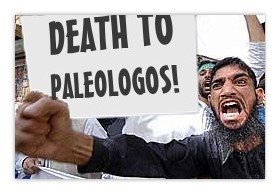
Yesterday I promised a post "analyzing" Pope Benedict XVI's Regensburg speech that set the Umma off once again. Herein I shall keep that promise. But first I note that, also yesterday, a friend of mine e-mailed the recent photo at the left. I hope that many of you get the black humor. If you do, you know that the main point of the Pope's remarks is irrefutable.

For those who don't, I point out that the man whose death is being called for by the devout Muslim holding the sign, namely the Byzantine emperor Manuel II Paleologus, has been dead for nearly 600 years. (To be charitable, I'm willing to allow that the demonstrator wants to emulate how one ninth-century pope treated his dead predecessor: he had the body disinterred, tried before a mock court, convicted, mutilated, and dumped into the Tiber. Plays to the gallery pretty well.) It was the Pope's citation of a remark made by Emperor Manuel which occasioned the latest paroxysm across the Umma, in which of course have been heard not a few threats on the Pope's life. Such threats are now understood to be a matter of course when somebody offends Muslims. We've learned the ground rule for dialogue: "Islam has been a religion of peace since 622; say otherwise and at least one of us will feel obliged to kill you." But it is well nonetheless that the Pope cannot unsay what he said. His choice to quote the Emperor was doubtless very carefully weighed to make a point that desperately needed to be made but also required plausible deniability from such a globally important figure. Many otherwise sympathetic people have taken the Pope to task for that. But they forget the significance of the fact that the very uproar he caused proved his point. Which is what?

Like everything the Pope says to or among academics, of which he was a star, the point is not immediately obvious. Perhaps the best way to unearth it is to consider how Benedict praised his old university.

[It] was also very proud of its two theological faculties. It was clear that, by inquiring about the reasonableness of faith, they too carried out a work which is necessarily part of the "whole" of the universitas scientiarum, even if not everyone could share the faith which theologians seek to correlate with reason as a whole. This profound sense of coherence within the universe of reason was not troubled, even when it was once reported that a colleague had said there was something odd about our university: it had two faculties devoted to something that did not exist: God. That even in the face of such radical scepticism it is still necessary and reasonable to raise the question of God through the use of reason, and to do so in the context of the tradition of the Christian faith: this, within the university as a whole, was accepted without question.

Such a vision of faith and reason is not only quintessentially Western but universally valid. Whether or not we believe we have a true answer to "the question of God," theology is a reasonable discipline, fit for a university, because the questions theology considers are reasonable ones meriting the most assiduous inquiry. But within both religious and secular culture, there has long been a certain theological tendency undermining the role of reason in the life of faith and in society as a whole.

To philosophers, the most familiar label for that tendency is voluntarism. In theology, voluntarism in its strong form is the notion that divine sovereignty is so absolute that God is not bound by anything at all—not even his by own goodness, and not even by reason itself. God wills what he wills what he wills: if he wills that good be evil and evil good, then it is so; if he wills that contradictions be true, then they are true. In Catholicism, certain late-medieval thinkers such as William of Ockham and Nicholas of Cusa were strong voluntarists, as have been not a few Protestant thinkers since. All that is old hat to philosophers and theologians, and the Pope alluded to it right after his discussion of the Emperor's words. But the striking thing about the lecture is the connection drawn between Muslim and Christian voluntarism, and how each relates to the problems of today.

Here's what the Pope said about the Muslim part of it (I have added the emphasis):

In the seventh conversation-controversy, edited by Professor Khoury, the emperor touches on the theme of the jihad (holy war). The emperor must have known that Sura 2, 256 reads: "There is no compulsion in religion". It is one of the suras of the early period, when Mohammed was still powerless and under threat. But naturally the emperor also knew the instructions, developed later and recorded in the Qur’an, concerning holy war. Without descending to details, such as the difference in treatment accorded to those who have the "Book" and the "infidels", he turns to his interlocutor somewhat brusquely with the central question on the relationship between religion and violence in general, in these words: "Show me just what Mohammed brought that was new, and there you will find things only evil and inhuman, such as his command to spread by the sword the faith he preached".

The emperor goes on to explain in detail the reasons why spreading the faith through violence is something unreasonable. Violence is incompatible with the nature of God and the nature of the soul. "God is not pleased by blood, and not acting reasonably is contrary to God’s nature. Faith is born of the soul, not the body. Whoever would lead someone to faith needs the ability to speak well and to reason properly, without violence and threats... To convince a reasonable soul, one does not need a strong arm, or weapons of any kind, or any other means of threatening a person with death...". The decisive statement in this argument against violent conversion is this: not to act in accordance with reason is contrary to God’s nature.

[Khoury] observes: "For the emperor, as a Byzantine shaped by Greek philosophy, this statement is self-evident. But for Muslim teaching, God is absolutely transcendent. His will is not bound up with any of our categories, even that of rationality. Here Khoury quotes a work of the noted French Islamist R. Arnaldez, who points out that Ibn Hazn went so far as to state that God is not bound even by his own word, and that nothing would oblige him to reveal the truth to us. Were it God’s will, we would even have to practise idolatry."

Well then: if, as remains common Muslim theology, God is "not bound even by his own word," then there can be no problem about religious violence or contradictions in the Qu'ran. In one sura we read that there's "no compulsion" in religion; in others, we read about all the conditions under which killing "infidels" is justified. This is why Muslims say with a straight face that Islam is a religion of peace and a religion of jihad, violent if need be, against infidels. This is why, though the majority of Muslims are not warlike, they have only weak arguments against those who are warlike. According to them, the Qu'ran is the literal words of God; if God is not bound by his own word, then of course he is not even bound by the logic of his words. But we are bound by his words; so if his words are illogical, then we are bound to be illogical.

That's quite pertinent to current events, and quite bad enough in itself. But such unreason is not the only sort of unreason that voluntarism has caused. The West is guilty too, albeit in a very different way.

I shall cut to the chase since you can read the lecture for yourself. The Pope's chief complaint is how the West, starting with medieval voluntarism, has ended relegating religion and ethics to the realm of the subjective, which may be interesting and even inspiring but cannot contain objective, rationally knowable truths. The Muslim way of divorcing faith and morality from reason leads to intolerance and violence; the Western way of doing so, which expresses itself as relativism and subjectivism, leads to cultural decadence. It is just such decadence that Muslims most dislike. And it's all the worse because it makes the bulk of contemporary Westerners unable to understand the Muslim challenge and react accordingly.

The only way to deal with that challenge is to restore a vision of reality in which religion and morality form part of a unitary vision of truth along with the science of which we are rightly proud. Such is what the Catholic Church continues to uphold—at least among those of her children, like the Pope, who think about such things and are able to appreciate their importance. In such a vision, God is bound by his own goodness and wisdom, which are dimly expressed in our virtues, our logic, and our science. To borrow a phrase from the American Declaration of Independence, science helps us understand "the laws of nature"; religion and natural morality help us to understand "nature's God." Together, they all form a unitary vision of truth. And it's one that excludes violence aimed at enforcing religious tenets.

It took Christians quite a long time to learn that. Most Muslims have not yet learned it. That is the main point of the Pope's lecture. It ought to be obvious. Too bad it isn't.

Wednesday, September 20, 2006

Are we cowards or men?

Reaction in the Western media to latest Muslim paroxysm of rage—a collective tantrum provoked by a wonderful lecture of the Pope's that I shall analyze in my next post—has got me asking myself a question that ought to trouble thoughtful people: do men any longer outnumber cowards in the West?

It is by my own experience that I know the difference between the two. There have been times in my life when I behaved in manly fashion, and times when I behaved like a coward. The biggest failures in my life have been caused by my own cowardice, and I'm still not sure whether I'll die a coward or a man. While I'm doing my best to meet the challenges of my life, and they are not trivial, I cannot take for granted that I won't flunk the next big test out of cowardice. (I'm sure it won't be about principle, of course; I'm too pig-headed for that to be a test worth giving me. My tests have all had to do with loving those hard to love, starting with myself; and I'm sure my next one will too.) But whatever the occasion of the test will be, I've been around too long to presume that much on the grace of God, let alone myself. That is why I don't at all like what I'm seeing in the so-called free world's reaction to Muslim bullying.

Consider the contents of a must-read article from the online magazine The Brussels Journal: The Church – Part of the Problem or Part of the Solution? Its sorry account of Western dhimmitude is all the more depressing given how the forces in our society that should be stiffening our spiritual backbone against jihad are those most given to weakening it: the churches. Were it not for my fear of playing armchair psychoanalyst, I'd say they have a collective death wish. The spiritual torpor and ingrained, cultural self-hatred so evident in so many of our clergy seems to me to be causing a desire to surrender to an enemy with far greater spiritual vigor. That is cowardice. I can understand that in agnostics and hedonists, but not in men of God. Yet there it is—the only explanation I can find for the fact that we are apparently expected to walk on eggshells around and about Muslims, so as not to provoke "understandable" reactions that wouldn't be tolerated for a New York minute from others under far greater provocation.

Don't believe me? Well, living where I do and reading what I read, I can hardly go a day without seeing or hearing my religion insulted. But if I burned a car in response, I'd do hard time; if I called for the death of the village atheist, I'd have a restraining order slapped on me; if I and my Catholic friends demonstrated with signs like the ones the Muslims have been carrying lately, we'd be dismissed and marginalized as kooks—if we were lucky. I can understand Muslims upholding such a double standard; but from Westerners it is absolutely intolerable, all the more because it's upheld in the name of "tolerance." If one cannot see what's intellectually wrong with moral relativism, just behold the cowardice it causes and encourages. Nobody likes the sight of cowardice, including those guilty of it.

Perhaps that's why they're blind to it. If 9/11 wasn't enough to remove their blinders, I shudder to think what would be.

Sunday, September 17, 2006

The Pope and the Muslims: give me the T-shirt

Here we go again. This time, the Pope gives a sound, sober, and elegant academic lecture at a university where he once taught, in which he cites in passing a derogatory statement about Islam made by a medieval Byzantine emperor. The purpose of the citation was to illustrate one side of a contrast Benedict wished to describe, one that is found not just in Islam but in the West too. And if you read the lecture, to which I've linked, it is clear that he was focusing much more on the West's internal problem. But because the quoted statement was a negative one about Islam, the Muslims are angry again. Demonstrations have been held all over the world; effigies have been burned and car windows smashed; outraged clerics have called for an apology. We saw this movie less than a year ago over something far less subtle and intellectual: a cartoon in a Danish newspaper. So what else is new? And I ask: so what?

For the past few generations, Muslims have been getting angrier all the time. Some Muslims, especially young and unemployed ones in their home countries, are angry that they do not enjoy the freedoms and privileges of the West. Others, immigrants in Western countries, enjoy such privileges while hating what makes them possible. Most Muslims believe that they shouldn't be willing to live with the fact that the rest of the world isn't Muslim. And a small but very well-known minority of Muslims regularly targets and kills innocent people, including Muslims, as part of the jihad or struggle against what they consider the enemies of Islam. In such a context, it doesn't matter to most Muslims what the Pope actually meant. It doesn't matter that he has called for, and practiced, mutual respect and interreligious dialogue. It doesn't even matter that his view of Islam is much more balanced than that of Manuel II Paleologus, the angry, almost despairing leader of an ever-shrinking Byzantine state which he knew was doomed to extinction by Muslim armies. No, all that matters is that the Pope quoted something negative about Islam. Anybody who even cites something negative about Islam must be, if not an outright enemy of Islam, than terribly disrepectful of Islam. Such, apparently, is the Muslim rule for interreligious dialogue. They may and do say what they like about Christians and Jews, but the latter may not say or even cite anything negative about Islam. Such is the double standard of angry people.

Frankly, my dears, I don't give a damn. The choices left us by the Muslim attitude are silence or dhimmitude, and neither is acceptable. The Pope had every right to say what he did. Presumably to calm the waters, he has issued a ritual expression of "regret"; he has to, if only for political purposes. But don't let that fool you. The Pope knows that what I'm saying is true, and he's not going to deny what he actually said, because it too was true. We should not hesitate to say so.

Over at Pontifications, one commenter has envisioned a T-shirt. On the front: “Islam: a religion of peace since A.D. 622″ and on the back, “Say otherwise and we’ll blow you up.” The thing should be said and the T-shirt made. I'd buy it. Of course, only those who want to live should feel free to wear it.

Monday, September 11, 2006

Five years ago today...

What happened to America five years ago today was an atrocity far worse than the Japanese attack on Pearl Harbor sixty years earlier. The latter took about as many lives as 9/11, but its target was military not civilian. It was a conventional act of war against soldiers, not one of mad terrorism against innocents. It lacerated my soul in another way too. At a party in 1975, I danced to the disco sound of "Burn, Baby, Burn!" at Windows on the World, at the top of one of the towers. All I could think of on 9/11 was penance.

While both Pearl Harbor and 9/11 roused this country from a certain slumber, there is another key difference: Pearl Harbor was an attempt to break our naval power; 9/11 was an attempt to break our will. The former did not long succeed; indeed, one might say that it roused and stifferened our will to prevail. In the short run, 9/11 failed too. But about the long run I am not so sanguine.

Americans and Westerners generally do not, as a whole, seem yet to understand what all the conflict within and about the Middle East has in common. This is not a war about "terrorism," which is only the most obvious weapon wielded by our true enemy. Whether one looks at Iraq, Southern Lebanon, Palestine, Afghanistan, or any place where Islamist terrorism has spilled blood, the enemy is the same: radical Islamic jihadism, whether of the Sunni (Wahhabi) or the Shi'ite variety best represented by Hezbollah and sustained by Iran in Iraq too. The aim of all jihadists is the same: the destruction of Israel and ultimately of the West, making way for the worldwide rule of Islam. While it is quite true, for example, that Saddam Hussein and al-Qaeda had no working connection, the trends throughout the Middle East and Southern Asia, both before and since Saddam, are toward increasing convergence of jihadist groups. Saddam paid off the families of Palestinian suicide bombers of Israelis and tolerated Iraq's homegrown jihadist group, Ansar al-Sunna. The hydra-headed monster had been, and has since been getting, more cohesive for quite some time. One might argue that the overthrow of Saddam and the subsequent Iraqi insurgency has only accelerated that process; but if it has, that is not such a bad thing. It helps prevent people from sleeping too long.

Wherever there is Islamist terrorism, one finds jihadists from many different countries joining together. We're seeing only the earliest stages of what will, in due course, evolve into a true "clash of civilizations." Secular tools and outlooks will not avail us. The West will lose if it does not, in Benedict XVI's words, recover its "spiritual roots."

Friday, September 08, 2006

The Birth of the Blessed Virgin Mary

I thought I should take note of this day for two reasons. First, it is the anniversary of the ordination of one of my oldest friends. Congratulations to him as he continues his ministry in difficult circumstances. Second, it's a good occasion to mention one of my favorite themes: the most salient area of theology today is ecclesiology.

Of course we have no idea on what date Mary was actually born, and I shall not detain you by speculating on why September 8 was chosen to celebrate this feast. It appears to have been first celebrated liturgically in sixth-century Palestine after the Council of Ephesus acclaiming her as Theotokos or "God-bearer." Since the sources for Mary's origins are apocryphal, Rome was slow to put the feast on the universal calendar; that didn't happen, apparently, until the 8th century, after all the christological councils of the first millennium had done their work. Yet even though the basic outlines of orthodox christology were settled by then, the question of the nature of the Church as Mystical Body of Christ had not been. And while there has been some development, the question still isn't really settled. Most of the theological disputes today, at least in my observation, either stem from or lead to that theme. And so I shall say something about it here. Taking his cues from St Andrew of Crete, A. Valentini has noted:
In the case of all the Saints, the Church commemorates their birthday on the day of their return to the Lord. However, in the cases of St. John the Baptizer and the Blessed Virgin, it also celebrates the day of their earthly birth. This is a singular fact already emphasized in ancient times, for example, by Paschasius Radbertus (d. about 859).

The reason for this fact is not found primarily in the greatness or the privileges of the persons involved but in the singular mission that was theirs in the History of Salvation. In this light, the birth of the Blessed Virgin is considered to be - like that of John the Baptizer - in direct relationship with the coming of the Savior of the world. Thus, the birth and existence of Mary—similar to and even more than those of the Baptizer—take on a significance that transcends her own person. It is explained solely in the context of the History of Salvation, connected with the People of God of the Old Covenant and the New. Mary's birth lies at the confluence of the two Testaments, bringing to an end the stage of expectation and the promises and inaugurating the new times of grace and salvation in Jesus Christ.

Mary, the Daughter of Zion and ideal personification of Israel, is the last and most worthy representative of the People of the Old Covenant but at the same time she is "the hope and the dawn of the whole world." With her, the elevated Daughter of Zion, after a long expectation of the promises, the times are fulfilled and a new economy is established (LG 55).

The birth of Mary is ordained in particular toward her mission as Mother of the Savior. Her existence is indissolubly connected with that of Christ: it partakes of a unique plan of predestination and grace. God's mysterious plan regarding the incarnation of the Word embraces also the Virgin who is His Mother. In this way, the Birth of Mary is inserted at the very heart of the History of Salvation (emphasis added).

Valentini cites Vatican II's Dogmatic Constitution on the Church, Lumen Gentium, which was concerned to present Mary above all as "Mother of the Church." Within the Church, Mary represents the feminine principle in which we all share as members of the Mystical Body of Christ, i.e. the Church. The Church is one body with Christ because she is the Bride whom he, the Bridegroom, has married. Thus Mary is Spouse of the Holy Spirit as well as Mother of the Son. As her divine Son's most perfect human disciple, filled to overflowing with the Holy Spirit who conceived the Son in her, she leads to the Son by the power of the Spirit all those who seek her care and protection. As personification of the Church, she helps to make the Church as collectivity what she is individually: the receiver and bearer of God in the world. Such is the "Marian charism" of all believers.

At the other pole of the Church we have the clerical hierarchy, with the college of bishops as collective head and the pope as head of them. The hierarchy represents the masculine principle of headship and self-immolation that is fully found only in the life, death, resurrection, and divine person of God the Son Incarnate: Our Lord Jesus Christ. As sinners, they fulfill their role quite imperfectly even as Mary fulfills hers perfectly. They and their role exist for the sake of all of us, whom the human person Mary represents. Such is the balance of the Church. The representation of headship, through which Jesus Christ exercises his headship, is done by sinful men; the representation of submission and sanctification, which Jesus also uses for his purpose, is done by a sinless woman.

We need to meditate more on such truths today. I could go on, but I don't have time and for now this is enough food for thought. I offer it to you, my readers, and to God for further development.

Monday, September 04, 2006

Not dead yet

Apologies to my vast readership once again for my month-long absence. I've moved to another city and have been working long hours as a wage slave to pay for that. Which reminds me that today is Labor Day.

Though fraught with struggle and violence, the labor movement's origins in the 19th century were on the whole laudable. It had been historically inevitable that the Industrial Revolution would cause massive exploitation of cheap labor, and it was morally imperative that such exploitation be mitigated. Communism was not the answer; and as an alternative, the American labor movement once had considerable success that we still benefit from today. But labor is now in eclipse: the forces of international competition, especially the influence of cheap Asian labor, have put many employers in a very strong position once again. If they don't move production to where labor is cheapest, they cannot price their products competitively and in due course go out of business. So, many jobs are exported overseas, and the pay for many of the remaining ones is forced downward. Such is globalization, which nothing can stop despite the pain and the reactionary longings for an easier past. What is to be done?

Right now, not much can be done save at the margins. More and more Americans lack access to adequate health care because they cannot afford it on their own and their employers cannot, for the reasons stated above, afford to provide them with insurance. Indeed, the very concept of employer-based health insurance is slowly but steadily becoming unworkable for all but the highest-paid workers, those in the most profitable industries, and government workers. We desperately need a system of tax-financed basic health care, with anything elective left to the current system and with rationing of services for those past Social-Security retirement age. But that would only be nibbling at the margins, and the force of prejudice against anything smacking of "socialism" is so strong that Americans don't seem ready even for that.

In any case, the real new labor revolution needs to be over the very nature of work itself. Even unionized and other well-paid workers tend to view their jobs less as intrinsically valuable than as the suffering one must undergo to obtain money for survival and pleasure. That is how I view my current job, and I have lots of company all over the world. Actually, my position is better than that of many, because at one time I actually did earn my living doing something I love and am young enough to regain that opportunity if I work smart enough in my spare time. But countless people don't have such opportunities. The only solution is to embrace the vision of human dignity best embodied in the social teaching of the Catholic Church.

To those willing to acquaint themselves with that, I recommend John Paul II's encyclical Laborem Exercens and the Compendium of the Social Doctrine of the Church.

Sunday, August 06, 2006

Transfiguration

I hate to admit it, but there's something of the normal American in me. The admission is due because I first started caring about the Feast of the Transfiguration, which is today, when I learned that the atomic-bombing of Hiroshima also occurred on the 6th of August (1945).

The flash of that bomb was the closest thing to the Uncreated Light that man had ever produced. Not surprisingly, it was for destructive purposes: killing scores of thousands of innocent people with the aim of terrorizing Japan into unconditional surrender. Whatever Americans may have thought of that then and now, the Catholic Church cannot but condemn the mass targeting of civilians in warfare—regardless of the weapon used. And Vatican II did so (Gaudium et spes §80). Yet the ghoulish juxtaposition of such evil with the good celebrated in today's feast provide much to ponder in wonder.

My own meditation is that the real power at the heart of reality is God's to bestow according to his gracious will, not man's to grasp at for his limited, selfish purposes. The creative force of the universe is also the transforming light of love. But as we delve ever deeper into the mysteries of the physical cosmos, we become capable of once-inconceivable violence. The potential for that is now so great that we can readily imagine the human race annihilating itself by unleashing it. So of course more and more nations yearn to acquire nuclear weapons, whose only rational use is to deter others from using them. But even though we have thousands of deliverable warheads affording "multi-layered redundancy," we will not reduce our force by a single one.

Such is one of Satan's ways of mocking the Transfiguration, the prototype of that deification to which we are all called. Let us live in the light so as to reduce such mockery to silence.

Friday, August 04, 2006

The "real" person inside?

The latest flap surrounding Mel Gibson perfectly illustrates some contemporary confusions about moral psychology. Truth can be served by pointing them out, thus encouraging humility—the sort of humility Gibson's obviously sincere public confession has shown.

Citing the old proverb in vino veritas, Gibson's old enemies and not a few of his erstwhile supporters take his drunken tirade as irrefutable evidence that he is, at heart, an anti-Semitic boor. Nonsense. If the proverb were true without qualification, then the best way for police to obtain confessions and judges to secure reliable testimony from witnesses would be to get the subjects drunk. But it isn't, and there's no argument against fact. So let's drop the all-too-easy illusion. What Gibson's anti-Semitic remarks show is that he has such ugliness inside him, along with other kinds of ugliness that he has manifested, such as alcoholism—a demon with which many otherwise good people have struggled. We all have ugliness inside us; some less than others, to be sure; but I know of nobody past the age of reason who has none at all. Indeed, saints are the most likely to see themselves as sinners and such unflinching, genuine humility is one reason they are saints. We cannot say who the "real" Mel Gibson is just because alcohol loosened his inhibitions on expressing his inner ugliness.

He was of course totally wrong to let himself get that drunk, and then drive in that state, to start with. But one could with at least as much justice—if not more—say that the "real" Mel Gibson is the one who repented of his rotten behavior and issued his well-publicized expression of regret. That's a choice he made while sober, after all; one is more likely to choose rationally and well when one is sober because reason and free will, our non-animal capacities, are more likely to operate without intoxicants. And such choices are more characteristically personal than much of the ugliness that people carry round inside them.

I'm struck by the fact that people have been quick to take the nasty side as the "really" real and the admirable as phony, a pose to be "seen through" and debunked. Given that Mel Gibson came out of Hollywood, it's just assumed that his confession is a publicity stunt pulled off for the sake of damage control. With some Hollywood types, that level of cynicism is probably justified. But I cannot think of the producer and director of The Passion of the Christ, who is also a loving father of eight, in that way. The man has too much good inside him. That he also has much bad inside him is only human. But I supose being human is unacceptable for those "right-wingers."

I'm sure somebody has written to explain that. Any references?

Thursday, August 03, 2006

The real and the fake hierarchy of truths

Since Vatican II, a lot of Catholic theologians who wish to jettison, marginalize, or render optional certain unpopular or hard-to-believe doctrines are wont, for that purpose, to cite the Council's statement about the "hierarchy of truths." Thus:
...in ecumenical dialogue, Catholic theologians standing fast by the teaching of the Church and investigating the divine mysteries with the separated brethren must proceed with love for the truth, with charity, and with humility. When comparing doctrines with one another, they should remember that in Catholic doctrine there exists a "hierarchy" of truths, since they vary in their relation to the fundamental Christian faith. Thus the way will be opened by which through fraternal rivalry all will be stirred to a deeper understanding and a clearer presentation of the unfathomable riches of Christ. (Unitatis Redintegratio §11)
The point of citing the hierarchy of truths in that context was to remind Catholics engaged in "ecumenical dialogue" not to dwell so much on certain distinctively Catholic doctrines "lower down" in the hierarchy, such as the Marian ones, as to obscure awareness of our unity with some non-Catholic Christians about some of the ones "higher up," such as the Trinity, the Hypostatic Union, and man's call to a share in the divine life. But some theologians, and not a few people who read them, interpret the Council's statement to mean that the lower-down doctrines are dispensable, inasmuch as they are matters of opinion not touching the "core" of faith, not articles of an organically whole faith. That view is incorrect.

Here's what Fr. Gus DiNoia, O.P., former chief editor of The Thomist and currently Undersecretary for the Vatican's Sacred Congregation for the Doctrine of the Faith, has to say about this issue:

A lot of modern theology has been seduced by the criterion of reasonability, or as somebody might say, critical reasonability. The result is that you have to pare down articles of faith, rather than taking the entirety of the revelation in all of its complexity, richness, challenged difficulty. You pare it down so that you have a core that you can "live with." This is deadly, because now the faith has to pass the bar of human reason, whereas for classical theology it was just the opposite. Human reason had to pass the bar of faith.

From this way of thinking has emerged one of the most insidious abuses of "the hierarchy of doctrines." The hierarchy of doctrines is treated as a way of ranking doctrines by their authority and as Avery Dulles has pointed out in an article we published in The Thomist. This of course was not what the Second Vatican Council meant by the hierarchy of doctrines. What the hierarchy of doctrines refers to is that all of the doctrines, which, you might say, seem not to be central, are not, therefore, dispensable, but only understandable with respect to a core.

Let me give you a very good example. We are all bodies with parts, fingers, toes, ears, livers, brains, hearts, now if I said to you, what is your most important part, most people would say either the brain or the heart. If I asked you what is your most least important part, you might say, your pinky. But the fact that you are able to identify important parts of your body with respect to less important ones, does not mean that you are prepared to part with any of the parts of your body. You are not prepared to part with pinkies, because they are not hearts.

Although this sounds funny, sometimes it's these kinds of examples that are the only ones that make sense to people. The hierarchy of doctrines is more correctly understood with an organic metaphor, because what the hierarchy of doctrine means is that doctrine like the perpetual virginity of Mary or sexual morality don't make sense apart from the core. It doesn't mean some beliefs are less important and therefore dispensable, it means that they don't work apart from the core and in this case, the core is the Trinity; The Father, Christ, and the Holy Spirit.
Quite so. While a given doctrine further from the "core" might not be as important as one closer thereto, it's sort of like one's pinky: it belongs to one's organism; one wouldn't want to treat it as dispensable; yet it only makes sense in terms of the whole and draws its life from more basic parts of the body.

Indeed, the hierarchy of faith is structured by the analogy of faith, by which the coherence of each part not only depends on but reflects the core and all the others. When people don't quite see the point of the "lesser" doctrines, such as those on sexual morality or the virginity of Mary, it's because they don't understand how the greater ones manifest themselves in the concrete and the particular. They are not immersed enough in the faith to grasp the analogy of faith, and thus are prey to the "insidious" error that Fr. DiNoia diagnoses and warns us about. That is especially true of many Catholics, who thus become legalistic, always looking to rank teachings of the Church by their precise "degree of authority" so that they can determine which they can get away with disbelieving.

While some teachings are hardly irreformable, such as those representing the exercise of prudential judgment about some morally significant aspects of contemporary life, the legalism I'm describing almost always extends to other teachings which indeed are irreformable. The cure is proper awareness of what holds the hierarchy of truths together. Such awareness can come about only if one is animated by a sincere desire to be grasped by the virtue and the content of faith, as distinct from developing religious opinions for oneself.

A good start for those so disposed would be the book whose cover is imaged at the beginning of this post. Just click it.