"You shall know the truth, and the truth shall make you odd." ~Flannery O'Connor

Showing posts with label faith. Show all posts

Wednesday, February 01, 2012

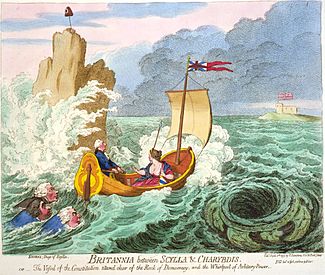
Scylla and Charybdis in theology


For the ever-growing majority without a classical education, my allusion to Scylla and Charybdis can be understood well enough with the Wikipedia background. Suffice it to say that, although those twin dangers often loom in theology, they can and should be avoided. They often appear under different pairs of names. One such is "fundamentalism and modernism," about which I've written before and will again. We must and can steer between the Scylla of fundamentalism and the Charybdis of modernism. Another S/C pair is common, for pretty much the same reasons: rationalism and fideism. Adherence to either only runs faith aground.

How rationalism runs faith aground is easy enough to understand. If the only admissible religious beliefs are those which can be established or otherwise secured by human reason, then there is no room for the unmerited, freely accepted gift of divine faith. Nor is there any room for the object of such faith: divine revelation. For such revelation supplies us, among other things, with truths that cannot be established or otherwise secured by natural reason; but ruling out divine faith entails ruling out recognizing, and trusting, any religious authority as the conveyor of divine revelation. Religion thus reduces to a matter of opinion—for there are no methods of proof that even religionists agree on. That was pretty much the view of Thomas Jefferson and of many others influenced by the Enlightenment. It is still the view of many philosophers today.

At the same time, fideism has undergone something of a renaissance among unbelievers as well as believers. Fideism is the view that religion, and with it divine faith, has nothing to do with reason, in the sense that "reasons" for having faith are as unnecessary as they are insufficient. The most common reason some believers end up as fideists is their conviction that the ultimate object of divine faith, God, so far transcends our reasoning capacities that rational criteria cannot be used to assess beliefs about God. Such beliefs are thus seen as insulated from rational criticism, which in its turn is seen as either ignorance or blasphemy. Most Sunni Muslims, and not a few Protestant and Orthodox Christians, are fideists in such a way. But to those of a scientific or otherwise critical bent, fideism can itself count as a reason against religious belief. For if religion is held to have nothing to do with reason, so that no particular religious belief can or should be subjected to rational scrutiny, then religion itself appears as positively irrational. And a cognitive stance that's irrational is not worthy of rational credence. Thus can rationalism and fideism, like so many pairs of extreme ideas, converge in similar attitudes.

To me, it seems almost self-evident that fideism, every bit as much as rationalism, is incompatible with divine faith. If rational criteria are not applicable to religious beliefs, then the fideist can only see the content of such beliefs as established arbitrarily by the absolute will of God. But such radical voluntarism empties the transcendental concepts of truth and goodness of all intrinsic content, and thus of all intrinsic meaning. It reduces religion to the blind worship of power. Some may find that prudent, but it hardly even makes sense to call it admirable.

The only way to steer between Scylla and Charybdis here is to insist, like such thinkers as Thomas Aquinas, both that divine faith cannot be established by human reason and that such faith must all the same be a reasonable choice. "Reasons", called "motives of credibility" in traditional apologetics, thus render divine faith rationally intelligible but not rationally necessitated. Such faith matches creation, for creation itself is rationally intelligible yet not rationally necessitated. Both faith and creation are thus mysteries in a positive sense—mysteries that will never be entirely dissipated when we see God face to face.

Wednesday, March 14, 2007

Standing firm in the faith

It's fairly easy to adhere firmly to the tenets of the Faith on the Internet. That's almost fun, save when the ensuing, inevitable polemics get tiresome. It's much harder to do so as a lay person planted firmly in real circumstances where the costs and risks are high. As inspiration, I shall present today two examples of that.

One is that of a gay Christian who calls himself "Episcopalienated." He begins:

Before I became a Christian, I understood perfectly well that there was one Biblical standard for human sexuality: that of lifelong, faithful, heterosexual monogamy. No exceptions! As a sexually active gay male, that was one of the best reasons I had for not wanting to be one (a Christian, that is). The Church was honest with me, and I was more than happy to return the favor.

After my conversion to Christ, my understanding remained fully intact and I knew what was expected of me. In order to be faithful to Our Lord and the demands of the Christian faith, active participation in a gay lifestyle had to go, and so it did. I have been practicing sexual abstinence for fifteen years now and I wouldn’t have it any other way. It may seem strange to many, but I have actually come to find it quite liberating.

He concludes:

As I struggle with temptation, and against any residual tendencies towards despair and resignation (and I do again and again), I am always drawn to the words of St. Peter to Our Lord: “Lord, to whom shall we go? You have the words of eternal life; and we have believed, and have come to know, that you are the Holy One of God.” To whom else, indeed? And so for me, the journey of faith, and the challenge of faithfulness, continues.

Read it all; the parts I have not quoted are even better. Even so, I particularly identify with Episcopalienated's "residual tendencies towards despair and resignation." Although I do not carry his particular cross, I carry enough others to know exactly what he means. Sometimes, the only thing that keeps me going are the words to which he is "always drawn." From them, I conclude there is no rational alternative to carrying on in courage despite how I feel. Only when I make that resolution are consolations sent. I suspect the same is true of him.

The other example I want to present is that of a man who calls himself "Woodrow." I cannot think of a better way to describe him than as a "lay evangelist." I found his story today in the combox of this post at Intentional Disciples.

I live in the archdiocese of Detroit. Some cities in the United States have a larger Arab-Muslim population than Detroit does, but we have the largest concentration of Arab-Muslims in the United States. While still an Evangelical Christian, a few years back I volunteered with a local interdenominational Evangelical organization that helped Middle Eastern immigrants learn English, become citizens, and as we made friendships with individuals, we shared the Gospel with them. Some Muslims did become Christians, albeit secretly. Many of them did eventually go back to Islam, but a few have remained faithful Christians. I was hoping the Archdiocese had some sort of similar outreach. When I contacted the main office, I was directed to the priest in charge of inter-religious dialogue. When I asked him whether or not the archdiocese has a program of service/evangelism for the local Islamic community, he was disturbed that I would even think of inviting a Muslim to become Catholic. He so strongly recommended against my doing such a thing that he nearly forbad me to testify about Christ to a Muslim. I understand that the diocese cannot have a public outreach to Muslims because when word reached the Islamic community, they would no longer have anything to do with the archdiocese or with Catholics. I understand that this priest cannot go around meeting leaders in the Islamic community and inviting them right off the bat to become followers of Jesus. However, it's ludicrous for this priest to tell me, a layman, not to proclaim the Gospel to the average "lay Muslim", and it's ludicrous for this priest to be closed to the possibility of inviting Islamic leaders with whom he's developed a good relationship with to become disciples of Jesus Christ. May the Holy Spirit give us love for the world's Muslims, a concern for their eternal well-being, and the courage to boldly proclaim, with great charity and humility, the Gospel to them.

Although my particular calling is not evangelization of Muslims, I can very much identify with Woodrow's story too. He has preached Christ courageously and creatively in difficult circumstances in spite of, not because of, the clergy. In my student days, that's exactly what I was impelled to do much of the time amid my secular colleagues. The priests around me, in many cases, were only nominally Catholic. Two were gay Jesuits: one spread slander about me before leaving the Church for his "lifestyle"; the other, who had taught me courses in both high school and college, eventually converted to Shi'ite Islam. But they were more honest than some other priests I had to deal with: material or formal heretics who remained priests in ostensibly "good standing," they caused gullible students to believe that their heresies were Catholic. I sure had my work cut out for me, and it did not make me popular. Even the orthodox priests did not openly support the efforts that I and my circle of orthodox lay friends made among our peers—even when those efforts were successful enough to bring people to the doors of those very priests.

The names change, but the stories remain more or less the same. It will only get tougher, people. Seat of wisdom, pray for us.

Saturday, December 02, 2006

Beating the filioque horse

I dedicate this essay to Fr. Alvin Kimel on the occasion of his ordination to the priesthood of the Roman Catholic Church on Sunday, December 3, 2006. When he has time, he might even help correct it!

If you follow this blog at all, you're probably the sort of person who knows what the "filioque problem" is. If you're not, go here.
My interest in the topic is great for two reasons: getting it right would both contribute to our knowledge of God and aid the cause of Orthodox-Catholic unity.

If you know anything about horsemanship, you know that the cliché 'beating a dead horse' does not refer to a paroxysm of futile rage but rather to an attempt to get somewhere with a vehicle unsuited to the purpose. To get a horse to gallop, one sometimes must give its flanks a whack or two; if the horse is dead, that method won't work. But this horse is not dead: theologians continue to whack its flanks intermittently. Given how old the battle lines are, however, success would not mean a gallop; a leisurely walk would do nicely, perhaps even better.

Our approach must be accordingly modest, avoiding all polemics; for as the late, great scholar of Christian doctrine Jaroslav Pelikan said: "If there is a special circle of the inferno described by Dante reserved for historians of theology, the principal homework assigned to that subdivision of hell for at least the first several eons of eternity may well be the thorough study of all the treatises--in Latin, Greek, Church Slavonic, and various modern languages--devoted to the inquiry: Does the Holy Spirit proceed from the Father only, as Eastern Christendom contends, or from both the Father and the Son (ex Patre Filioque),as the Latin Church teaches?" Save only, perhaps, for the topic of justification—a staple of Protestant-Catholic polemics—one is hard-pressed to find a theological topic on which more ink has been spilled to less constructive effect than the filioque. Beyond warning the unwary, the only justification for addressing it is to try to find a way to accommodate what each sides is, respectively, dogmatically committed to.

To that end, the first rule of discussion should be that any truth we can come up with on this topic will not add to our knowledge of God's inner life. There are far better means than academic theology for doing that—to the quite limited and indirect extent it can be done at all—and they are about living the Christian life to the full rather than disputation. What we can do by reasoning is to make more explicit and consistent what is already implicit in our dogmatic formulations of the deposit of faith. It's a matter of harmonizing our ways of talking, not of presuming, blasphemously, to do what is undoable. But even that modest goal would increase our knowledge of God by breaking down polemical battle lines and coming up with something that does justice to both sides' formulations. I've already set forth a bit about how; here I want to continue along that line.

In my brief earlier treatment, I argued that the filioque as defined by the Council of Lyons (1274), whereby the Holy Spirit proceeds from the Father and the Son "as from one principle" (quasi uno principio) can be logically derived from (a) what both sides profess in common and (b) two additional premises I take to be unexceptionable: God is essentially hypostatic, and the Spirit is the Spirit of the Father and the Son. Such a result is opposed by many Orthodox on the ground that it confuses "economy" with "theology" in such a way as to violate the mutually-agreed doctrine of the "monarchy of the Father," i.e. that the Father is the "sole cause" (monos aitia) of the existence of the other two divine Persons. Thus, while the Spirit proceeds from the Father and the Son in terms of the "economy," i.e. what God does for us, that does not and indeed could not follow in terms of "theology," i.e., what God is in himself. The way round that objection is to make some distinctions both sides could accept consistently with their dogmas.

If one takes the doctrine of the monarchy of the Father in a modest sense, to mean that the existence of the Father alone is underived, and that of the other two persons is derived from the Father's, there is no dispute. The dispute arises over the question whether the Son has something to do with the eternal "coming forth" (ekporeusis) of the Spirit's existence, a mode of derivation that is ineffably distinct from the Son's "generation" by the Father. The West has tended to take as axiomatic that economy reveals theology, so that the Spirit's "sending" of the Son in the "economy" reveals by analogy something about the Son's role in the Spirit's eternal procession in "theology," which is inchoately expressed by Lyons' definition of the filioque. So the question then becomes whether the result the West is thus committed to—i.e. the "theological" filioque—is compatible with the monarchy of the Father taken in a stronger sense, to mean that the Father alone is the cause of the being of the other two persons. People who take the monarchy in that sense are what Cardinal Dulles terms "strict monopatrists."

If strict monopatrism is true, then the theological filioque is false; for the former entails that the Son has nothing whatsoever to do with the Spirit's coming forth from the Father. But most Orthodox theologians seem, at the least, reluctant to say that. Thus a good many grant an "eternal manifestation" of the Spirit from both Father and Son, such that in that sense the Holy Spirit can be said to proceed from the Father "through" the Son. On that point too, there is no dispute; and if both sides had been suitably modest, the filioque problem could have been solved right there. For if the Holy Spirit proceeds from the Father through the Son, then there is a sense, perfectly compatible with Lyons as well as with the monarchy, in which the Holy Spirit proceeds from the Father and the Son. But the latter expression is vague, lending itself to other, arguably heterodox interpretations, such as the doctrine of the "dual procession" that seems to have been adopted by the Carolingians through their reading of Augustine. It has been agreed at least since Lyons that dual procession is out of bounds. So, in the final analysis, the dispute is really over whether the Spirit's eternal manifestation is somehow equivalent to his existence. If it is, then the theological filioque follows; if not, not.

The issue so framed hinges on the distinction between the divine "essence" and the divine "energies" from the Orthodox side ('DEE' for short) and the doctrine of divine simplicity on the Western side ('DDS' for short). Following the Palamite councils of the thirteenth and fourteenth centuries, most Orthodox insist that there is a "real" distinction between the essence and the energies, such that the Spirit's energetic manifestation through the Son does not logically entail the eternal procession of his being from the Son as well as the Father. Now if, by positing DEE that way, one urges that what-God-is does not necessitate what he does, there is a sense in which that is true and undisputed. What God has eternally decreed to do ad extra is in no way necessitated by what he is. On that the West should and does agree. But does it follow that what God eternally does ad intra is distinct in the same way from what he necessarily is? If so, then the theological filioque is false; if not, the question remains logically open.

Recall my earlier claim that God is "essentially hypostatic." That means that the Father's causing of the Son and the Spirit is necessary, not contingent: it's not as though the Father might have chosen not to generate the Son and breathe forth the Spirit; it is of the divine essence that he do so. On that, I take it, the Orthodox agree. The existence of the Son and the Spirit is accordingly logically equivalent to that of the Father: just as the Son and the Spirit exist only if the Father exists, so too does the Father exist only if the Son and the Spirit do. You get one of them if and only if you get all three. The question facing us at this stage of inquiry is similar: is the eternal but energetic manifestation of the Spirit ad intra logically equivalent to his existence? If DDS, the answer is yes and the theological filioque follows; if DEE, the answer would seem to be no, and the theological filioque consequently false.

I said the answer "would seem" to be no. Strict monopatrists have long taken that ball and run with it, which is why, e.g., Mark of Ephesus repudiated the reunion formula of Florence, a council where he was the chief Orthodox champion, and eventually induced the Orthodox world as a whole to do so. But things are not what they seem. As is so often the case, all depends on how terms are used.

If one takes the term 'divine essence' in DEE to mean what-God-is apart from what he does, then Mark's position follows almost trivially. What God does is, in certain respects, free, so that what he does is not necessitated by what he is; by the same token, what he is is not even communicated by what he does. That is why, in this kind of thinking, "theology" cannot be inferred from "economy." In that way, the essence of A is "really" distinct from A's manifestations and thus not logically equivalent to any of them. But DEE doesn't do the work that strict monopatrists require of it here.

For God is not just essentially hypostatic; God is essentially perichoretic too. The term perichoresis means 'mutually inhering' or 'mutually indwelling'; and as the Apostle John wrote, God is love. The love that is God ad intra consists precisely in how the Persons mutually inhere or indwell, which is something our minds can perceive only dimly and indirectly, by analogy, even as we are called to participate in it as children of God. That the Persons mutually indwell in love is, accordingly, not free: it is of the essence of God that they do so. What is free is only how they do so, since God is love and love, as distinct from desire or affection, is free. But if God is necessarily and thus essentially perichoretic in the way indicated, then we get the Spirit's eternal manifestation ad intra from the Father through the Son just in case we get the Spirit's existence, and vice-versa. The two are logically equivalent. From that, it follows that whatever holds necessarily of the Spirit's eternal manifestation ad intra holds of his eternal procession. It follows in turn that there is a theological filioque in a certain sense: it is the Spirit's eternal existence, not just his eternal manfestation, that proceeds from the Father through the Son, and therefore from the Father and the Son.

The filioque in that sense is not compatible with strict monopatrism, and thus is unacceptable to some Orthodox. Yet it's also a weaker filioque than the majority of Western theologians want and take for granted. But as far as I can tell, it's perfectly compatible with what each side is committed to dogmatically. Even if my way of framing it is not the best we can hope for, that sort of result is the best we can hope for. And I believe getting agreement on it is attainable.

Tuesday, November 21, 2006

Authority and Dissent in the Catholic Church

Dr William May, Michael J. McGivney Professor of Moral Theology at the John Paul II Institute for Studies on Marriage and Family at The Catholic University of America, has a very useful article posted at Ignatius Insight on the topic described in the title above. Hat tip to Al Kimel for alerting me to it.

I realize that none of the commenters here are Catholic progs, so that they suffer not from the disease he addresses. I doubt any such progs even read this blog, since they know by now that they will rarely if ever hear anything they really want to hear. But I believe May's article supplies non-Catholic Christians with a much-needed overview of what sorts of assent are required of Catholics and hence what sorts of dissent are permissible or impermissible for them.

That is important for my vast readership because, I have found, one of the most common complaints about the Catholic Church from Orthodox and conservative Protestants is that she is not tough enough in practice on dissenting Catholics. Leaving aside the irony that what's being complained about is the freedom of some Catholics to reject with impunity beliefs that the complainers also reject, I happen to share the complaint. But the problem is not one of theory or even theology; indeed, the fact being complained about is no evidence that what the Church teaches is untrue. Rather, and in some cases, it is evidence that bishops with the responsibility to deal with public dissent fail in their pastoral duty. But I also don't quite get what further conclusion is supposed to be drawn from that. Since there have been negligent and even heretical bishops ever since there have been bishops, it should hardly shock that such bishops exist in the Catholic Church today, when she is concerned not to revive fears of the old Inquisition—an institution for which, of course, she is still taken to task regularly enough.

Like Chesterton, I find it to be one of the marks of truth in Catholicism that it is so often subject to mutually incompatible criticisms from opposite sides of the spectrum of her opponents. We see the same phenonomenon in intra-Catholic disputes too. To the trads, Rome is too liberal; to the progs, Rome is too conservative; and both believe that some Catholic teaching today is discontinuous, even incompatible, with definitive teaching of the past. As I've explained before, I'm a "neoCath" because I find in the hermeneutic of continuity the only way to be both an orthodox and an intellectually honest Catholic. I hope that May's article helps others, especially Catholics, to get there if they aren't already.

Sunday, November 12, 2006

Regensburg II: the Pope on faith and reason at Verona

Pope Benedict XVI's address to the 4th Annual Convention of the Catholic Church in Italy, on October 19 and now available online, was rich fare indeed. One theme that stood out for me was one on which I've posted before: what one might call the apologetical significance of mathematics. Thus the Pope:

Mathematics, as such, is a creation of our intelligence: the correspondence between its structures and the real structures of the universe—which is the presupposition of all modern scientific and technological developments, already expressly formulated by Galileo Galilei with the famous affirmation that the book of nature is written in mathematical language—arouses our admiration and raises a big question.

It implies, in fact, that the universe itself is structured in an intelligent manner, such that a profound correspondence exists between our subjective reason and the objective reason in nature. It then becomes inevitable to ask oneself if there might not be a single original intelligence that is the common font of them both.

Thus, precisely the reflection on the development of science brings us towards the creator Logos. The tendency to give irrationality, chance and necessity the primacy is overturned, also to lead our intelligence and our freedom back to it. Upon these bases it again becomes possible to enlarge the area of our rationality, to reopen it to the larger questions of the truth and the good, to link theology, philosophy and science between them in full respect for the methods proper to them and of their reciprocal autonomy, but also in the awareness of the intrinsic unity that holds them together.

This is the task that is before us, a fascinating adventure that is worth our effort, to give a new thrust to the culture of our time and to restore the Christian faith to full citizenship in it.

Such is the vision of the relationship between reason and faith that Benedict defended at Regensburg, where he criticized theological voluntarism as inimical to it. It seems to me that only in Catholicism is the inevitable creative tension implied by that vision maintained. Some of course would see that as a disadvantage; but I don't think it can be disputed that Western culture, which has given so much to the world, depended on it for a long time. That it no longer does means we are living off the spiritual capital of the past.