"You shall know the truth, and the truth shall make you odd." ~Flannery O'Connor

Showing posts with label liturgy. Show all posts

Sunday, July 08, 2007

The motu proprio at last

I have hitherto held aloof from all the speculation about the Pope's plans for the Tridentine Mass because I believed, and continue to believe, that the attention has been disproportionate. I have never quite understood how having "two forms of the Roman Rite," the newer "ordinary" form and the older "extraordinary" form, somehow merits so much more attention from Catholic blogdom than, e.g., the fact that the global war of Islam against Christianity continues to accelerate, or than the moral outrages facilitated by advances in genetic research, or even than the culture of divorce and contraception. Unlike the co-existence of two forms of the Mass, all three are mortal threats. But now that Summorum Pontificum, the papal motu proprio, is out, here's my take.

Before pontificating on my own account, I note that I take the Pope's "explanatory letter" at face value. He is clearly saying just what he believes; there's no reason to suspect any hidden agenda; and he's clearly consulted widely about this. His motives are pure, his intentions good. And I like having the older rite around, even though I vastly prefer a well-done Novus Ordo Mass in Latin, and once sung regularly in a polyphonic choir for such a liturgy. The Tridentine Rite has helped to keep appreciation for Tradition alive amid the massive loss of culture, and in some cases even of memory, that Catholicism saw in the generation following Vatican II. Even so, I don't think Benedict's new move will or can usher in anything more than a transitional phase.

As he himself indicates, there aren't that many priests out there with the liturgical training and knowledge of Latin necessary to make celebration of the Mass according to the 1962 Missal widespread. For that reason, he seems to believe that bishops worried about this move's sowing disunity in their dioceses are mistaken. But the truth, as I see it, lies somewhere in between.

Despite the best of intentions, this move will legitimate what is already a de facto schism. For the Tridentine Mass is the rallying point for Catholics, clerical or lay, who think Vatican II was unnecessary at best and a disaster at worst. The new indult will make it easier for lay Catholics of that sort to attend Mass in that form; many of them already attend such a Mass but do so despite resistance from their bishops, so that some of the priests who preside at such Masses are doing so illicitly—either without "faculties" or as members of schismatic groups. Greater lay access will do little to change the attitude of such priests toward either their bishops or to the "updated" Church in general; what it will do is make attendance at their liturgies guilt-free; and in the medium term, the most conservative bishops will probably permit seminarians to learn how to do a Tridentine Mass. The effect of all that will be to make it easier and more respectable to be what the traditionalists already are, which is a much wider reality than that of liturgy alone. In effect, it will further entrench a spiritual culture sharply at odds with much of what has happened, good as well as bad, since Vatican II.

That does not mean I oppose the new indult. As a tactical matter, it is probably the only way to bring closer that "reform of the reform" which Joseph Ratzinger has long thought necessary. I suspect that's probably what he now thinks too. For the effect of the Tridentine-Mass culture on the wider Church will be to make it more respectable to seek out liturgy that isn't schlock and is more organically connected to the great past than the Novus Ordo has been. My own preference, for example, has long been to bring back Latin for the Ordinary of Mass and celebration ad orientem by the priest, neither of which Vatican II or the Missal of 1970 forbade, but without sacrificing those aspects of the Novus Ordo I like, such as the wider lectionary cycle in the vernacular, lay lectors, and communion in the hand. My hope and prayer is that easier access to the "extraordinary" form will make that possible in many quarters where it now is not. But in the meantime the price will be high.

Oremus.

Saturday, March 17, 2007

Reditus

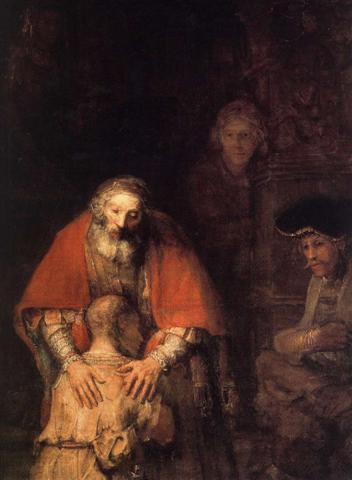
Normally I post my meditations on the Mass's Scripture readings on Sunday night, after people have heard their pastors preach. In my experience, that leaves me looking good enough in most cases. But not always. There are enough fine preachers out there, such as Fr. Philip Powell, OP, to put my sermonettes to shame. Today's Gospel, the parable of the prodigal son, brings out the best in many preachers. So I've decided to post my thoughts tonight, before I'm rightly ignored, leaving the Orthodox-Catholic debate over DD for tomorrow. A few, I know, will hear them.

St. Thomas Aquinas crafted his great Summa Theologiae on a theogonic model drawn from the sixth-century Pseudo-Dionysius: that of the going forth from and return of all things to God. Scholars call that "the exitus-reditus model." Now 'theogony' means 'origin of the divine'; and I use the associated adjective because the Pseudo-Dionysius thought of creation as destined to be 'divinized' through our theosis: a gift from the Father given through the Son and in the Holy Spirit. Theosis is indeed the purpose of this our life. (I am not now concerned with the sense in which we are to become God; I merely note that, in some sense, that is what life is about.) When Jesus speaks of the return of the prodigal son, he is giving us an extended metaphor for all that. But it works at two levels.

On one level, the exitus is creation itself, and reditus is simply the right ordering of creation to its source. Thus both would obtain even if man had never sinned. But Jesus is speaking more directly of our return to God from lives of sin. "All have sinned and have fallen short of the glory of God," but none of us baptized can get away with ignoring the call to attain glory anyhow by God's grace. Grace in the primary sense of the term is God himself, communicating his life to us as unmerited gift. Bestowed through baptism, that life changes us forever; we abide in the eternal whether we want to or not; hence, to sin and fall away from God leaves us worse off than we could ever have been had we never been called to be "partakers of the divine nature." So, given that we belong to the eternal anyhow, resuming the process of theosis by repenting and returning to God is elementary good sense.

But it's not just good sense, as if life were just about being a solid citizen. It is an occasion of joy. C.S. Lewis spoke of being "surprised by joy," and anybody who's read that book of his knows what he means. The ineffable joy we can experience even without knowing God explicitly is restored and deepened when we return to God after dissipating our primal joy in the darkness of willful ignorance and sin. I have experienced that. But it cannot be communicated in words, and it cannot be manufactured. It can only be facilitated by how we choose to respond to the father who awaits us in patient love and infinite mercy.

This Lent, let us remember that emptying ourselves through prayer, self-denial, and charity is just we would want to do if we recognized that what we so often feed on is pig fodder far from home. When we so empty ourselves, we are really resuming our walk on the path of theosis because we are removing obstacles to our interior journey back to God. His Spirit will propel us on the way. Soon or eventually, if we persevere, the joy of returning to our true home will be the fruit.

Wednesday, March 14, 2007

Sheen: "The Meaning of Mass"


With hat tip to Dawn Eden, I present in sequence the late Archbishop Fulton Sheen's presentation on The Meaning of Mass as a three-part YouTube series. The series forms part of his larger "Family Retreat." (Caveat: his talks presuppose that one has access to a reverent, rubrical liturgy. What he's talking about will not be clear to people at a typical, schlocky AmChurch liturgy.)


Tuesday, March 13, 2007

Sacramentum Caritatis

As I read it, I'm liking more and more the Pope's new, lengthy, and long-awaited Apostolic Exhortation on the Eucharist and the Mass. (For the Vatican's English translation, click the title of this post, which is the title of the document.) Two things I like about SC right off.

The first is what it does not do. It does not widen the indult for Mass in Latin according to the 1962 Missal; it does not even require that the currently normative rite, set forth in Paul VI's Missal of 1970, be offered in Latin in addition to the vernacular. Indeed, it does not impose any new requirements or broaden any old permissions. It expresses some of the Pope's wishes and makes suggestions. Regarding Latin:

62. ... In order to express more clearly the unity and universality of the Church, I wish to endorse the proposal made by the Synod of Bishops, in harmony with the directives of the Second Vatican Council that, with the exception of the readings, the homily and the prayer of the faithful, such liturgies could be celebrated in Latin. Similarly, the better-known prayers of the Church's tradition should be recited in Latin and, if possible, selections of Gregorian chant should be sung.

Notice: "could be celebrated in Latin...", "should be recited in Latin." No orders are given; no penalties are threatened. It's all very collegial and seeks to lead by persuasion. I believe there's a very good reason for that. If orders and penalties had been issued, all the media attention and therefore most of the attention of Catholics would be on them, not on the theology set forth in SC. The theology, and the personal example based on it, need time to sink in first.

It will of course be objected that nothing will broadly improve the currently dreadful state of liturgy "on the ground" until the appropriate orders and penalties are issued. That might or might not be true; I suspect it is true; but even so, the tactical approach being adopted by the Pope is sound for the time being.

The other thing I like about SC is the similarity of its title to that of this blog, and the difference of its title from that of this blog. In adopting my title, I had originally meant to allude to authoritative papal documents about sexuality, reproduction, and other "life" issues published since Vatican II: Humanae Vitae, Donum Vitae, and Evangelium Vitae. That's because I've long thought that the "pelvic issues" are the main spiritual salient in the world today, including and especially among Catholics. The spread of sound doctrine and praxis in that area seems to me to depend on a vision of human sexuality as sacramental in both a broad and a specific sense. And I also count on people getting the pun on "life." But I've come to realize that the cause of truth and righteousness in this area depends, among other things, on a better appreciation of that sacrament which is the "font and summit" of the Church's life. For that and many related reasons, it is the sacrament of charity par excellence. There is never too much of either the sacrament or charity. The more we appreciate the former and are accordingly animated by the latter, the more progress we'll make on the pelvic front.

Monday, March 05, 2007

Turning toward the Lord

The Latin conversio, whence comes the English "conversion," is a translation of the Greek metanoia, meaning a change of mind or heart. Metanoia is the New Testament word for conversion, meaning repentance and turning toward the Lord for one's very life. It is a repudiation of the old, doomed self in favor of the self one will become in eternity if we let Christ truly live within us. Lent is a time for renewed conversion in that sense. And liturgy is meant to facilitate that. Unfortunately, that's exactly what liturgy in many quarters of the Catholic Church today fails to do.

Last night I attended a Sunday Mass at an average-sized parish in Charlotte. That was unusual for me. Having worked third shift Saturday night/Sunday morning, I could not get up for the liturgy I usually attend, the 11:00 am Mass at Belmont Abbey. I must say that I was appalled. The music by the teenaged choir was, without interruption or mixture, the worst of the saccharine, 70s Jesuit stuff I thought I had left behind for good after abandoning the Catholic campus ministry in college three decades ago. The priest—whom nobody would mistake for an intellectual, or even for an NPR listener—practically tied himself in knots with solecisms. His five-minute homily, which relied on The Lone Ranger as an extended metaphor, preceded a long presentation by a portly, middle-aged woman about the Diocesan Support Appeal. The chief feature of that was exhaustive number-crunching done dialogically with the congregation in the format of a quiz show. (Don't ask any more, please.) That lasted fifteen minutes; they ought to give partial indulgences for having to sit through such a thing. Toward the end of it I began reading the classifieds in my search for an affordable apartment. Catholic Social Services in the diocese, I had recently discovered, doesn't "do housing."

The announcements that immediately followed the usual drab Liturgy of the Eucharist took another ten minutes. In good Catholic fashion, I left after five of those minutes so as to beat the crowd out of the parking lot; there are, after all, few places on earth more dangerous than the parking lot of a Catholic church after Mass. All I could do as I sped forth was grit my teeth, offer it up to the Lord inside me, and make my way to my favorite pub for an oatmeal stout.

What can one say? In the Catholic Church, it is time to "reform the reform" of the liturgy so that Mass once again becomes a place where the eternal can be perceived as penetrating and elevating the temporal. One gets the sense that many Catholics, including clergy, don't even know what that means anymore. Yet as I've also observed, enough do to make such a reform doable.

A good place to start is to, um, turn toward the Lord physically. Let's bring back celebration of the Mass ad orientem, which means that both priest and people symbolically face the Lord together by facing east during those parts of the Mass when the priest addresses God on the people's behalf. For more on that topic, I recommend Fr. Scott Newman's recent post and the book he himself recommends.

Pope John Paul II's private chapel did Mass that way. There's no reason why it can't even be offered as an option for the mass of laity. I'd bet the bishops would be surprised at how well received the option would be.

Sunday, December 17, 2006

True rejoicing vs. the clamor for glamor

Today, the third Sunday of Advent, is known liturgically as "Gaudete Sunday," gaudete being the Latin for "rejoice!" That is a divine command which many have no trouble obeying during this season. Yet the usual reasons for doing that are the wrong reasons. People usually rejoice only when they are fortunate: when they enjoy material prosperity, intact families, congenial opportunities in their careers or leisure activities. Ordinarily, that is natural and legitimate; but at this time, rejoicing is commanded as a break in a penitential regimen, so that we might sustain our hope in what we are waiting for. In our culture, no such regimen is observed, even by Catholics; as far as waiting is concerned, the holiday music started playing in public places two weeks before Thanksgiving, and the shopping not long after that. So, how can disciples rejoice in the spirit intended by the liturgy?

I suggest we ponder the state of the Church. As Fr. Philip Powell, OP, puts it, the crowds "clamor for glamor." If, as per Vatican II and the present pope, you suggest some Latin and Gregorian chant in the liturgy, they howl for their shlock: they want entertainment. As the bishops continue to pull punches on contraception, they urge optional celibacy for priests and the approval of buggery: they want more sex. If you give them parish councils, they seek lay participation in the selection of clergy, including bishops: they want more power. They want, in short, the Church to conform to their contemporary American values, which are mostly the fashions now worn by those old characters known as the world, the flesh, and the Devil. In reaction against all that prog stuff, some Catholics insist on attending only an ornate Tridentine liturgy and would prefer to see Vatican II become a dead letter. Such Catholics have little use for Church teaching on war and capital punishment, and also find the hierarchy far too liberal about such internal matters as marriage annulments. For the most part, the spirit of both the prog and the trad wings of the Church is prideful: they want the Church to conform to them, not vice-versa. And then there's that large, squishy middle which treats their parish church like a gas station: they pull in, fuel up, pay up, and pull out, so that they can move briskly on to brunch and/or football. That's why we don't often see regular adult education in American parishes. So, be careful today: next to an active war zone, I can think of no place on earth more dangerous than the parking lot of a Catholic church after Sunday Mass.

None of this is metanoia, which is Greek for 'conversion', as in conversion of hearts and minds. Since the main purpose of penance is conversion, it's inevitable that there is little penance of the sort that this Sunday is meant to give us a break from. So I've thought about how to change that.

One must of course start with oneself. As I prepare for Mass, I aim to locate and identify those aspects of myself which need conversion, so that I can rejoice that the advent of God the Son helps me to overcome them and become what I was created to be. Since, like most of us, I'm good at kidding myself about my real faults, I shall offer my participation in the hope that the Holy Spirit will lessen my self-deception. He will do that if we get out of the way. The coming of the Son is the light that will illuminate the dark corners of our very selves and prompt conversion if we care to look at them. That's what I'm going to rejoice about.

Sunday, December 03, 2006

A hopeful rant

Today is the First Sunday of Advent and thus the first day of the new liturgical year. For explanation and resources, I recommend CatholicCulture.org's page on the subject. It is a special day for me. One reason why is a special ordination (see below); another is that I'm convinced by the Holy Spirit that this is a year of new beginnings for me as well. He knows that I need them. But culturally, nothing has changed. And so I now reissue, with only the slight needed update, what's become my standard Advent rant.

American Christians, most Catholics included, don't know how to celebrate Advent anymore. They don't even know what it is. For them, it's "the Christmas season," that time of mandatory jollity and expense that the unfortunate dread as much as the fortunate welcome. What used to be called "insane asylums," and are now called "behavioral-health units," get very busy this time of year.

The kickoff is Black Friday, the day after Thanksgiving, when the malls open during the wee hours for the biggest shopping day of the year. This year it was earlier and uglier than usual because Sony's PlayStation 3, oddly enough, had just hit the stores. There were campouts, scuffles, and scalping even as the holiday music played absurdly early in the background. Never yet have I seen such enthusiasm to acquire anything of true spiritual worth, such as indulgences. For residually spiritual reasons, this is also supposed to be a time when families get closer and good will more actively expressed to all; the gift-buying and parties were once meant to subserve that; now, they just as often spoil it. This year the sentimental "holiday-season" music got ubiquitous two weeks before Thanksgiving. All that does for me is stimulate me to greater solitude and silence by reminding me that the merchants have taken over this season with our full connivance. For most people, today is just one more shopping day. The pressure is on, after all. About that fact, Scrooge was right.

In 1991, the year I actually owned a house, I enjoyed annoying my neighbors by refusing to mount Christmas decorations until Christmas Eve and then refusing to take them down until Epiphany. That is because the Christmas season consists of twelve days, starting on...uh, Christmas. But "the twelve days of Christmas"—remembered by most only in the form of a song first composed as underground catechesis-in-code—are now mostly a time of winding down, in which people process the detritus of what they take to be the Christmas now past: the dead evergreen trees, the packaging and wrappings, the credit-card bills they would rather not view, the gifts to be returned in store lines almost as long as they were the week before Christmas. It's a depressing time relieved only by the socially-sanctioned opportunity to get drunk on New Year's Eve and sleep in on New Year's Day. But then there's that hangover on New Year's Day: a great day to make resolutions one won't keep....

It's better to start counteracting the secular rituals now by treating Advent as a time of contemplation and fasting, heightening our sense that God first visibly entered our lives as a baby, sharing our vulnerability, just as he later did on the Cross. God does not make life better by zapping all the bad stuff; he makes it better by being fully present to us amidst the bad stuff. If we spent more time praying and thinking about that, and less time buying and drinking, perhaps this wouldn't be called "the crazy season."

Sunday, November 26, 2006

The Feast of the Counterculture

Those of us over a certain age remember the hippie culture of the late 1960s and early 70s, which quickly came to be called "the counterculture." (I wish I could remember who coined that term.) It was not long before the counterculture proved to be as ephemeral as the mainstream culture against which it was a reaction. By now, most elements of it have themselves been mainstreamed economically and sexually—so much so that the mainstream is now almost impossible for the young to rebel against. We need to consider what's now at stake spiritually because of that.

Today's Feast of Christ the King was instituted by Pope Pius XI in 1925 for a number of reasons, not least of which was the ever-rising rule of totalitarian ideologies in Europe and Russia. Liturgically it forms the perfect segue into Advent, when the theme of Christ's coming dominates the lectionary. Sometimes it's hard to tell whether the Holy Spirit is speaking of the Second or the First Coming in the readings between now and Christmas, which is rather the point, since those comings are interrelated as the two most specific modes of God's presence in the world. They respectively signify humility and triumph, the former being prerequisite for the latter. That is why the Kingdom that will last forever is the kingdom of the One killed on a cross. Given the secular trends in the West today, it's more important than ever to meditate and act on that theme. Accordingly, this feast calls for more focused attention than it normally gets.

Today's homily by the Dominican Philip N. Powell starkly poses the basic issue for each of us: "Who rules in our hearts," Jesus Christ or the Devil? Despite how democracy and materialism lull us, those are the only choices that matter at the end of the day. Choosing is unavoidable and the alternatives, under whatever names, are literal not metaphorical. Fr. Powell preaches:

Who or what sits on the throne of your heart? Who or what rules your mind, your body, your soul? If you are not ruled from your heart by the Word Made Flesh, then you are ruled by some alien power, some foreign god. Let me name some of them: there are spirits who would rule us—spirits of disobedience and arrogance; of narcissism and selfishness; of deceit and false witness; of judgment and self-righteousness; of confusion and syncreticism; of rage and violence. There are disordered passions that would rule us: lust posing as love; greed posing as desire; pride posing as self-esteem; envy posing as competition; gluttony posing as the entitlement; sloth posing as leisure; and anger posing as righteous indignation. There are fallen angels, counterfeit messengers, who would rule us with false information and corrupted wisdom: ancient seers, ascended masters, make-believe prophets, self-anointed messiahs, cults of personality, cults of scientism, cults of success w/no money down, churches of the Barbie Waistline and the Ken Pecs and Abs, and the demonic choirs of celebrities singing their own praises!

Yet because of its default secularism, and its corresponding ideology of what I call "autonomism," the West today makes it almost impossible for most of us to keep focused on what at's stake in every choice we make. That holds even for most "religious" and/or "spiritual" people. There are two aspects to such dissipation.

Even when we know otherwise in theory, we assume in practice that the visible, practical side of life is one sphere, the invisible, spiritual side is another, and the former should occupy most of our attention. After all, unless you're in clerical or religious orders—and sometimes not even then—few people care about your spiritual life but many people care about how you perform and what you pay for. What's important is what's measurable: How competently? How much? (And for the impatient: how long?) That's how materialism and secularism are self-reinforcing. Temporal matters are not unimportant or worthless; far from it. The Incarnation gives them eternal significance for us. But unless we learn the habit of seeing them sub specie aeternitatis, we learn the opposite habit of treating the value of temporalities as intrinsic and self-evident, instead of in how they mediate spiritual realities that are not at all self-evident to most people. That habit in turn makes it impossible to live out what the baptismal vocation entails for most of us: to be in the world without being of it.

The other aspect of our dissipation is the fruit of autonomism. The now-prevalent assumption is that freedom, for which many American soldiers have given their lives, is incompatible with anybody but oneself ruling one's heart. That is why "choice" for women is broadly taken to entail the right to kill their unborn children; that is why we have a harder and harder time seeing what's wrong with any form of consensual sex or even with defining gender for oneself; that is why marriage, the affective foundation of society, is now one of the few legal contracts that can be broken at will by one party without penalty and, often enough, with considerable economic benefit. Choice has almost become more important than whatever is chosen. Yet, and of course, the result is increasing slavery to disordered passions. It's evident everywhere in our culture—especially among young women, who as a class now surpass their male counterparts educationally yet seem to be striving ever more assiduously to become sex objects. The more we arrogate to ourselves the right to define value for ourselves, the more our values get defined for us by the irrational—both the animal, which is sub-rational, and the demonic, which is reasoned but based on an impossible premise. Such is the paradox of autonomism. To the extent we choose to live it, we've already chosen who will rule in our hearts. And it ain't us. That is why moral relativism only allows for freedom in a form not worth having.

The solution, if we would but have it, is to choose to let Christ rule our hearts. Our moral and spiritual freedom is never absolute: like democracy, it is the freedom to choose our masters, not the freedom to choose what the ultimate alternatives shall be. So if we let the message of today's feast sink in, we can develop the humility needed to be soundly countercultural, and thus be assured of eternal triumph.

Saturday, November 25, 2006

The Pontificator weighs in on pro multis

Al Kimel picks up on Ratzinger's discussion of this topic, to which I referred yesterday. This is one of those topics that ought not to be important, but is important simply because many people believe it's important. In this case, the importance is not the kind any sensible person would be comfortable with.

Friday, November 24, 2006

Ratzinger on pro multis

The recent Vatican decision to order a more literal translation of a key phrase of the Mass is starting to provoke controversy. It would be salutary to read the wise, balanced words the Pope wrote about the issue as Cardinal Ratzinger. Ignatius Press has been good enough to share that with us by posting the relevant passage from his book God is Near Us: The Eucharist, the Heart of Life, of which they are the publishers of the English translation.

The Catholics among you will certainly be edified and well-informed on this much-misunderstood topic if you just read the passage. I recommend the book too.

Tuesday, November 21, 2006

Dr Scott Carson on pro multis

A few days I noted what seems so far to be a little-noted move on the Vatican's part to translate the phrase in the Mass's words of consecration pro multis as the literal "for many" rather than the catechetical amplification "for all" to which English-speaking Catholics have grown accustomed since Vatican II. Liturgical aficionados know that that issue has been hotly debated between trads and neoCaths for decades; some trads even go so far as to say it invalidates the Novus Ordo Mass. (It doesn't.)

Scott Carson, professor of philosophy at the University of Ohio at Athens, has a sensible and sophisticated post up about the issue. Catholics had better learn to be that way about it. Once the new translation hits the parishes, the questions and debates will probably rattle the walls. The trads will snap their suspenders and cry toldyaso, and the prog-besotted masses will wonder whether the Church now denies that Christ died for everybody, since most don't know that the Latin pro multis is (a) in the current Roman Missal and (b) itself literally translates, from the Gospel Greek, Christ's words of institution.

Get ready.

Sunday, November 19, 2006

The splendor of the firmament

As the liturgical year draws to a close, the theme of "the last things" comes to the forefront of the Liturgy. Prominent among them is divine judgment, which will be good or bad for you depending on how you've chosen to live. The first reading from Mass today tells us that “...the wise shall shine brightly like the splendor of the firmament, and those who lead the many to justice shall be like the stars forever"—unlike certain others, who will be "an everlasting horror and disgrace." Let nobody tell you that hell might well be empty; I can think of little that inspires me more to be one of "the wise" than this passage, which the words of Jesus echo in many ways. I want to be one of those stars. That the alternative thereto is so ugly only points up the beauty by chiaroscuro.

But is the wisdom in question that of human intelligence or learning? Will only the educated and the theologians shine so brightly at the Last Judgment? Hardly; or as they say down here in the South, "not hardly." If anything, the proportion of the dull and the uneducated among God's "stars" will probably be greater than that of the learned. For the wisdom in question is one of the "seven gifts of the Holy Spirit" enumerated in Isaiah 11: 1-3. Those gifts are bestowed on believers embryonically in the sacrament of confirmation, and are enhanced when we undergo that special manifestation of the power of the sacraments of initiation which is known among charismatics as "baptism in the Holy Spirit." Such gifts cannot be earned, though they must be cultivated; those most likely to receive God's gifts with joy and cultivate them as he wills are those who are not full of themselves but empty themselves for him; and the more temporal gifts we have, the more likely we are to be full of ourselves rather than empty for God. In my experience, only athletes, movie stars, and politicians tend to be as full of themselves as academics, among whom are to be found, um, theologians.

Even so, there is hope for us self-styled intellectuals. For God, all things are possible—even the salvation of theologians. St. Thomas Aquinas says of the gift of wisdom that it instills that virtue whereby we habitually "judge and order all things in accordance with divine norms and with a connaturality that flows from loving union with God." As his own life so well illustrated, it is possible even for the learned to do that. If those of us who love theology and do it are to shine like the splendor of the firmament, therefore, we had better make sure to get out of God's way long enough to let him unite us to him in loving union. In the meantime, the dull and the uneducated who are already there will pray for us.

Saturday, November 18, 2006

Pro multis means "for many," says the Vatican

So I've just learned. The trads and progs will now uncork, and the faithful in the pews will be as confused as they were when we went from "for many" to "for all" right after Vatican II. Lovely.

The Vatican is etymologically correct, of course. Not that such a fact will spare us much outrage and sterile debate.

Sunday, November 12, 2006

Worshipping with our hands and bodies

Al Kimel at Pontifications has a great post up that gives voice to what I've thought for a long time but have been afraid to say for fear of seeming the curmudgeon—now that I'm old enough to qualify for the label. Although, on the whole, I prefer a well-done Novus Ordo Mass to a Tridentine, the sad fact is that people don't cross and bow in the former the way they all used to do, and some once again do, in the latter. This "ritual inactivity" has always seemed sterile and boring to me, as to Al.

We need to bring back not only frequent crossings and bowings, which are traditional part-and-parcel of Eastern and Western liturgy, but breast-beating especially. I do some of all three, thus marking me off as a weirdo, of which I am proud. Ritual breast-beating, at the penitential rite but also at any of the frequent points during Mass when our sinfulness is mentioned, expresses the sense of sin in such a way as to help open us to the hope and glow of mercy. Come to think of it, perhaps that's why it has all but disappeared in the Novus Ordo. The sense of sin has become badly attenuated, so that people don't want to make a big deal out of sin at Mass any more than by going to confession. All the more reason to bring it back, and all the more explanation why it probably won't be brought back in the foreseeable future.