Only this year, my first as a Dominican, did I notice that August is a huge month for feast days. To name just some, in order: St. Alfonso Liguori, St. Jean-Marie Vianney, The Transfiguration of the Lord, St. Dominic (my father in faith), St. Teresa Benedicta of the Cross (Edith Stein), St. Lawrence, St. Clare, The Assumption of Mary (which I will have celebrated at one of her shrines), St. John Eudes, St. Bernard of Clairvaux, St. Rose of Lima (lay Dominican), The Beheading of St. John the Baptist. Contemplating such a lineup, it's easy is to feel inadequate to the mission of evangelization—the most visible form of what used to be called "apostolate" in the Catholic Church, and in more traditional quarters, still is. But Christ spares no disciple their mission. Accordingly, while we do well to seek the help of our great forefathers and mothers in faith, the point is to emulate them.
Tuesday, August 16, 2011
Why "Apostolate" is Bigger Than Ever
Only this year, my first as a Dominican, did I notice that August is a huge month for feast days. To name just some, in order: St. Alfonso Liguori, St. Jean-Marie Vianney, The Transfiguration of the Lord, St. Dominic (my father in faith), St. Teresa Benedicta of the Cross (Edith Stein), St. Lawrence, St. Clare, The Assumption of Mary (which I will have celebrated at one of her shrines), St. John Eudes, St. Bernard of Clairvaux, St. Rose of Lima (lay Dominican), The Beheading of St. John the Baptist. Contemplating such a lineup, it's easy is to feel inadequate to the mission of evangelization—the most visible form of what used to be called "apostolate" in the Catholic Church, and in more traditional quarters, still is. But Christ spares no disciple their mission. Accordingly, while we do well to seek the help of our great forefathers and mothers in faith, the point is to emulate them.
Monday, August 15, 2011
Assumptions
In its basic goodness, human life expresses the divine goodness, which has no need of it. But precisely because it has no need of its human signification, divine goodness is fittingly expressed by the creation into which it overflows. Rational creatures, such as ourselves, enhance that expression by appreciating and responding to it. That's what divine "glory" is. By becoming what we are created to be, we give God glory. In prayer, I've learned once again that this blog is a means for me to become that and give God glory. That's why I've picked today to resume blogging after eight months of silence.
With that resolution, I can now proceed on several other assumptions. For example, this summer I finally joined the lay wing of the Dominican order as a novice. For several years I had hesitated to do so, sincerely believing such a move would be hypocritical. Joining a religious order, even as a mere tertiary, means acknowledging a charism and taking on a mission. That requires resolving to preach Christ by deeds as well as words. And though I have preached Christ with my lips and keyboard, I have not done so successfully with my life. But my confrères persuaded me that, if I wholeheartedly desire to become whatever it is I am meant to be, God will give the increase. I now proceed on that assumption.
Another assumption is that many of my online friends and acquaintances will be willing to follow me again. I hope that's a safe assumption. A few weeks ago, I warned my Facebook friends that I would switch to Google+ for my social networking. I do not regret that decision; I find Facebook annoying for any number of reasons, and am impressed with G+'s implementation of sharing as well as with its integration with other Google services I use, including this one. I am still allowed to invite people; if you're a friend and not on G+ already, please let me know either on my Facebook wall or by email, and I'll get you here.
Finally, you may safely assume that this blog will see many changes in format and usage over the next few months. The online world is moving fast, and I strive to move with it.
Friday, December 24, 2010
Taking Stock of our Inner Scrooge

The unregenerate Scrooge got and gets a bum rap. Of course he was cruel, selfish, cynical, and unbelieving. But so are all of us, to the extent we fail to internalize the message of Christmas. Scrooge is the old Adam (and Eve) within everybody past the age of reason, saying secretly or not so secretly "Bah, humbug" to the vulnerability of God in the Christ Child. It is not obvious that our inner Scrooge is wrong. If it were, divine revelation would have been unnecessary.
Nor is the truth of the revelation in Jesus Christ itself obvious. That a baby, sucking at a breast and needing diaper changes, was God, is not obvious. It is not obvious that, as an adult, he would save humanity from itself by letting himself be tortured and executed as a threat to the powers-that-be. It is by no means obvious that the vulnerability of God is the most important means by which he manifests his love and power to us. The Manger is as much a paradox as the Cross, and for the same reason. That must be recognized and acknowledged before we can internalize the message. Until we do, all we have are scapegoats for cleansing ourselves of evil. Scrooge unregenerate is a literary scapegoat; but not even creating real ones, which we do all the time, can effect transformation.
By the same token, however, it is not unreasonable to embrace the paradox. Our world teems with violence, exploitation, and filth that pose their own paradoxes. Wars are always breaking out, simmering, or threatening; most are the usual grabs at power and wealth, wasting countless lives in the process. But a certain class of monotheist still kills the innocent in the name of God "the Merciful, the Compassionate." Before they can see the light of day, when they would become even more inconvenient, children are regularly slaughtered in the name of freedom and life for women. Drug- and sex-trafficking entrench forms of slavery even worse than the buying and selling of human beings for their unpaid labor—itself a practice which it took humanity until the 19th century to begin to see as wrong. We degrade the ecosphere as a whole to support "economic growth," thus coming ever closer to killing the goose while we debate whether there is any problem at all. We rack up unprecedented levels of debt, public and private, thus robbing our children and grandchildren—who, thanks to contraception and abortion, won't be numerous enough anyhow to support us in the style to which we have grown accustomed. We are now on the verge of recreating life through genetic manipulation when we can't even live life now with enough sense and compassion. Those who most loudly champion "science," a human discipline that has indeed increased knowledge and improved life, expect us to believe that life is from nothing, to nothing, for nothing. Does life not seen and appreciated through the paradox of the Manger and Cross make more sense than life seen through it? I for one cannot think so, and I have a lot of company.
Yet even I and that company often have a hard time seeing the urgency of living the message of Christmas. Even when we do, we have a hard time living it. That signifies the unregenerate nature which made redemption necessary. We are animals commanded to become gods (cf. John 10:34; 2 Peter 1:4). On the other hand, we can thank God that our nature is not wholly corrupted. That is why even unbelievers can appreciate Christmas. The challenge for believers as well as unbelievers is to move beyond sentimentality to celebration, beyond appreciation to transformation. Since we cannot meet that challenge ourselves, the first step is to get out of the Child's way. My prayer is that we have the courage to do so.
Tuesday, August 10, 2010
Where's the joy?
What I mean is illustrated by a contrasting pair of items from the blogosphere. Such items at least have the advantage of being easy to retrieve.
Consider theologian Rusty Reno's First Things "On the Square" piece Homosexuality and the Moral Failure of Higher Education. Discussing why the affirmation of homosexuality has become a key benchmark of the rigorous orthodoxy enforced on secular campuses, he concludes:
Thus the need to use a kind of intellectual Agent Orange to destroy even the slightest judgments of immorality, because they reinforce what the voice of conscience keeps telling us, and what we would like to avoid hearing. Those who say that homosexual acts are immoral are oppressors, because their words—however dispassionate, however well-reasoned, however subtly expressed, however concerned for others—agitate consciences and block the free flow of desire.The well-known phenomenon Reno describes instances a larger phenomenon that philosopher J. Budziszewski calls "the revenge of conscience." Read both pieces in full. Now I am not primarily concerned to argue that peoples' consciences ought to tell them that sodomy, whether practiced by gays or straights, is immoral. I'm not even primarily concerned with the question how to tell the difference between the moral and the immoral. What I'm struck by today is the deep-seated joylessness of the new secular orthodoxy in general, and by that of complete sexual autonomy in particular. I've known plenty of people who live by that ideology. Such autonomy, when lived as though it can really be had, leads to many things—most of them bad. Yet even those who defend it passionately do not argue that it leads, in the long run, to what Lewis called "joy." Even old queens living together in a distant parody of marriage wouldn't tell you it does—at least not the ones I've known. Yet that joy, deep down, is what we all want—even though the self-styled best and brightest are ideologically committed to viewing it as "nothing but" one of the brain's evolutionary adaptations. Nothing-buttery is not tasty.
Indeed, even those who are diffident are under suspicion, because that voice of conscience needs complete support to be suppressed. In the cause of sexual liberation nothing is acceptable short of full affirmation, or at least a scrupulous silence that expresses no reservations.
Sexual liberation is a Gucci freedom. Upper middle class Americans possess the resources to get a great deal of what they want, and part of what they want is sexual liberation. It’s not surprising, therefore, that the modern institution most closely associated with elite culture—higher education—should devote a great deal of energy to removing those who believe in moral limitations.
Now consider, by contrast, this story from Rod Dreher about how God gave him the woman he fell in love with and married. It's almost four years old now, and I wish I had seen it sooner. When I finished it today, I was in tears. What an affirmation of prayer in true faith, and the joy that it leads to! The story of the Drehers' meeting, love, and marriage is an instance of how God wants things to be, at least for those called to Christian marriage. Whatever is natural, as opposed to what is anti-natural, can be a fit occasion for joy.
But the thing about joy is that you can't get it by striving for it directly. Doing that, in fact, loses it. You get it unbidden, and it leaves one with Sehnsucht, a poignant longing for the Reality toward which even the greatest of earthly beauty and joy only points. It is a law of spiritual nature that one only gains what joy is about by leaving joy aside to do what one must, while offering the resulting abnegation to God and remembering the joy. That's what Jesus did. That's what the ideologues of radical autonomism, sexual or otherwise, cannot do. If they remember joy at all, they think it can be had, or at least preserved, by doing what feels best. Sometimes, that is true—when what feels best coincides, like a husband and wife making love, with what we ought by nature to be doing. But only then. If we seek joy on our terms, we end up with ennui: the intimation of the nihil of evil, not of that Reality which is the source and goal of all.
Sunday, June 13, 2010
Love and debt
The first thing I note is that this "sinful" woman who loves Jesus, and is forgiven by him, is a lot like King David, whose sin, condemnation, and confession we hear about today's first reading. Given her time and culture, it's likely that the woman's sins were sexual. Given that she could afford expensive nard to lavish on Jesus, she may well have been a high-class whore. Or perhaps she was just a successful businesswoman who had enjoyed sexual variety; the end of today's Gospel does, after all, identify a group of women who subsidized Jesus' ministry, and she may well have been one of them. In any case, the very lavishness of her gesture signified the great thing about her: the "great love" by virtue of which her sins were forgiven. The same, I should think, was true of David. He committed adultery with another man's wife and, so as to take her for himself, ensured that her husband would be killed in battle. Serious stuff. Yet when the prophet Nathan confronted him with the Lord's judgment, he admitted his sins and was told he was forgiven. David was a passionate fellow, and his passion carried over into his love of God, as any reader of the Psalms can see for themselves. And like David, the woman whom Jesus forgave loved God passionately. Of course she loved a man who is God, which is very important; for as the Fathers liked to say: "God became man so that man could become God." But both sinners attained forgiveness by virtue of their love of God.

This is not to say that they earned forgiveness thereby. We cannot earn divine mercy, which is his grace, which is primarily the Spirit living within us, transforming us into the gods we were created to become by living that same life. It's rather that the same Spirit which moved them to repentance moved them to love for the God they knew they had spurned. The fathers and doctors of the Church called the accompanying attitude "compunction." And the gift of compunction often brings that of tears, such as that woman's. But the love of God to which they were moved is, itself, the forgiveness of God. Love for God wipes away sin; beyond merely declaring the sinner righteous, which he does, God transforms the sinner. When that starts to happen, and only then, people realize that God always loved them and was just inspiring them to come home and embrace him. They react with disgust for their sins and joy in the Lord. I know it well. Conversely, the "wrath" or "judgment" of God is what happens to us when we prefer to live on our own terms, forgetting God's love, which brooks no compromise and entails unconditional obedience. I know that well too, and it's a lesson that we must all learn in order to grow into spiritual adulthood. As Dorothy Sayers once said: "None of us feels the true love of God till we realize how wicked we are. But you can't teach people that -- they have to learn by experience."
So why Jesus did say to the woman (and to others on other occasions): "Your faith has saved you"? Did she earn salvation by faith? Of course not. Accepting God's love in compunction is part of the same process by which we trust him and his word. All is made possible by the Spirit working within us, and what we call "graces" are just the occasions and manifestations of that primary grace. Existentially, it's not important which comes first; either can lead to the other. Conceptually, I suppose, faith comes first; for we can love God only if we recognize his presence or word as such, believe it, and trust him accordingly. And that means loving him, which entails putting him first. But explicit faith sometimes only follows on repentance and the experience of mercy.
Hence the most extraordinary thing about this passage is another statement Jesus makes: "The one to whom little is forgiven, loves little.” Ostensibly, that's about the mercenary attitude Jesus describes in his little parable about the debtors. The more I am forgiven for, the more I love the one who forgives me; conversely, the less I am forgiven for, the less I love the one who forgives me. But here's the thing: it's only the one who is forgiven little and loves little who thinks of the whole thing as a mercenary exchange. Like the Pharisee, in this case the "Simon" to whom Jesus addressed himself. He is the opposite of that sinful woman, who seemingly went overboard with the hospitality Simon should have shown Jesus. And there are many pharisees. They're the ones who think God owes them for keeping their part of the deal. An archetypal Pharisee says to himself that if he keeps the Ten Commandments, and most of the other 603 commandments, then he's a decent-enough sort and doesn't need forgiveness. So of course he doesn't get it. And he doesn't get it because, even though he needs it without realizing it, he doesn't really love God as God. That's why Simon didn't bother making any gesture of care or affection for Jesus. He saw God as The Boss who owes him fair pay. He had little or no love.
That attitude is all too easy for "religious" people and, yes, "spiritual" people to fall into. I'm afraid that explains how many Catholics today see the spiritual life. They say to themselves: "I'm a nice person. I don't rape boys; I obey the civil laws (OK, not the speeding law, but who does?); I pay my taxes and even throw a twenty into the basket each week; I love my kids and visit my aged mother in the nursing home; I even get a tingly feeling when I see a sunset or meditate. So what's the problem? The Church is so hung up about [sexuality] [social justice] [fill in your own blank]. I've got enough demands to meet, and I'm not doing a bad job of meeting them. There's no need for me to confess to some pampered hypocrite in black. And half the time I can't believe I'm paying to hear awful music and boring sermons!" The loss of a sense of sin is why Sunday Mass attendance is down to about 30% and one rarely sees people at the confessional. People don't love God because they think they're already keeping their end of the deal and aren't interested in hearing that they are supposed to become gods. Football and shopping are more interesting than fire insurance one doubts one needs.
To be fair, it's hard to blame people for that attitude. Too often, they are not challenged to become more than what they are. Semi-Pelagianism is not limited to the laity. Too often I hear preaching—whether from the Right, the Left, or the Laodicean middle—which reduces the Christian life to morality. What the laity hear, if they're listening, is not that they have to be something of another and higher order, but simply that they must do more of this and less of that. Another list to check off, another exam to pass.
In the end, though, it's not about sin and forgiveness, because the "rules" broken by sin do not exist for their own sake or even to facilitate a bargain. To stop at that level is to reify the metaphor of exchange that Jesus uses. The story of sin and forgiveness is ultimately a love story. Our destiny is to become partakers of the divine nature (1 Peter 2:4), which is love (1 John 4:8). Sin is whatever keeps us from that; repentance and forgiveness are what re-introduce us to it. We are released from our debts not to live as we prefer, but to live the unimaginably joyful life of the one who releases us. That is why Paul says, in today's second reading: "It is no longer I who live, but Christ who lives in me." My daily prayer is that that statement become true of me. It should be every Christian's prayer.
Thursday, June 03, 2010
Thoughts on the role of emotion in faith
All that may seem like humdrum common sense. Yet in both real life and online discussion, I've encountered many debaters who proceed as if it were anything but. Their love for truth is so single-minded that they insist that how anybody feels about any religious idea is simply irrelevant to assessing claims that it is true (or false). That's what I found in a couple of the reactions to Anders' essay. Their error is the opposite of that woman's. It is the cold pride of the (real or self-styled) scholar who thinks he's "above all that" and is concerned only with the truth.
But even as a revert, I know all too well the knack the Catholic Church has for misusing people. Those who don't already know it should know that the Catholic Church is no more a meritocracy than a democracy.
Take my own case (please). I’ve always wanted to be a man of God, and am fully qualified for that in an academic sense. I have three years’ experience as director of adult education for a large urban parish, and have taught as an adjunct in three different Catholic seminaries. Yet, for different reasons at different stages of my life, the Catholic authorities have never seen fit to admit me to a seminary as a student. That has been a source of intense frustration for me. And there’s a lot more I could say about the experience of old Catholic friends of mine who actually did become priests. They adhere to their vocations not for the emotional or financial rewards, which in their cases are at best minimal. They adhere by grace alone.
Like them, I don’t remain a Catholic because I like being Catholic. Given my experiences in the Church, I’m emotionally ambivalent about the whole thing, to say the least. And I haven't even gotten into all the slovenly liturgy and woolly-minded preaching I've so often been forced to endure. They cause me to say to myself: "I could do a better job in my sleep. So why won't they let me?" I remain Catholic simply because I am utterly convinced that Catholicism is true. And because I am thus convinced, I've reasonably concluded that it's God who won't let me become a priest—probably because I'd get too pleased with myself if he did.
Some people, like Anders, do become or remain Catholic partly because they feel good about it. And why shouldn't they? They aren't brains in a vat; and if Catholicism is true, then such a response is fitting. But some people, such as myself, become or remain Catholic partly in spite of how they feel about it. And in either case the same goes, mutatis mutandis, for certain other forms of religion. The question how feelings might constitute evidence for or against such a decision is not one that can be answered by easy, polemical generalizations.
All I can speak to on my own account is Catholicism. If one firmly believes Catholicism is true, one is going to come to see the central place of the Cross in one's life. I know I'm not a saint because I take no joy in that place. But all that means is that I am not yet what I am called to be. We should all know that about ourselves.
Monday, May 31, 2010
Another trinity of days
In the Roman-Catholic calendar, yesterday was Trinity Sunday and today is the Feast of the Visitation. In the American civil calendar, today is Memorial Day. As soon as I realized that, the thought occurred to me that all the themes can be connected with one another. As always, we must start with God even as we will end with God.
The Divine trinity of persons, which is God, is a infinite community of love. That is why the Apostle John says "God is love," and that is why the life of God, which it is our destiny to share, is inexhaustible. What the Latin scholastics called "the Beatific Vision" will not be a Big Long Stare at an Undifferentiated One, but a participation in the life of a community whose members "indwell" one another in a dynamic, mutual self-giving. Thus do they enact by choice the unity they enjoy by nature; in fact, and ultimately, the enacting and the nature are the same. By analogy, the community of saints will do the same among themselves in the world to come, and do so in part even now in the Church Militant. Imagine being called to do that forever without having to worry about bills!
But in this vale of tears, such love starts small. In the run-up to the Cross, its primary expression, it buds with babies. The Feast of the Visitation (why can't they just call it 'The Visit'? I hate words only used in churchy contexts...) has a young woman miraculously pregnant with the Messiah making a trip through rough country to visit her cousin, an old woman miraculously pregnant with his herald. The fulfillment of a family duty becomes an important episode in salvation history: the Old and the New covenants join in the Spirit as they meet in the flesh for the first time. Mary's Magnificat, uttered on just this occasion, celebrates the magnificent love with which God makes use of the humble, and thus enters the world as a baby, in order to fulfill his promises to Israel. Thus began the decisive self-emptying of God for our salvation, whose eternal model is the inner life of the Trinity itself.
Those whom we commemorate today, Memorial Day, made the ultimate sacrifice for their country. Perhaps not all did so willingly or well, but that is no matter; even the best of us, the saints, are saved by grace alone. And grace is not some sort of spiritual fuel for which we pull up, pay up, and tank up before we pull out of the filling stations known as churches. Grace, in the primary sense of the term, is the life of God himself lived within us, transforming us to become partakers of his nature, which is self-emptying love. To live and die by grace is to attain glory, and the only glory worth acquiring is that of self-emptying love. Many women show that in bearing and raising their children. The Americans, mostly men, whom we commemorate today poured themselves out by dying in their country's wars. In so doing, most showed the sort of love to which we are all called, even when the policies of the men who sent them to their deaths were not wise, and even though their motives were never pure.
Courage and love are closely related. Mary showed courage by saying 'yes' to the conception of her Son by the Spirit, knowing what could befall her if she turned up pregnant from a source not her husband. She showed courage as a pregnant teenager doing her duty by making a trip over territory haunted by brigands. Any woman who gives birth willingly shows courage. Soldiers in combat show courage. And courage, for the most part, is an manifestation of love: the greater the courage, the greater the love. And "greater love has no man than this: to lay down his life for his friends..."
Then there are the people who don't get to love in the ways that mothers and soldiers do. I don't. I will never be a mother and have never been a soldier; though I volunteered for Iraq in 2003, I was told what I should have known already, that I was too old and slow. And so my prayer this day is not only for those who have made the ultimate sacrifice, but for those who don't quite know how they are supposed to do the same: how they are supposed to live for Christ, which is to say die for Christ. If they are faithful, and care more about God than themselves, they will be shown.
Sunday, May 23, 2010
Pentecost and metanoia
If we're going to get "it," we have to care more about the Lord Jesus Christ than about any other human being or value. "It" is the whole "economy of salvation," all that God has done and continues to do for us. Of course that's paradoxical: if it's we who are being saved—God needs no salvation—why would the whole thing not be about us? But our redemption is itself paradoxical: God saved us from ourselves by becoming one of us and then letting people torture and execute him as a threat to public order. By rising from the dead into glory, he demonstrated that abundant life is attained by giving life away. At Pentecost, the disciples were empowered to overcome their fear and confusion and go on to proclaim that kerygma to the whole world. Following that model, indeed participating in it, we must realize that the conversion, the metanoia, needed for salvation is that we come to care far less about what God does for us as individuals than that God himself be glorified.
That is hard to understand and appreciate in our self-indulgent, narcissistic age. Many indeed think that, if it were true, then God himself would be a self-indulgent narcissist--which is only further proof of how spiritually degenerate our age is. But the truth was hard to understand even in harder ages, when people took the centrality of sacrifice for granted because most of them could expect no other sort of life.
St. Paul got it, of course. He said that "it is no longer I who live, but Christ who lives in me." That's the attitude we must aspire to. Baptism is only the inauguration of that reality to which said attitude is our only rational response. Thus, the indicative statement should coordinate with a hortatory-subjunctive prayer: "Let it not be I who live, but you who live in me." I have made that one of my daily prayers. But I have only begun to learn its lesson.
For reasons a few of my readers know, and that most probably wouldn't care to know, my life was thoroughly deconstructed during the 1990s. By the end of 2000, I had to be hospitalized for really major depression. I got depressed partly for biochemical reasons, but mainly because I felt that God had been playing a long, cruel joke on me. Since my recovery, in which the objective circumstances of my life have actually been harder than they were in the 90s, I've been having a long debate with God. I've wanted him to show me that my life wasn't and isn't one long, cruel joke. Of course he has been showing me that. Many of his children have shown his love to me at some cost to themselves. In fact I sometimes get impatient with myself, and God, about the extent to which I find myself the object of their heartfelt charity. But recently I've begun to notice that I've avoided a relapse not because I have the right pills and people in my life—I can't afford the pills, and no adult can expect others to solve their problems for them—but because I've slowly, grudgingly come to recognize that it's not about me.
My life is not about what I want or would prefer. My life is a gift meant to bring others closer to God. For that, it's not necessary that my life be what I want or would prefer. It's only necessary that I find Christ in the circumstances he wills for me, love as he would have me love in those circumstances, and let myself be loved by him in those circumstances. Yet I often find that fact immensely frustrating. I still tend to feel that I deserve a "better" life, more of a domestic and professional niche, than I've managed to achieve since my exit from the psych ward nine years ago. I think of myself as a wandering pilgrim at this point. That partly results from my own sins and failings, but I have grown certain that it is the positive will of God. I don't know why it's that, but I don't think I'm just being "made to pay." And I certainly don't think anymore that it's all just a cruel joke. Maybe I'm just supposed to be a knight-errant of faith. If I'd seen myself that way earlier, I would have handled things very differently indeed.
But of course I don't and can't know exactly what God sees for me. None of us needs to know that; we'll find out soon enough at the judgment seat of Christ. We need only know that he wills only our good. That willing consists in the Trinity's striving, often gently and sometimes forcefully, to make its home within us. That is why "it" means turning our very lives into a prayer to the Father, through the Son, in the Holy Spirit—my preferred form of the Doxology. For that, we need to look for the incarnate Son every day of our lives, and adhere to him who obeyed the Father.
Pentecost is a great day to recall that. For as the Pope has said in his homily, the "Son who speaks to the Father exists and they are both one in the Spirit, who constitutes, so to speak, the atmosphere of giving and loving which makes them one God." "It" is ultimately about participating forever in that.
Friday, May 07, 2010
Comedy Central needs a sense of humor

In a First Thoughts post yesterday, Jody Bottum noted:
Comedy Central—the origin of the South Park program that had its references to Mohammad censored— has apparently announced that it is developing a new cartoon about Jesus Christ, the premise of which will be that God, preoccupied with playing video games, loses track of Jesus, who moves to New York and tries to “adjust to life in the big city.”There is much that could be said about all this, but here are two quick predictions:
1) It will be far more blasphemous about Christianity than the Danish cartoons were about Islam.
2) There won’t be any riots over it.
Indeed. The explanation might be just cowardice, as Bottum suggests. That smoking car they found near Times Square last week was a reminder of what we're dealing with. But I'm afraid it's also that Comedy Central sees no irony in the disproportion.
Sunday, June 28, 2009
Petitionary prayer and miracles
Today's Gospel reading in the Ordinary Form of the Roman Rite is about miraculous healings Jesus did in response to faith-filled requests. Most people react to such stories by asking why the divine and risen Lord doesn't do the same for the countless others who ask, in apparent faith, for the same sort of thing on behalf of themselves or loved ones. And I know firsthand that many have lost faith precisely because, after fervent and persistent prayers for such miracles, what they request does not happen. Atheists beat us over the head with that often. The latest instance in the blogosphere is this post by Heather McDonald of the "Secular Right" (H/T to Andrew Sullivan).She writes:
I take it that believers do not ascribe such inconsistent results to capriciousness on God’s part, but rather to their own limited capacities to understand God’s ways: “Thy Will be done.” But why continue directing any psychic energy to a being so lacking in sympathetic correspondence to human needs and values. It will not do to say: “God does respond to our prayers, but in ways that we cannot fathom.” Saving a child from cancer and letting a child die from cancer cannot both be a sympathetic response to prayer; if we had wanted a stricken child to die in order to secure an earlier entry to heaven, we would have said so. And if premature death from cancer is such a boon, why doesn’t a loving God provide it to one and all?
Now believers can answer those questions in a self-consistent way. Before they can address McDonald's first and quite common question, they should begin with acknowledging the obvious.
Almost by definition, miracles involving tangible exceptions to the natural order must be rare. The very term 'miracle' comes from the Latin miraculum, meaning 'a marvel', and we don't marvel when things happen as the natural order would lead us to expect. We marvel only at the favorable exceptions. Second and more substantively, we cannot expect regular exceptions to the natural order, whether favorable or unfavorable. If we could, the natural order would cease to be the natural order; and not even the most fervent religious believers claim that God will destroy the natural order before Kingdom Come. Hence, not even believers really expect God to answer most prayers for miracles in the way the petitioners explicitly ask. Of course, many unbelievers object: "So much the worse for the natural order." That's really a way of posing the so-called "problem of evil" as an objection to classical theism. But such an objection has force only if it be assumed that our utility calculations are better than God's. Believers need not take that assumption seriously.
Nevertheless, defenders of the faith are not done demonstrating their self-consistency. For the most common rebuttal to the argument I've offered so far is to cite biblical passages such as today's Gospel. Jesus not only did healing miracles in response to faith-filled requests; he is generally taken to have assured believers that if our own requests are faith-filled, we can expect marvels from God in response. But not even the most devout petitioners are usually answered with the marvels they're actually seeking. So, if we take Jesus at his word, then the fact that the vast majority of such requests go unfulfilled should be taken as evidence that they weren't filled enough with faith. Or so the argument goes—and it isn't an argument offered only by skeptics. In some Christian quarters, mostly evangelical and pentecostal, people really believe that if they just believed hard enough, they'd get what they're asking for. So if they don't get it, they conclude that they didn't believe hard enough. That may well be true in this or that case; but if my argument in the previous paragraph is correct, it could not be true in the generality of cases. To believe it's true in the generality of cases is, I think, silly and destructive. For the most part, we cannot "believe" God into doing such things for us. That would be magic, and Christians are not supposed to be magicians. It could hardly be otherwise. How, then, is a believer to show that her faith is at least consistent with what Jesus is recorded as having said and done?
Not a few Christians, mostly mainline or conservative Protestants, believe that "the age of miracles" pretty much ended with the death of the last of the Apostles. For the purpose of such miracles was to signify the occurrence and meaning of the central event of divine self-disclosure: what theologians often call "the Christ-event." Now that divine revelation is definitive and complete, there is no need for a proliferation of healing miracles. The "ordinary means" of faith and personal conversion are enough for appreciating what Jesus' miracles signified: the tangible presence of the God-Man and the meaning of his main message, which is God's merciful and healing love for us. Once that message was got across by the Christ-event as recorded in the New Testament, the natural order could and should be left undisturbed.
There is some element of truth in that view—which I shall call the "cessationist" view (CV)—but I don't think it will ultimately do. For one thing, it is not the traditional Christian answer. For 1,500 years before the Protestant Reformation, Christians took for granted that healing and other miracles occurred surprisingly often in response to prayer—usually, petitions for the intercession of the saints with God. Devout Catholics and Orthodox still take that for granted. Indeed, by no means all Protestants today accept CV: the fastest-growing segments of Protestantism are just those whose adherents seek and expect miracles. It's easy to chalk that up to wishful thinking; but the fact is that CV has never been the prevailing view among Christians. The relative dearth of miracles today can be explained by the same reasons which explain the relative dearth of miracles generally. Of course CV is not entirely without merit. If Christianity is true, then we would expect more miracles from Jesus and the Apostles then in latter times. But it doesn't follow that we can expect none; nor do Christians in general believe there are none.
The only way, I believe, to preserve the traditional view's self-consistency is to show why the relative and necessary rarity of healing miracles since the time of Christ should not be taken as evidence against what Jesus promised to those with "faith." And one can do that only by pointing out that, assuming that Jesus' promise applies to his latter-day followers, he cannot usually answer prayers made today, in the spirit of the centurion or the woman with the hemorrhage, in the way that the petitioners want—at least not with anything like the frequency with which he found it expedient to do them with while still on earth. To do so would be to destroy the natural order that he himself wills to continue, and thus to "immanentize the Eschaton" before he's ready. So, if he does answer them favorably, that must be in some way other than what the petitioners are explicitly seeking.
This is where McDonald's first question becomes not just directly pertinent, but also applicable to petitionary prayer generally. She asks: "[W]hy continue directing any psychic energy to a being so lacking in sympathetic correspondence to human needs and values[?]" The answer is that God is not lacking in "sympathetic correspondence" to our needs, but wills to re-orient our values to align more closely with our needs—the chief of which is redemption, which requires faith. After the Christ-event and before the Eschaton, redemption does not usually consist in miraculous physical healing and, for reasons I've already given, could not. But that doesn't mean it doesn't happen on occasion. It happens just often enough to constitute a ratio credendi for those already moved by grace to grasp the main point of such miracles. That point is, as Jesus said in response to a question raised about his restoring sight to the man blind from birth (John 9: 1-41): "to show forth God's mercy." But that is shown forth in other ways too: chiefly by the lives of those who have truly accepted divine mercy by means of repentance and faith.
Needless to say, that invites another objection implicit in McDonald's last question: if what God does, or fails to do, for one person is what's good for that person, why not for that other person too, who might well "need" it as much if not more? I shall call that the "arbitrariness" objection, or 'AO' for short.
The Christian answer to AO can only be that God's perspective is more unlike than like the one we naturally adopt. We cannot always or even often know how each of us as individuals will serve best as signs and instruments of God's redemption of the world. If we did, we would enjoy a perspective that we could not fully share even in heaven—even though the blessed in heaven presumably share more of it than anybody still in via. Accordingly, AO is a sign of lack of faith. But notice that miracles were never promised to those who lack faith. So, AO is not only misguided but self-defeating. By implicitly tasking God or believers with explaining God's methods, it precludes the very state of mind necessary for getting an answer that might otherwise be satisfactory. That is the lesson of Job.
Of course that leaves open a final, perennially vexing question: how do petitionary prayers influence God? According to classical theism, God's actions are eternal and unalterable, so that we cannot literally "change his mind." To that question, the only reasonable answer is this: God eternally and unalterably chooses, by lights infinitely greater than ours, how he will favorably answer prayer that he eternally and unalterably knows is offered in genuine faith. And in most cases since his appearance on earth, that will mean that people are "healed" in ways knowable only to the eyes of faith.
Friday, April 17, 2009
Cutting to the bone
So much has been happening lately in the spheres which interest me that I have hardly known where to begin writing. I'll just start with three of the most egregious events as the set-up act for the big one.I'm amused by Homeland Security's classification of pro-life activists as "right-wing extremists" and of returning combat veterans as potential "terrorists." Only dogmatic liberals could view that as more than ideological boilerplate. But I'm sickened by Notre Dame's bestowing an honorary J.D. on a president who thinks that outlawing even partial-birth abortion is incompatible with what the Supreme Court has said the Constitution means. This is the newest low since The Vagina Monologues was allowed to be performed on campus for what used to be called Valentine's Day, a holiday whose politically-correct designation is now 'V-Day'. With Ralph McInerny retiring from the philosophy department after 54 years, I have even less use for the place. By all means read his little jeremiad Is Obama Worth a Mass? Indeed we know what Jesus said about salt which has lost its savor.
I'm actually less sickened by the hue and cry over the Pope's remarks about the perennial AIDS-condom issue. Every few years or so, the media broadcast the charge that the Vatican is guilty of mass murder for opposing the use of condoms to prevent the spread of HIV infection in Africa. Now even if condom use were generally effective for that purpose, it takes only a moment's reflection to expose the recurring charge as ludicrous. Surely anybody can figure out that the number of AIDS-infected people who take Catholic teaching seriously enough to avoid using condoms, but not seriously enough to avoid sex with uninfected partners, has got to be pretty close to nil. In any case, all the Pope said was that passing out condoms en masse is more likely to be part of the problem than of the solution. Even the research from Harvard agrees—much to its author's chagrin, I'm told. What is the freakin' problem here? It's not that hard to understand. People who believe in what was called, during the 60s and 70s, "the sexual revolution" can't imagine that abstinence is a more humane and effective prophylactic than latex. That's because they can't imagine truly voluntary abstinence at all. Thus, if somebody capable of sexual activity and attractive enough to have a partner is abstinent, that must be because some malign force—such as mental illness, a controlling paterfamilias, or a religious hierarchy—is coercing them to avoid sex. That view is a prejudice which explains a lot of other attitudes as well. The latest hue and cry about the Pope, and the outrage against the Harvard report, only confirms the liveliness of the prejudice. But I'm more amused than sickened. And I thank God the salt's savor is likely to increase in quarters such as in the Archdiocese of New York under the newly installed Timothy Dolan.
Yet all the nasty things happening in society and the Church come down, I believe, to a culpably ignorant repetition of the sin committed at the very dawn of humanity. And I can't help feeling that the day of judgment is at hand.
The bone I want to cut to is described in the following few lines from an otherwise pedestrian article on pastoral strategy by an earnest Paulist priest:
We have to use tools that respond to the criterion that most people, de facto, use for religion today (whether we like it or not) -- experience. What people see, feel and get involved with constitutes the criterion of faith today. Faith (as modern Americans construe it) is not some objective reality into which they feel they should fit; rather, faith is the way people choose to assemble their ideals, in accord with the force or thrust of those ideals.
Again, we may wish this was not so, but it is. Just look at the proliferation of so-called ''non denominational'' churches -- they are a Rorschach for the multiple kinds of expressions of faith we Americans keep inventing for ourselves. The criterion for all of this? Experience. ''This is what I (want to) feel or think.''
That, my friends, presents the basic spiritual problem from which all of America's ecclesial and social ills flow. I wonder whether the author knew that when he wrote those words. I rather doubt he did, but I hope he comes to see it's so.
Think more deeply for a moment about the sentence I've bolded. Now think of Eve in the Garden as the serpent slithers and glitters before her. He tells Eve that she will not die if she eats the fruit of the "tree of knowledge of good and evil"; instead he asserts that God made such a false threat so as to keep her from becoming like God, "knowing good and evil." Eve sees that the fruit is a delight the eyes and fit for gaining wisdom. She concludes that eating it would be good for her; thus, she believes the serpent and disbelieves God. And so "faith is no longer an objective reality" into which she feels she must "fit," namely the objective reality of God and his will. She eats the fruit and induces her spineless husband, who should have prevented her from doing so, to eat it too. Faith has now become "the way people choose to assemble their ideals, in accord with the force or thrust of those ideals." And indeed the couple don't die: not physically, not right away. But they see they are naked and cover themselves in shame. Meant to be one body, in complete harmony with God and each other, they have lost their innocence. Now they are something of a threat to each other, and they experience God as a threat to them both. They fear and hide from him who made them and provided for them. For they know they have disobeyed him. They have died spiritually, and they will soon learn what that means.
That is why SCOTUS said in 1992, and was believed almost without question when it repeated in 2003: "At the heart of liberty is the right to define one's own concept of existence, of meaning, of the universe, and of the mystery of human life." That's exactly the right our first parents claimed for themselves. Satan would have us think that makes them heroes, and many who call themselves Christians agree with him. But their Fall is the root of our problems. Given freedom for love—love of God, of each other, of the rest of creation—the first couple grasped freedom from the guideposts of love. The world has been full of lies and murder ever since.
For our day and hour, the above is why Barack Obama can blithely say that the question of the fetus' humanity is "above my pay grade" as he awaits the opportunity to sign FOCA into law. That is why marriage has become, under civil law, the only important contract that can be broken unilaterally with impunity, even reward. Now that marriage is such a legal monster, more and more people think it possible, even necessary, to make it an absolute farce: to redefine marriage so as to make the sex of the spouses irrelevant. That conceit has a common cause with what explains why the birth rate is falling below replacement level in almost all "developed" countries. Freedom from real love is also why we think we may produce human beings in vitro while discarding many of them as useless. And I'm omitting here a lot of other, apparently unrelated evils that bother more people than the ones I've cited. It's all about the imperial self in each of us. But we don't see that because, like Adam and Eve, we'd rather blame those other imperial selves over there.
So, I don't just see original sin anymore. Original sin is a state we inherit, not an act we commit. It is the state of deprivation of that divine grace we were given primordially. That state has the effect of physical death for us all and spiritual death for those who are not in some degree of communion with the Mystical Body of Christ, the Church. But what I also see now is actual, collective repetition of the first sin. That is only to be expected of the world at large; but we see it even in the Church, in the form described by that good, "pastoral" Paulist priest. It's why "cafeteria Catholicism" is now the rule not the exception. It's why only a remnant will survive the next great chastisement spiritually intact. The Church's flesh will have been cut to the bone.
Monday, April 13, 2009
If Christ be not risen...
In this year of St. Paul, it's worth noting for the Easter season something he says about the Resurrection: "If Christ be not risen, our faith is vain and we are the most pitiable of men" (1 Cor 15: 14). That statement is just as fitting today as when Paul made it. The Western world as a whole is sliding into a new paganism as hopeless as that of late antiquity. Even the U.S., still a "religous" country, is headed down the same path as Europe and Canada; we're just not as far along yet, but the secularist rot is clearly setting in. Many "theologians"—i.e., professors of various academic disciplines pursued within theology departments—treat the Resurrection as theory not history. In such a cynical, sterile environment, it is fitting that the Pope transmits Paul's message in the following paragraphs from his urbi et orbi address last week:The resurrection, then, is not a theory, but a historical reality revealed by the man Jesus Christ by means of his “Passover”, his “passage”, that has opened a “new way” between heaven and earth (cf. Heb 10:20). It is neither a myth nor a dream, it is not a vision or a utopia, it is not a fairy tale, but it is a singular and unrepeatable event: Jesus of Nazareth, son of Mary, who at dusk on Friday was taken down from the Cross and buried, has victoriously left the tomb. In fact, at dawn on the first day after the Sabbath, Peter and John found the tomb empty. Mary Magdalene and the other women encountered the risen Jesus. On the way to Emmaus the two disciples recognized him at the breaking of the bread. The Risen One appeared to the Apostles that evening in the Upper Room and then to many other disciples in Galilee.
The proclamation of the Lord’s Resurrection lightens up the dark regions of the world in which we live. I am referring particularly to materialism and nihilism, to a vision of the world that is unable to move beyond what is scientifically verifiable, and retreats cheerlessly into a sense of emptiness which is thought to be the definitive destiny of human life. It is a fact that if Christ had not risen, the “emptiness” would be set to prevail. If we take away Christ and his resurrection, there is no escape for man, and every one of his hopes remains an illusion. Yet today is the day when the proclamation of the Lord’s resurrection vigorously bursts forth, and it is the answer to the recurring question of the sceptics, that we also find in the book of Ecclesiastes: “Is there a thing of which it is said, ‘See, this is new’?” (Ec 1:10). We answer, yes: on Easter morning, everything was renewed. “Mors et vita, duello conflixere mirando: dux vitae mortuus, regnat vivus – Death and life have come face to face in a tremendous duel: the Lord of life was dead, but now he lives triumphant.” This is what is new! A newness that changes the lives of those who accept it, as in the case of the saints. This, for example, is what happened to Saint Paul.
Most of us are not saints and do not experience what Paul did. We get knocked off our horses and blinded, but we do not hear the risen Lord himself asking us why we persecute him or telling us which Christian house will be the place where we come to our senses. To be sure, it is a commonplace of preaching and spiritual writing to claim that committed disciples will and ought to undergo much "dying and rising" in the course of their journeys of faith. And that is true. But without faith, it will not serve either to hear that or undergo it; for "without faith one cannot be saved." And that faith would be vain if the Lord did not rise as the Apostles and the current pontiff say.
The Resurrection has everything to do with history, even with evolution, on which the "new atheists" stake their worldview. In his Easter-Vigil homily three years ago, the Pope preached:
Of what exactly does this "rising" consist? What does it mean for us, for the whole world and the whole of history? A German theologian once said ironically that the miracle of a corpse returning to life - if it really happened, which he did not actually believe - would be ultimately irrelevant precisely because it would not concern us. In fact, if it were simply that somebody was once brought back to life, and no more than that, in what way should this concern us? But the point is that Christ’s Resurrection is something more, something different. If we may borrow the language of the theory of evolution, it is the greatest "mutation", absolutely the most crucial leap into a totally new dimension that there has ever been in the long history of life and its development: a leap into a completely new order which does concern us, and concerns the whole of history.
The Resurrection is the "great mutation" pointing to what we are destined for and making it possible. We are animals destined to become gods; but God himself had to make the transition so that we can. It is up to each of us to choose whether to hitch that ride or not. We can choose to see ourselves merely as animals with a better computer in the cranium, or we can treat that status as the biological base for a great transformation that animals and computers cannot make.
If we choose the former, we will eventually destroy ourselves: we will effect, as CS Lewis said, the "abolition of man." For our power over Nature will increasingly become that of "some men over others with Nature as its instrument," and those wielding such power will acknowledge no higher norms than their own appetites. We will have "evolved" into a particularly savage animal hierarchy. If we choose the latter, we will be spared none of the difficulties of life. But we will be able to bear them as instruments for being taken up, obediently, into the life of infinite love himself.
Our hope, then, lies in receiving divinity as a gift rather than striving to be gods while denying God. Even the God-man received it as such, from all eternity and by being raised. He is thus "the source of eternal life for all who obey him" (Heb 5:9). To obey him, though, we need to believe he lives as a transformed man even now. Otherwise he is an abstraction, the kind of god who leaves us alone, the kind many seem to want. But of abstractions the world has more than enough.
Saturday, April 11, 2009
Descending into hell
Commenting on earlier sources, Ephesians 4:8-9 does after all read: "Therefore, it says: "He ascended on high and took prisoners captive; he gave gifts to men." What does "he ascended" mean except that he also descended into the lower (regions) of the earth?"(NAB translation). The idea is that the ascent and descent are all part of the same process of redemption. Many Christians don't seem to know what to make of that. What little we can make of it, indeed of the very nature of the Atonement, is mysterious enough. But that doesn't mean we can't benefit from meditating on the mystery.
The Apostles' Creed echoes Ephesians in saying that Jesus descended into the underworld. In English, said destination is often translated as 'hell', from the Latin infernum, the same word used in the Western tradition for the place of sempiternal punishment. But, I am told, the Greek text is the original and echoes the scripture verse just cited. Thus the earliest extant "creed," itself an expansion of a still-earlier baptismal formula, metaphorically describes a complex reality which most modern Christians barely pause to consider. The received doctrine, no doubt true as far as it goes, is that the place in question of "the limbo of the fathers," i.e. of our fathers in faith who lived before the time of Christ. An ancient homily even has Jesus, having descended to the underworld after his death, preaching to and liberating Adam himself. That's in keeping with John 12: 32's reference to the Crucifixion: "When I am lifted up, I will draw all men to myself." His "lifting up" on the Cross—an event which, to the ancient mind, was supremely humiliating—is also the first stage of his "glorification." That glorification continues with Jesus' descent after his death. But that should tell us that the further descent ad infernum is not just glory and triumph. It is descent and dereliction, for it is part of the Passion as a whole: and the glory consists in a love willing to reach down to us even as far as that. In fact, the descent into hell is the completion of the Son's loving descent on our behalf: the very descent by which he "became sin" (2 Cor 5:21) for us so that we might be freed from slavery to sin.
I came to think that way by reading Hans Urs von Balthasar. As far as I know, only he among major theologians has thought hard about all this. According to my own interpretation (which, along with several dollars, will get you a latté), his argument was that, in order to complete our redemption, Jesus had to experience what it's like to be alienated from God even though he could not, objectively speaking, ever have ceased being in communion with the Father. Given the patristic dictum "whatever is not assumed is not redeemed," Jesus had to "assume" all the effects of sin while being sinless. That's how he could "become sin" without sinning. So it wasn't enough that our Immortal King became sin by dying, in a supremely humiliating way, as a condemned criminal. He had to become sin by going to the furthest place from heaven one could go: "the lower reaches" where the souls of the dead were imprisoned. But because his is an unconquerable love, Jesus's presence in such an apparently desperate place was a victory for him and for the souls of the just abiding there. They greeted Jesus with joy and were liberated. Tradition does not say how the souls of the unjust greeted him. It doesn't have to. They are there to stay. But that is not for want of divine love manifested to them. The same, I believe, has been true ever since.
Some who pride themselves on their orthodoxy suspect that von Balthasar's speculation about the descent into hell is heretical. There was a dustup about that in First Things last year, calmly and judiciously reviewed by Richard Reno, who provides links to it. In my own view, such a suspicion overlooks the pattern of descent-as-ascent that is so clear in St. John. There is no contradiction in saying that Jesus achieved the best by experiencing the worst, even emotionally. He didn't just quote Psalm 22 in saying on the Cross: "My God, my God, why have you forsaken me?" He felt that. But in due course he got his answer because, in the economy of salvation, the two go hand in hand.
And so it is for us, to the extent we get serious about following him. It is as much in our weaknesses and failures, our sufferings deserved and undeserved, as in our virtues and successes that our loving Savior abides with us. His power is most manifest when we are powerless. I cannot always remember that when I contemplate the great failures and disappointments of my life. I feel very far from God at such times, when I am not even grateful for the gift of life. Sometimes, in my impatience with reality, I don't even remember it amid my lesser weaknesses and disappointments. The least I can do tonight, whens I enter the church in darkness for the Easter Vigil service, is to offer such failures with the petition that I remember to remember that He has been through it all, and worse.
Friday, February 27, 2009
Confession as solidarity
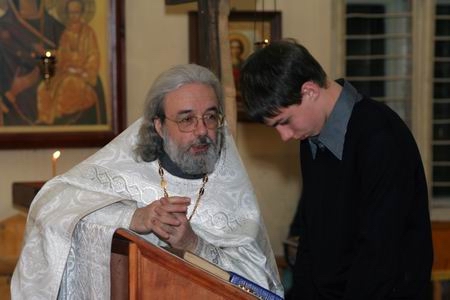
It is disappointing, if inevitable, that most images of the Sacrament of Reconciliation show a priest sitting in one half of a big dark box and separated by a grille from the shame-faced penitent kneeling in the other half. That's why I've used an image of a different method. Although many people still "go to confession" in the box, utilizing a soft-gauze, emotionally unthreatening anonymity, most churches and priests now offer other physical formats too. They should. For even when conducted in complete anonymity, the sacrament is a communal celebration. It ought to be. For that reason, I prefer that it seem to be—especially in our culture, where individualism runs rampant and even good Christians like to pretend that their repentance is only between "me and Jesus."As a semi-monthly penitent, and a weekly one during Lent, I sit face-to-face with my confessor. That's because what I need is more like a conversation than a mutual recitation. I want to be clear about the journey on which I've stumbled. For my habitual sins are so humdrum that it would bore even me to restrict myself to listing them, and the Spirit occasionally leads to me to see this-or-that sin as unusual or grave enough to be interesting. Yet I know that many priests prefer as much brevity as possible. Sometimes that's because they are fortunate enough to have a long line of penitents to deal with, and sometimes it's because they don't set aside enough time to hear confessions in the first place. Sometimes that in turn is because they simply hate hearing confessions, especially when, as is likely, they find themselves with a penitent who has little to say and less to confess but rattles on anyhow. So I've learned to be concise. But I avoid lines when I can, and I don't confess to priests who otherwise won't have a conversation. I want to confess why I've been backsliding, and I want to do it before somebody willing and able to tell me whether, and if so how, I'm kidding myself. I don't want to do that because I fancy myself better able to handle the truth than others. I don't compare myself with others in such ways. Rather, I want to risk being told I'm kidding myself because the Church I love, the Mystical Body of Christ in which we are all family, needs me to be honest with myself. I need to see how I've been wounding her; for if I can see that, then I am better motivated to change than I would otherwise be. Then, when I receive absolution, I feel I am being welcomed back to the family I've hurt.
Although my dislike of "the box" is admittedly a subjective preference, I don't believe it is merely that. That degree of anonymity was not normative for rites of reconciliation in the early centuries of the Church; for reasons I lack time to explain, it took a long time to become the norm. Until rather recently, though, that was not a problem. Most people were Catholic because that's what they, along with everybody they knew and indeed the very culture, had always been. The people's sense of Catholicism as "us" was lively in the sense that mattered. When it could be had, sacramental confession was seen almost as a form of good citizenship. That's not to say there weren't plenty of sinners and of the lukewarm. But there was still the sense that an individual's spiritual sloth was bad for "us" as well as for the individual. That's why, today, I favor a more physically open style of confession. You get the sense that you're speaking to and hearing from the family, even if most of the actual individuals would rather not hear what you're saying any more than you would like them to.
Catholic culture, to the extent such a thing still exists, is not much like that anymore. Americans, especially, want people to mind their own beeswax. Cars, computers, and now video games have made that easier than ever to do. It it no accident that the sense of the Church as a mystical body, as a covenant family, has declined at the same time. To some, she is primarily the hierarchy or the institution and only secondarily "the people of God." That is unfortunate, though not universal. Yet nowadays, among many Catholics who do have a lively sense of "us" as the Church, a sense of sin arises only within a political matrix. In "progressive" parishes, sin is seen mostly as "structural," as a systemic failure to embody those social teachings of the Church which are not somehow connected with sex and/or procreation. With the exception of the grossest felonies, pretty much everything else is seen as more a matter for therapy than repentance. So, most prog Catholics rarely if ever celebrate the sacrament of reconciliation. But even among more orthodox Catholics, sin is seen almost exclusively as a private, individual matter. Even though they reject the Protestant mantra: "I don't need a priest between me and God," they see the priest who represents Christ as keeping sin and forgiveness between "me and Jesus." It's no wonder that so many regular penitents prefer the box and hope they get a penance that won't involve their interacting with anybody but Jesus.
It is not that I judge those who do. That would be silly and pretentious. But I do think that priests need to emphasize the corporate consequences of sin, and the corresponding need for concrete acts of repentance that often involve doing things to help repair the damage sin does to others. Clergy and catechists must also stress the importance of the confessor as representing the Church, the Mystical Body of the Lord, wounded by every sin her members commit. Celebrating the sacrament with that in mind might be one of the most important ways in which we pray for each other. That would be "solidarity" which goes beyond even that kind which is called for by the principle of Catholic social teaching so labeled. It would instance the solidarity of the communion of saints.
Wednesday, February 25, 2009
Sacramental contradiction
This year, I want to greet Ash Wednesday with the observation that Lent is sacramental. I don't mean that the Church ought to make it the "eighth" sacrament—as if the Church would care if I did mean that. I mean that Lent is an efficacious sign. By signifying in small ways certain kinds of things we should be doing year round, our Lenten practices increase our power to do them year round. One of the most important of those things is repentance; the word itself is another name for that conversion which ought to be ongoing and daily. For those who follow and meditate on current ecclesial events, meditating on one such event should help us realize how we all need to be repenting, and thus converting.Ruth Gledhill, religion correspondent for the London Times, is a "Facebook friend" of mine. In no way does that mean personal acquaintance; we have never met, and I doubt we ever will. It's more like a networking relationship for me, and I'm grateful to her for assenting to that. Gledhill's writings are timely in the best sense; her name is well-known, and her face is even pretty. But above all, her views are so predictably "progressive" that she affords a blogger like me ample fodder for comment. On her blog yesterday, she posted what was for me an astonishing commentary on the recent flap over SSPX Bishop Richard Williamson. Since it's the performance as a whole that I find so astonishing, I suggest you read the whole thing, and watch the video, before you read this post further. It won't take long.
Gledhill is angry. So am I, albeit for very different reasons. She is angry because she finds it grotesque that, on the one hand, the official policy of the Catholic Church is to deny communion to unjustly abandoned spouses who proceed to divorce and remarry, while, on the other hand, the Pope has lifted the excommunication of a Holocaust denier who has now physically threatened a reporter in an airport. In fine prog style, she thinks Williamson ought to have stayed excommunicated while remarried single parents ought to be readmitted to communion forthwith. And so:
Sadly, the Holy See will never understand that as far as the public is concerned, to the millions who will watch this unseemly brawl on television over the next few days, to the thousands of innocent men and women denied communion because of the Church's inhumane disciplines on remarriage, the Church appears to be descending into a new dark age when anti-Semitic hooded thugs with eyes shielded from the light by dark glasses are welcomed into the fold. Meanwhile 'ecclesial communities' such as my own are condemned as 'not proper churches' and Archbishops such as Rowan Williams are not permitted to receive communion in Catholic churches.
Sorry, I forgot: it's an additional outrage that Rome does not recognize the Anglican Communion as a "church" in the strict sense of the word, but only as an "ecclesial community." Apparently, the Vatican has not mollified liberal Protestants by saying only that the Church of Christ "subsists in" the Catholic Church, rather than repeating the older formula that the Catholic Church just is the Church of Christ. Nope, it's an outrage that the Catholic Church still regards herself as "the" Church, the Church in which the Church of Christ exists as a unitary whole, with other Christian bodies united to her only in varying degrees. It's small comfort that people like Gledhill testify unwittingly to the hermeneutic of continuity rejected by the likes of the SSPX.
Collectively and in Gledhill's view, such outrages constitute a massive failure of "witness." The Catholic Church just doesn't "get" witness: "Maybe you actually do have to be a Protestant to get what witness really means." Hmmm. I thought progressive Anglicans were inclusivist and tolerant in theology. If that remark instances inclusivism and tolerance, I'd hate to see Ruth being exclusivist and intolerant. Maybe we'd see that if she saw fit to comment on the Q'uranic law which calls for killing apostates from Islam. That law is no dead letter: there are Muslim countries which carry it out in earnest. Or how about the "honor killings" of young Muslim women who happen to be caught fornicating? Or the tendency of Muslim mobs around the world to go berserk when somebody in the West publishes something snarky about the Prophet? Or when Benedict XVI himself quoted, for purely illustrative purposes, a 14th-century Byzantine emperor who, having been taken hostage by a sultan, made a bitter remark about Islam to his captor? Where's the outrage from liberal Christians about all that? Maybe I've missed it. Or maybe I just don't get the fact that witness means judging the Catholic Church by liberal Protestant standards while giving a pass to people who want to supplant all forms of Christianity with Islam.
Perhaps the most telling paragraph is the last, meant as a message to the Pope as he welcomes Williamson back into the fold:
Supping with sinners is all very well. But shouldn't the sinner show some sign of repentance first? Someone needs to buy the Pope some very long spoons indeed, and perhaps both him and Bishop Williamson some proper glasses, to make them see.
So it's taken for granted that Williamson is a sinner with whom the Pope should sup only with a very long spoon. But what's the sin, and how do we know Williamson is guilty?
It might seem that the sin is racism: Ruth does brand Williamson as an "anti-Semitic thug." But anti-Semitism is racism against Semites, who include Arabs as well as Jews. As far as we know, Williamson is not anti-Arab. He's anti-Jewish. That's a religious prejudice, not a racial one. But why is Williamson anti-Jewish? Well, it might have something to do with his traditionalist theology, which is "supersessionist" on the question how the Old Israel relates to the New, the Church. But that doesn't explain much. For not all supersessionists are anti-Jewish—certainly not to the point of being willing to blind themselves to the Holocaust. So, what might explain Williamson's being a Holocaust denier?
I'm not sure. Everything I've read and heard about the man suggests that he is thoroughly dotty, like many conspiracy theorists. Perhaps, then, Williamson is just mentally ill. Another bit of evidence for that hypothesis is that he clearly has a lot of anger to manage. Of course, the evidence is not a slam-dunk. It doesn't prove he's mentally ill. But the same goes, mutatis mutandis, for the hypothesis that he is a sinner worthy of staying excommunicated for being anti-Jewish. We don't know that Holocausts deniers are sinners just for being anti-Jewish; probably some are, but some are mentally ill as well or instead. Often, a person's being mentally ill diminishes or eliminates their moral responsibility for their beliefs and/or actions; so if Williamson is mentally ill, then there is room for doubt that he is guilty of mortal sin for his holding admittedly contemptible views about the Jews. How, after all, does anybody know how morally responsible he is for this nonsense of his, which he shares not only with the Supreme Leader of Iran, but also with not a few Palestinian Muslims, a people with whom the religious and political Left are very sympathetic? Is it anti-Jewish to sympathize with a people the majority of whom think it's perfectly alright to rocket Israeli civilians daily? I would not venture to say that. But I've read pieces by Jews who do say it; and after the very real Holocaust, I hesitate to blame them.
It would be easy to say that, once again, I just don't get it. Gledhill, a liberal Protestant, believes it's wicked of the Catholic Church to adopt the juridical presumption, defeasible by annulment, that divorced Catholics who remarry are living in adultery; but she thinks it obligatory to judge and sentence Catholics like Bishop Williamson, whose anti-Jewishness is indeed quite objectionable, but might be explained just by his being very dotty. I hate to say it, but what we have here is anti-Papist religious prejudice. It's just assumed that the Catholic Church's teaching on the indissolubility of marriage, which is the key premise of her policy about divorce and remarriage, is false—and not only false, but wicked to believe and act on. That assumption is religious prejudice. But Williamson's religious prejudice is deemed wicked because it's—what? Religious prejudice? Maybe that's the reason, maybe not; but I do see that the question why the prejudice is held doesn't matter to the Ruth Gledhills of the world. Whoever holds it is ipso facto "a sinner."
On second thought, however, I do get it. Gledhill is merely expressing the values of her set, i.e. the values of religiously progressive Western journalists. That her values don't quite cohere rationally makes her no different from most members of her set. And it's at just this point that the lesson for each of us during Lent comes to the fore: it makes her no different from most of us.
Most Catholics, most Christians for that matter, have values and attitudes that do not cohere with the faith they profess. Of course they are unwilling to admit as much; if they were, they'd be motivated to change. Having emerged from the immigrant ghetto and joined the "mainstream" over the last fifty or sixty years, American Catholics are as guilty of incoherence as anybody, and more than many. For many of us, worldly values and attitudes are now prejudices taken for granted. We judge the Church by the values of our "set" in the world, not vice-versa. Usually, such values and attitudes have never been exposed to informed, objective examination themselves. That's easy to explain, but impossible to justify. People don't like examining and critically evaluating their prejudices. That would mean thinking, as opposed to quite a number of more entertaining activities; worse, it would mean admitting that what we like being may not be what we ought to be. That is why the discipline of Lent is so vital. By denying ourselves things we like, and using the space created thereby to love more sacrificially, we get out of our comfort zones and admit that we need repentance—not just for a season and ritually, but every day of the year.
And so I feel no sense of moral superiority when I savage Ruth Gledhill and her set. She and they are merely one illustration, and not the most important one, of a universal human tendency that Lent exists to help root out. By observing our Lenten rituals with the humble yet acute awareness that we are all wretched sinners, we might open ourselves to the grace of being taught just what our most insidious sins are. Being taught as much takes grace because the sins in question are more deeply rooted than we think. But the truly serious Christians will often seem a bit dotty for wanting to root out of themselves the kinds of sins most people are happy to live with. The truly serious Christians willingly embrace the sacramental contradiction of dying to self in order to live more abundantly. In other words, they live the Paschal Mystery. That's the kind of dottiness we need more of.